


You put your foot on the floor when you wake up and your knee cracks. You ignore it, assuming it’s "normal." But then you get to training, try to do a lunge or a deep squat, and the pain is still there. You’re stiff and the discomfort doesn’t go away no matter how much you warm up.
Before it would disappear after ten minutes of jogging, now it stays with you throughout the entire workout. You modify exercises, lower the weight, wear tighter knee braces, or worse, you stop doing the sport you love because you’re hurting yourself.
And then you do what almost everyone does. You go to a pharmacy or supermarket and buy the first giant jar labeled "collagen". Weeks go by, you take the shake every morning and... nothing. Your knees keep cracking and your shoulders still hurt every time you exercise.
The problem? You’re not lacking collagen, you’re lacking the right collagen. Today at Wellbeinn we’re going to talk about what your body needs to regenerate and how to choose the best collagen for bones and joints.
📑 Today you will discover:
What is collagen for if you only train and don’t recover?
We've been led to believe that collagen is just an aesthetic issue. Nothing could be further from the truth. If you exercise and feel discomfort, the first thing is to understand what collagen is for. It's the material that "supports" the load when you do a deep squat, a change of pace, or a long run. It forms your tendons, ligaments, and cartilage.
The problem comes with age. After 30, we naturally produce less. If you keep training with the same intensity as always, you’re wearing down that tissue faster than your body can rebuild it. Cartilage thins, you lose cushioning, and that constant friction ends up causing inflammation and cracking sounds. The bone starts to “complain” because it’s left unprotected.
How to choose good collagen for your bones and joints
Taking any generic collagen jar does not guarantee cartilage regeneration. When digested, the body absorbs these amino acids and distributes them randomly. Only a minimal amount with no structural capacity reaches the worn knee or shoulder.
Joint recovery requires precision. For the supplement to really work, local cells (chondrocytes) must receive a direct stimulus. That’s why quality supplementation uses patented peptides, specific collagen structures that survive digestion and act directly on the connective tissue that supports the impact of your workouts.
Collagen doesn’t work if you don’t stop inflammation first
We think wear and tear comes just from adding miles or loading the bar, but joint pain almost always hides silent inflammation. If your tissue is chronically inflamed, nutrients don’t penetrate well. You can spend money on the best collagen for bones and joints, but if you don’t reduce that prior inflammation, your body won’t benefit from it.
You need a complete solution. Taking only collagen is only half the job. A good joint supplement has to provide the material to regenerate cartilage, yes, but it also needs to reduce inflammation in the area and supply vitamins so your body can absorb it all. If you miss any of these three steps, your knee will keep complaining.
What Wellbeinn's Joint Support+ Contains and Why It's Not Just Another Supplement
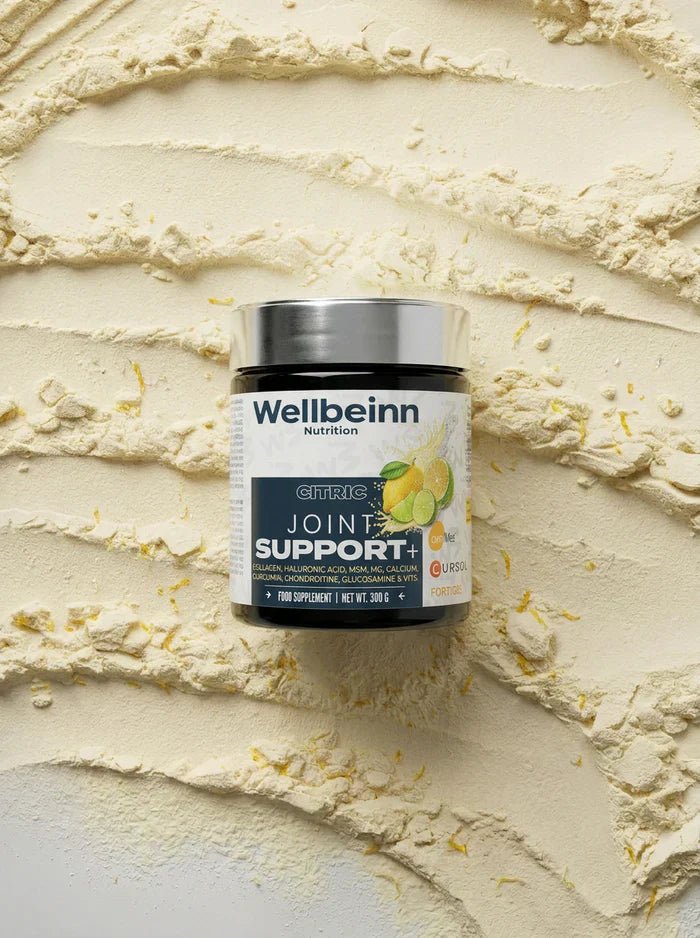
We saw too many people spending money every month on collagen jars that didn’t relieve their discomfort. We wanted a formula that really worked. So we created Joint Support+ collagen, attacking the problem from three angles:
1 Supplements that actually reach the cartilage (Fortigel® and Ovomet®)
We use Fortigel®, specific peptides that survive digestion and go straight to the joint to stimulate repair. We add Ovomet® (eggshell membrane), which naturally provides hyaluronic acid and elastin to restore your tendons’ flexibility.
2 Reducing inflammation to stop pain (Turmeric Cursol® and MSM)
To relieve pain, we added Cursol®, a highly absorbable turmeric extract that actually reaches the bloodstream. We rounded it out with precise doses of MSM and Glucosamine to eliminate joint stiffness.
3 A strong bone foundation (Magnesium, D3, K2, and Vitamin C)
Healthy cartilage is useless if the bone beneath it is weak. That’s why we include Magnesium, Vitamins D3, K2, and Vitamin C, essential for your body to biologically produce new collagen.

"As a physiotherapist, I know joint wear isn’t treated by rest alone. To regain mobility, athletes need supplement support, and the best ally here is collagen."
Miguel Ortín — CEO and Physiotherapist at WellbeinnTraining with pain doesn’t have to be the norm
Hearing a crack when you get up or feeling sharp pains with every squat is not "just part of life" or something you have to accept as you age. Your body is made to move, run, and lift weights for decades, but it needs the right materials to repair itself after every workout.
With Joint Support+ collagen, we've eliminated the excuses. No gritty textures or strange flavors: it's an ultra-fine powder that mixes in seconds with a refreshing orange and lemon taste. A 300g jar covers exactly a full month of recovery.
Give your bones and cartilage what they really need and feel the difference between going to the gym to suffer or going to perform at your best.
Artículo redactado por...
Jorge Albert Mallabrera
Redactor especializado en fitness, recuperación muscular y bienestar.
Miguel Artín
CEO en Welbeinn · Especialista en terapias de recuperación.
Caetano
Equipo Welbeinn · Producto y protocolos de uso.
Share:
Creatine monohydrate: The supplement you need to improve your training
Why your recovery routine doesn’t work