


You get home, take off your shoes, and the sock mark remains outlined around your ankle. Your legs feel heavy, as if you had climbed a mountain, even though you have spent the day sitting down. You search for “lymphatic drainage for legs” and find three options: make an appointment with a physiotherapist, do it yourself at home, or buy a device. All three work, but not for the same purposes or at the same price.
Here we will not repeat what the lymphatic system is: we are focusing on the legs and practical matters. What each option really does, how to perform lymphatic drainage on yourself step by step, how much each approach costs over a year, and when drainage is not advisable. With the calculator, you can find out in one minute which option suits you based on your time, budget, and reason.
| Manual drainage with a professional | Self-massage at home | At-home pressotherapy | |
|---|---|---|---|
| Who does it | A physiotherapist trained in lymphatic drainage | You, using your hands | Boots or trousers with air chambers |
| Time | 45-60 min, plus travel time | 10-15 min | 20-30 min, sitting or lying down |
| Cost | Per session, each time | Free | One-time payment |
| Best for | Medical and postoperative cases | Daily maintenance and quick relief | Frequent heaviness and sports recovery |
| Its limitation | Price and consistency | Technique and hand fatigue | Contraindications and the initial investment |
Which type of drainage suits your situation?
Answer four questions and we will tell you whether the manual technique, a device, or a combination of both suits you, along with what it would cost you over a year.
 Measurable health · Compression therapy
Clinic-grade compression therapy, at home and cable-free
Trousers with six chambers that compress in sequence from foot to hip, including glutes and lower back.
6 chambers · pressure adjustable from 0 to 200 mmHg · 5 programmes: circulation, sport and mixed
View the HighFly Pro Max€749,00
Why fluid stays in the legs
Lymph is the fluid that collects what is left over between the cells and returns it to the blood. It does not have a heart to pump it: it moves forward thanks to the muscles as they move, breathing, and valves that prevent it from flowing backward. In the legs, it also has to move upward against gravity.
That is why the problem appears in the ankles and calves, and why it gets worse with anything that keeps the calf still, the muscle that pumps the most: hours sitting or standing without walking, long trips, heat (which dilates the veins), and the days before your period. If you want the complete explanation of how the system works, see lymphatic drainage: what it is and when it helps.
Any type of drainage, whether done with the hands or with air, does the same thing: help from the outside with that pumping action that has become insufficient inside. What changes is who performs it, how long it lasts, and how much it costs.

Manual lymphatic drainage on the legs: what the physiotherapist does
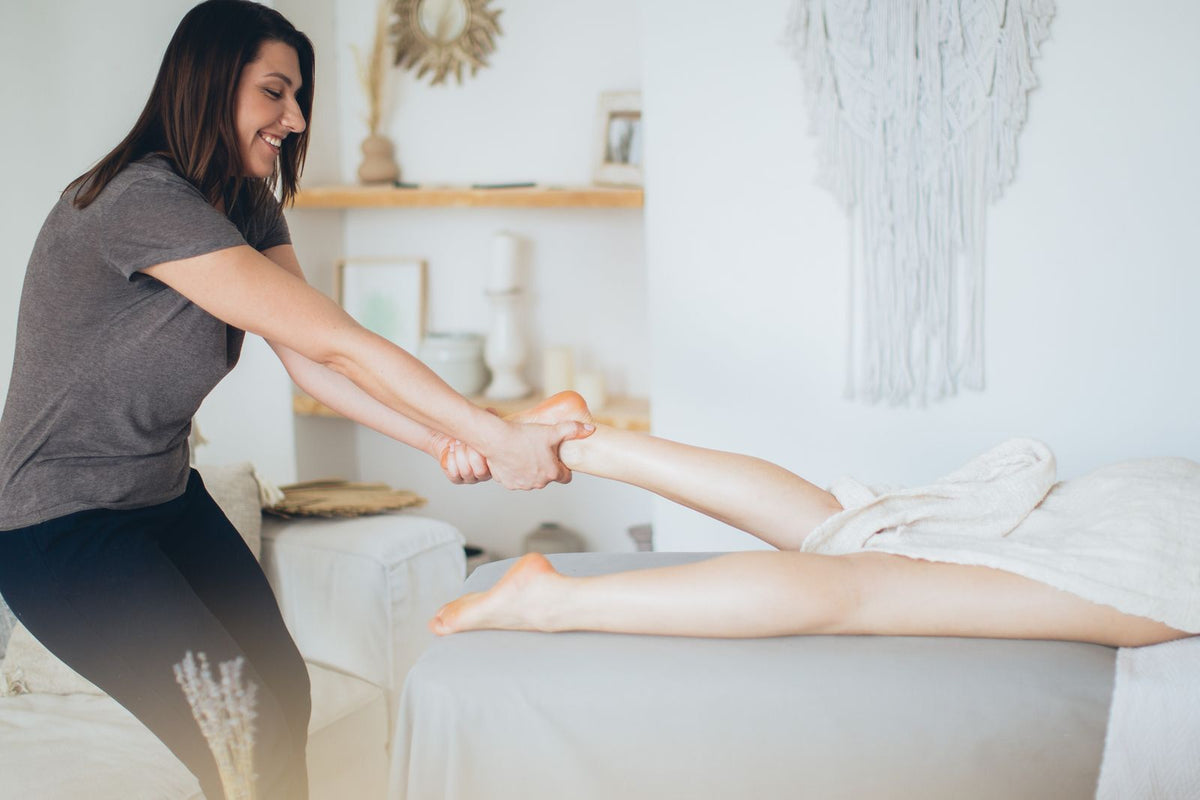
Proper manual lymphatic drainage does not resemble a massage. It consists of slow, gentle, repetitive maneuvers that move the skin in a specific direction without pressing the muscle. The professional starts away from the swollen area, on the abdomen and groin, to “clear the way,” and only then works on the thigh, knee, calf, and foot, always pushing upward.
A leg session lasts between 45 and 60 minutes and in Spain usually costs between 40 and 70 euros. It is the appropriate option when there is a medical reason: after an operation or when prescribed by a doctor. In these cases, it is performed by a physiotherapist with specific training and is often combined with bandaging or compression stockings.
Be careful with what is sold to you under the same name. If it presses hard, hurts, or leaves your skin red, it is not drainage: it is a massage under another name. We explain the difference in lymphatic massage and lymphatic drainage: they are not the same.

How to perform lymphatic drainage on your legs at home, step by step
Self-massage does not replace professional treatment in a medical case, but it works for end-of-day heaviness and costs nothing. The key is the pressure: just enough to move the skin, as if you were stroking a cat. If you can feel the muscle underneath, you are pressing too hard. Use no oil, or very little, so your hand does not slip.
Sit with your back supported and your leg extended on the sofa or bed. About 10-15 minutes in total, for both legs:
- Breathe with your abdomen (1 minute). Take five or six slow, deep breaths, expanding your belly. Breathing moves lymph from the torso and prepares the way.
- Groin (1 minute). With your hand flat on the groin crease, make small, gentle upward pumping movements about ten times. This is the “outlet” for the entire leg.
- Thigh (2-3 minutes). With both hands flat, glide from above the knee toward the groin. Inner, front, and outer sides, five to ten strokes on each.
- Behind the knee (1 minute). With your fingers together in the hollow behind the knee, make gentle upward pumping movements about ten times.
- Calf (2-3 minutes). From the ankle to the knee, with your hands around the leg, always moving upward. Slowly: take a few seconds for each stroke.
- Ankle and foot (1-2 minutes). Small circles around the ankle bone and strokes from the toes toward the ankle.
- Full pass (1 minute). Three long strokes from the ankle to the groin, without stopping at the knee.
- Finish with your legs elevated. Lie down for five minutes with your feet on a cushion, moving your ankles up and down. This movement activates the calf pump.
Lymphatic drainage devices for the legs: what is available and what each one does
When looking for a lymphatic drainage device, you will find very different things, and not all of them provide drainage.
Pressotherapy: pneumatic compression boots and pants
These are garments with air chambers that inflate one after another, from the foot upward, and then deflate. They reproduce the direction of manual drainage and the pumping action the calf would perform while walking. It is the only option that works on the entire leg at once, passively: you lie down and the machine does the work for 20-30 minutes. Models that reach the hip also cover the thigh and buttock, which short boots leave uncovered.
Light pressure is used for drainage; high pressure is for sports recovery. More pressure does not mean more drainage.
Rollers, cupping cups, and massage guns
A foam roller, brush, or cupping cups can help if you follow the same direction, from bottom to top, and use light pressure, but they depend on your technique just like hands do. Percussion massage guns are different: they work the muscle, not the lymph, and are useful for tension or muscle soreness, not for reducing swelling.
Manual treatment, device, or pressotherapy? What each one costs in a year
The decision is almost always determined by frequency. If you notice your legs feeling heavy a couple of times a year, paying for a session when needed makes sense. If you notice it almost every day, the calculation changes:
| Frequency | Manual sessions per year | Approximate cost (€40-70 per session) |
|---|---|---|
| Once a month | 12 | 480-840 € |
| Once a week | 52 | 2.080-3.640 € |
| Twice a week | 104 | 4.160-7.280 € |
What the table doesn’t show: the device does not replace a professional in a medical case, and self-massage is free but requires consistency and technique. What works best in most cases is to combine: self-massage or pressotherapy at home for day-to-day use, and a physiotherapist when there is a specific reason.

HighFly Pro - Pressotherapy Pants
6 sequential air chambers from the feet to the hips, including the buttocks and lower back. Adjustable pressure, 6 modes starting with lymphatic drainage, wireless, and with more than 3 hours of battery life. Care from licensed physiotherapists.
View productWhen not to perform drainage on the legs
Moving fluid is safe in a healthy leg, but there are situations in which it should not be done, either by hand or with a device, without medical approval:
- Thrombosis or suspected thrombosis. A single leg that suddenly becomes swollen, painful, hot, or red is a reason to seek emergency care, not drainage.
- Infection or wound on the leg: red, hot skin, fever, or an open wound.
- Heart or kidney problems that cause fluid retention: the fluid has an underlying cause, and moving it may overburden the body.
- Cancer under treatment, unless instructed otherwise by your treating team.
- Pregnancy: gentle self-massage is usually fine, but consult your doctor before using pressotherapy.
The complete list for pressotherapy is in pressotherapy contraindications.

What you can expect and how long it takes
The feeling of lighter legs is noticeable during the same session, whether it is manual or with pressotherapy. What you do not get is a permanent effect: if the cause remains (spending many hours sitting still, heat, genetics), the fluid returns. That is why it works better as a habit than as a one-off treatment.
What amplifies the effect costs little: walk for a few minutes every hour, elevate your feet at the end of the day, drink water normally (fluid retention is not fixed by drinking less), and wear compression stockings if you spend many hours standing. And if you are looking for results for cellulite, be realistic: drainage improves its appearance when there is fluid retention, but it does not eliminate fat.
Frequently asked questions
Start with abdominal breathing and gentle pumping movements in the groin, continue through the thigh, the hollow behind the knee, the calf, and the foot, always gliding upward with very light pressure. Finish with your legs elevated while moving your ankles. It takes about 10-15 minutes; the step-by-step instructions are above.
Both at once: the strokes always go upward, toward the groin, but the order of the areas goes from top to bottom. First the groin and thigh, then the knee, calf, and foot. This way, the fluid has a clear path.
For relief, just one: you notice the lightness immediately. For lasting results, regularity is what matters: two or three times a week during periods when you notice it most. In medical cases, the professional determines the number.
For a medical or postoperative case, manual drainage with a physiotherapist is best because they adapt each maneuver. For everyday heaviness or recovery after training, pressotherapy does similar work across the entire leg, effortlessly and with the consistency that is difficult to maintain with paid sessions.
In Spain, it usually costs between 40 and 70 euros per session, depending on the city and whether it is performed by a physiotherapist or at a beauty center. Packages of several sessions reduce the price per session somewhat.
It depends on the type. Pressotherapy devices with sequential air chambers do reproduce the direction of drainage. Massage guns and vibrators work on the muscle and are not designed to move lymph.
It shouldn’t. It is a gentle, slow technique that many people find relaxing. If it hurts or leaves marks, the pressure is excessive and it is no longer drainage.
No. It may reduce the volume somewhat when fluid is retained, which is why the leg looks and feels slimmer, but it does not burn fat. If the fluid builds up again, the volume returns too.
In the afternoon or evening, when your legs have accumulated the day’s fluid. Doing it before bed and keeping your legs elevated afterward can help you wake up with them feeling lighter.
In summary
Lymphatic drainage in the legs is not just one thing. Manual drainage with a physiotherapist is the right choice when there is a medical reason; self-massage is free and can provide relief in ten minutes if you do it in the correct order; and at-home pressotherapy is what helps you stay consistent when heaviness is frequent. If you want to understand the system properly, start with what lymphatic drainage is; if you have been offered a “lymphatic massage,” first check how it differs from drainage.
And if yours is an almost-every-day case, do the math with the calculator and take a look at the HighFly Pro pressotherapy pants, which cover you from foot to hip.
It’s not magic: it’s helping a system that has to work against gravity.
Redacción y revisión del artículo
Share:
Why do your legs feel heavy after the age of 40?
Melatonin: side effects and whether it can be taken every day