
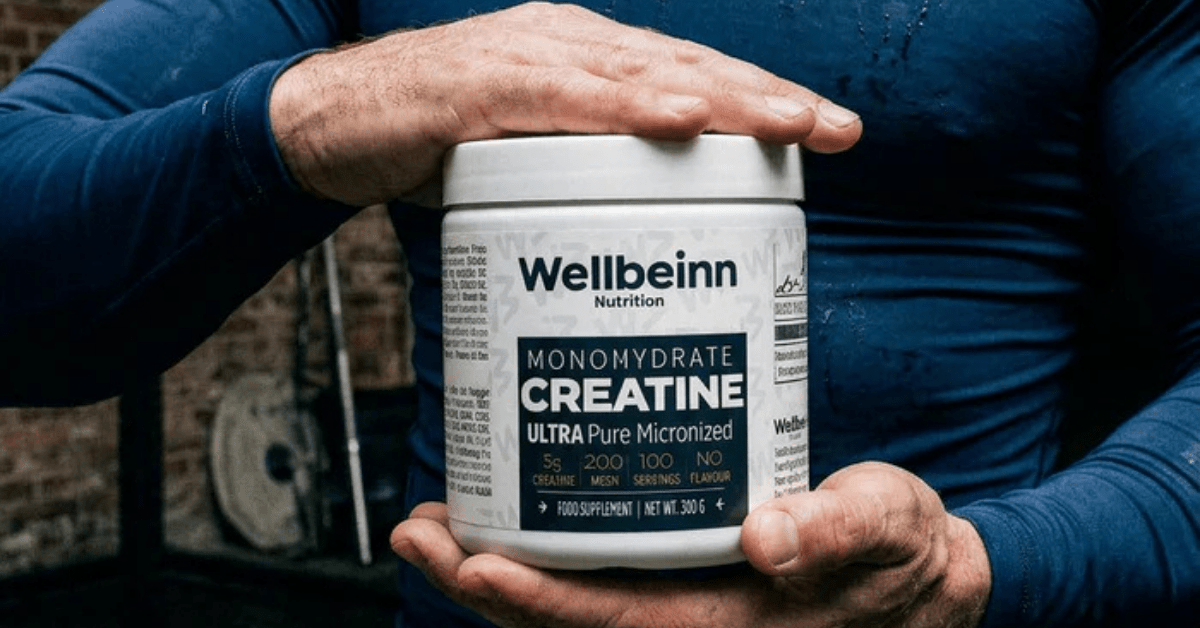


Creatine is the most studied sports supplement in history. More than 500 peer-reviewed studies, decades of use in athletes elite athletes and a conclusion that is repeated over and over: works.
But with so much information, it’s hard to separate what creatine it really does what is attributed to it without basis. Is it good for gain muscle? Does it improve performance? And what about kidneys, water retention or baldness?
In this guide, we explain what creatine is for, how it works in your body, what benefits you can really expect, and what effects side effects you should know before you start supplementing.
| Aspect | What you need to know |
|---|---|
| What it is | Natural compound your body produces and that you also get from meat and fish |
| Main function | Regenerates ATP, the immediate energy molecule for your muscles |
| Key benefit | More strength, more reps, and better recovery between sets |
| Recommended dose | 3-5 grams per day, every day |
| Most effective form | Creatine monohydrate (the only one with solid evidence) |
| Safety | Safe long-term in healthy people (up to 30 g/day for 5 years in studies) |
| Main side effect | Intramuscular water retention of 1-2 kg (not fat) |
What is creatine is and how it works in your body
Before talking about what it’s for, it’s useful to understand what exactly.
Creatine is not a steroid, not a hormone, and technically not even not even an amino acid, although it is often classified as one. It is a compound that your body naturally synthesizes from three amino acids: arginine, glycine, and methionine. It is produced mainly in the liver and kidneys, and is stored in the muscles.
This is where ATP (adenosine triphosphate). Think of ATP as the energy currency of your cells muscles. Every time you lift a weight, sprint, or do an explosive movement, your muscles use ATP. The problem is that ATP stores last only a few seconds.
Creatine stored in the muscle (in the form of phosphocreatine) acts as a rapid ATP recharge system. When when you supplement with creatine, you increase those phosphocreatine stores by between 15% and 40%, according to the International Society of Sports Nutrition. More phosphocreatine means more ATP available, and more ATP means that your muscles can work at maximum intensity for longer.
That is the foundation of everything else: more reps, more strength, better recovery between sets. There is no magic. It’s pure biochemistry.
For what creatine is for: the 7 science-backed benefits
Not all the benefits attributed to creatine have the same level of evidence. These are the ones that are supported by serious studies.
1. More strength and power muscle
This is the star effect. Creatine supplementation monohydrate increases maximum strength and power in high-intensity, short-duration exercises: squats, bench press, bench press, sprints, jumps.
How much? Studies report 5-15% improvements in performance during strength sets. It may seem small on paper, but in practice is the difference between doing 8 reps and doing 10. And those 2 extra reps, accumulated week after week, are what generate real progress.
2. Greater training volume training
Directly related to the above. By recovering ATP faster, faster between sets, you can maintain intensity longer. Eso se traduce en más series efectivas, más repeticiones totales and more accumulated work in every session.
If you train with some intensity, you’ve probably already noticed that the last sets are much harder than the first. With creatine, that performance drop is softened. It doesn’t disappear — you will still get fatigued — but the difference is noticeable.
3. Muscle mass gain
Creatine doesn’t build muscle directly. What it does is allowing you to train with more volume and intensity, which is what builds muscle. It’s an indirect but very real effect.
Additionally, creatine promotes cellular hydration: draws water inside the muscle cell. This increase in volume cellular is not just aesthetic — it has been proposed as a signal that stimulates muscle protein synthesis.
4. Faster recovery
Varios estudios muestran que la creatina reduce el daño muscle and inflammation after intense workouts. That means less soreness and less time needed between sessions to perform at your best again.
Anyone who trains 4-5 days a week knows how important this is. If on Tuesday you’re still dragging Monday’s soreness, your lower body session higher will be mediocre. Creatine doesn’t eliminate muscle soreness, but it does shorten the recovery window.
5. Cognitive benefits
This is where creatine surprises. Your brain also uses ATP, and when under stress (lack of sleep, mental fatigue, demand cognitiva alta), la creatina puede mejorar la memoria de work, attention, and problem-solving ability.
A meta-analysis published in Experimental Gerontology found significant improvements in short-term memory and reasoning in people supplemented with creatine, especially in situations of stress or sleep deprivation.
It’s not a miracle nootropic, but it is one of the few supplements with real evidence on cognitive function.
6. Protection against age-related muscle loss
From age 30, you start to gradually lose muscle mass (sarcopenia). Creatine, combined with resistance training, can slow this loss and maintain strength functional for longer.
This is especially relevant for people over 40-50 years old who want to maintain their physical autonomy and reduce the risk of falls and fractures.
7. Clinical applications under investigation
Creatine is being researched with promising results in:
- Neurodegenerative diseases (Parkinson’s, Huntington’s)
- Muscular dystrophy
- Depression
- Fibromyalgia
- Bone health
These uses do not yet have widespread clinical recommendation, but research volume grows every year.

Wellbeinn Creatine Monohydrate
100% Pure · Ultra Micronized 200 Mesh · 100 servings
18,90 € 25,90 €
Creatine monohydrate: why it is the only form that matters
There are many forms of creatine on the market: HCl, citrate, ethyl ester, kre-alkalyn, nitrate. Each promises better absorption, less fluid retention or greater effectiveness.
The reality: none has proven to be superior to monohydrate in no independent study.
| Form | Scientific evidence | Absorption | Cost |
|---|---|---|---|
| Monohydrate | More than 500 studies | ~99% oral absorption | Low |
| HCl | Limited | Similar to monohydrate | Medium-high |
| Ethyl ester | Degrades faster | Inferior to monohydrate | High |
| Kre-alkalyn | No proven advantage | Similar to monohydrate | High |
| Nitrate | Very limited | No conclusive data | High |
Creatine monohydrate is stable in solid form, is absorbed almost fully during digestion and has the best ratio cost-effectiveness on the market. It is the form recommended by the Society International Society of Sports Nutrition, EFSA, and practically all researchers working with this supplement.
Within monohydrate, quality varies. A micronized creatine at 200 Mesh dissolves completely in water without leaving lumps or gritty texture gritty — and that matters both for the user experience and for absorción. Nuestra creatine monohydrate is micronized exactly to that degree of purity.
Effects side effects of creatine: benefits and drawbacks
Let's get to what most people worry about.
Fluid retention
It is the most visible effect and the one that causes the most confusion. Creatine draws water inside the muscle cell (intracellular retention) intramuscular), not under the skin like the retention caused by excess sodium. You can gain 1-2 kg in the first weeks, but not you are gaining weight — your muscles are more hydrated and full.
When you stop taking creatine, that water is released within a few days.
The kidneys
“Creatine is bad for the kidneys” is one of the most persistentes en nutrición deportiva. La realidad es que no hay a single study showing kidney damage by supplementation with creatine in healthy people.
It is true that creatine slightly raises creatinine levels in blood (a marker that doctors use to assess function kidney). But this increase is an effect of creatine metabolism, not a sign of damage. If you have preexisting kidney disease, consult your doctor before supplementing.
Baldness
A 2009 study in rugby players found an increase in DHT (dihydrotestosterone) levels after a creatine loading phase. Ese estudio se ha citado miles de veces, pero nunca se ha replicated. There is no solid evidence that creatine causes hair loss.
Digestive discomfort
Some people report nausea, bloating, or diarrhea, especially with high doses (loading phase of 20 g/day). With the dose of with usual maintenance (3-5 g/day), these effects are rare.
| Effect | Is it real? | Context |
|---|---|---|
| Intramuscular water retention | Yes | 1-2 kg, inside the muscle, reversible |
| Kidney damage | No (in healthy people) | Myth based on confusion between creatine/creatinine |
| Baldness | Not proven | A single study, never replicated |
| Digestive discomfort | Possible | More common with high doses (>10 g/day) |
| Performance boost | Yes | 5-15% increase in strength and power |
| Cognitive improvement | Yes | Especially under stress or lack of sleep |
The creatine as a sports supplement: who should take it?
The short answer: practically anyone who trains with intensity athletes.
Strength and power
The clearest case. If you do weightlifting, CrossFit, weighted calisthenics, or any discipline where maximum strength and power matter, creatine creatine will make a difference. It won’t do the work for you, but it will will allow you to train harder and recover better.
Endurance athletes
Here the benefit is less direct but it exists. Runners, cyclists and swimmers benefit from creatine in sprints sprints, explosive bursts, and changes of pace. It also helps with recovery between intense training sessions.
Women
Creatine works exactly the same in men and women. In in fact, recent studies suggest specific benefits for women: support during hormonal fluctuations of the menstrual cycle, better performance in phases of high energy demand and possible effects positivos sobre la salud ósea. Te lo contamos en detalle here.
People over 40
The combination of creatine + resistance training is one of the best strategies to combat muscle loss associated with aging. It’s not just for young athletes.
Who should NOT take it?
People with preexisting kidney or liver disease should consult with your doctor. For other healthy people, creatine is safe even in the long term.
How to taking powdered creatine to get the most out of it
Supplementation is simple, but there are nuances worth know.
Dosage: 3-5 grams per day. You don’t need a loading loading. The loading phase (20 g/day for 5-7 days) saturates your stores faster, but after a month the results are identical to take it directly at 3-5 g/day. Why complicate it?
Timing: It doesn’t matter. Morning, afternoon, pre-workout, post-workout. What matters is daily consistency. That said, tomarla con tu batido de protein after training is convenient and there is evidence that absorption improves slightly when taken with carbohydrates or proteins.
Format: Creatine powder is the most practical and economical. With a neutral flavor, you can mix it with any drink without altering the flavor. A 300 g container at 3 g/day gives you more than three months of supplementation.
Continuity: You don’t need to cycle creatine. You can taking it continuously without problem. Safety studies cover uninterrupted supplementation for years.
For a more detailed guide on doses by weight, optimal timing y combinaciones, consulta nuestro artículo cómo tomar la creatine.
Frequently asked questions about creatine
No. The 1-2 kg weight gain some people experience is water inside the muscle, not fat. It does not change your body composition negatively. In fact, in the medium term creatine allows you to train with more intensity, which promotes fat burning and muscle gain muscle.
For the same purpose as any other format. Creatine powder monohydrate is simply the most economical and versatile form of take it. It dissolves in water, juice, or a shake and is absorbed the same in the same way as capsules or tablets.
Yes. In fact, it is the recommended way. The benefits of taking taking creatine every day is because you maintain the muscles constantly saturated. Taking it only on training days training is less effective.
Creatine is not a stimulant — it won’t give you an energy rush energy like caffeine. What it does is increase your ATP reserves so you can perform better during training. It doesn’t matter if you you take it before or after training; what matters is that you take it every day.
Nothing bad happens, but you waste its potential. Creatine increases the energy available in the muscle, but if you don’t train there is no demand to meet. If your goal is performance or body composition body, creatine needs to be accompanied by training.
No. Creatine has no relation to steroids anabolic. It does not alter your hormone levels, it is not banned by no anti-doping agency and its mechanism of action (ATP recharge) is completely different from hormones.
Artículo redactado por...
Jorge Albert Mallabrera
Redactor especializado en fitness, recuperación muscular y bienestar.
Miguel Artín
CEO en Welbeinn · Especialista en terapias de recuperación.
Caetano
Equipo Welbeinn · Producto y protocolos de uso.
Share:
Whey protein vs isolate: real differences and which to choose according to your goal
Swollen legs at the end of the day? This simple 20-minute habit changes everything.