
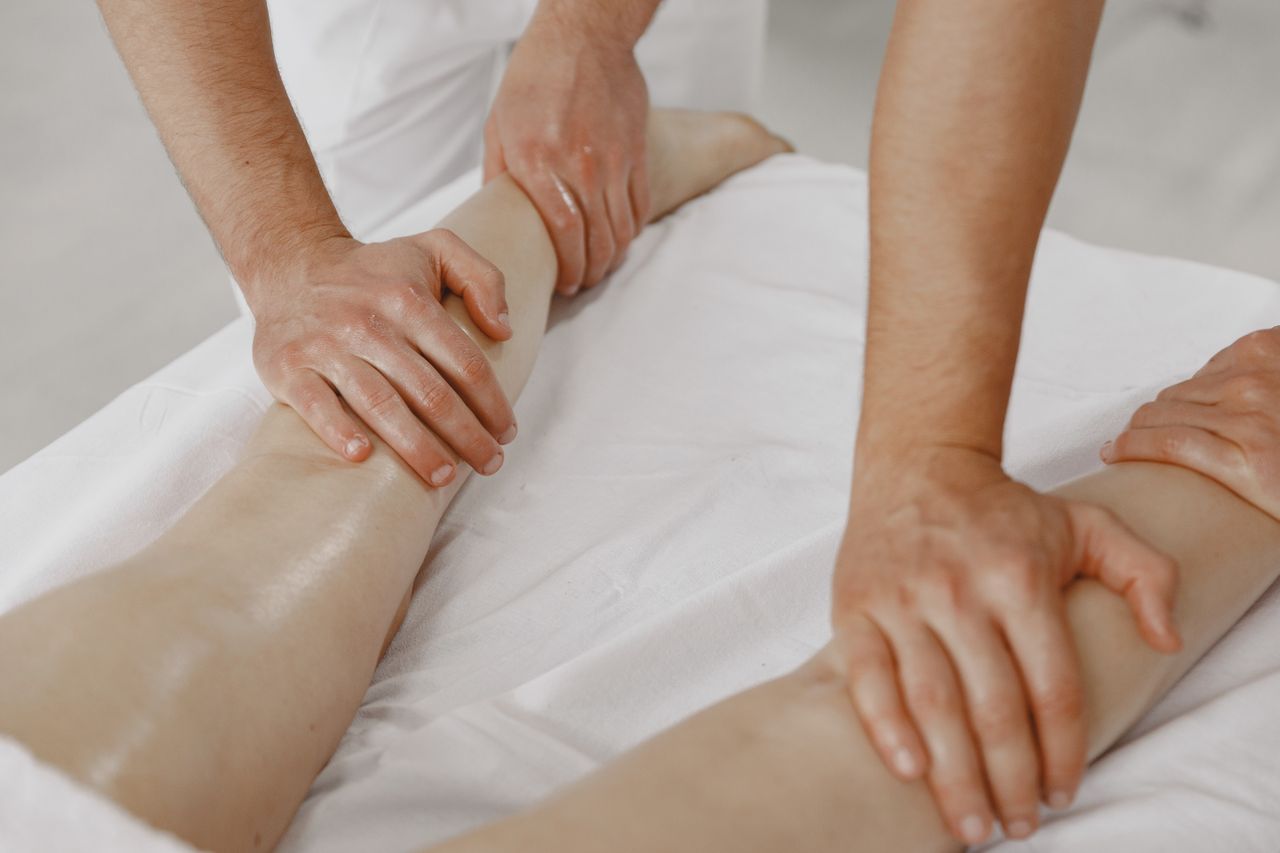


You ask for a “lymphatic massage” and you may receive two radically different things. One is a healthcare technique so gentle that the first time, you think you are not being touched. The other is an energetic massage that leaves marks on your leg and makes you say, “now that’s really worked.”
The second one is not drainage. And the curious thing is that the feeling that it has “worked” is exactly the opposite of what actually works: the harder you are squeezed, the less lymph you are moving. This article explains why, how to tell them apart, and where pressotherapy fits into all this.
| Manual lymphatic drainage | Ordinary “lymphatic massage” | |
|---|---|---|
| What it is | Regulated healthcare technique | Commercial term with no fixed definition |
| Pressure | Minimal, barely moving the skin | Medium or strong |
| Pace | Very slow and repetitive | Variable, often fast |
| Where it begins | Neck and lymph nodes first, before the area | Directly on the area |
| Who applies it | Physiotherapist with specific training | Either |
| How you finish | Very relaxed, with the urge to urinate | Sometimes with red or marked skin |
Which one do you need?
Hands, machine, or both. It depends quite a lot on what you need it for.
 Measurable health · Compression therapy
Clinic-grade compression therapy, at home and cable-free
Trousers with six chambers that compress in sequence from foot to hip, including glutes and lower back.
6 chambers · pressure adjustable from 0 to 200 mmHg · 5 programmes: circulation, sport and mixed
View the HighFly Pro Max€675,00
Measurable health · Compression therapy
Clinic-grade compression therapy, at home and cable-free
Trousers with six chambers that compress in sequence from foot to hip, including glutes and lower back.
6 chambers · pressure adjustable from 0 to 200 mmHg · 5 programmes: circulation, sport and mixed
View the HighFly Pro Max€675,00
Your lymphatic system in thirty seconds
In addition to veins and arteries, you have a third network: the lymphatic system. It collects the fluid that escapes from the capillaries into the tissues, filters it through the lymph nodes, and returns it to the circulation near the collarbone.
It has two distinctive features that explain almost everything. First: it has no pump. There is no lymphatic heart, so it moves through the rhythmic contraction of its own walls, muscle movement, and breathing. Second: its most superficial vessels are just beneath the skin, less than a millimeter deep.
Hence the practical consequence that almost nobody knows: if you press hard, you crush those superficial lymphatic capillaries and close them off. You are working beneath them, on the muscle, and the lymph does not notice. You can find the mechanism explained in what lymphatic drainage is.
What exactly is manual lymphatic drainage?
It is a technique developed in the 1930s and later systematized by several schools. It has a protocol, a specific sequence, and concrete medical indications. It is performed by a physiotherapist with specialized training and is recognized by four characteristics:
Minimal pressure. The movements shift the skin over the tissue without sinking into it. There should be no redness afterward.
Slow, repetitive rhythm. Each movement is repeated several times in the same spot before moving on. This cadence synchronizes with the lymphatic vessels’ own contractions, which occur about six to ten times per minute.
Centripetal and preliminary emptying sequence. This is the most visible difference: treatment begins at the neck, even when the problem is in the leg. The logic is plumbing: first open the final drain, then the intermediate ones, and only afterward push from the source. Pushing into a full channel is useless.
Filling and evacuation phases. Each movement has a moment of minimal pressure followed by complete relaxation, because the vessel needs to refill before it can be emptied again.
A typical session lasts between 45 and 60 minutes, and it’s common to finish feeling drowsy and needing to use the bathroom an hour later. That last part is a good sign: the mobilized fluid is eliminated by the kidneys.
What usually happens when you ask for a “lymphatic massage”
The term isn’t protected, so it’s used for almost anything. The most common examples:
- A gentle circulatory massage. Pleasant, relaxing, and offering some relief from the sensation of heavy legs. It isn’t drainage, but it doesn’t do any harm either.
- A slimming or sculpting massage. Firm pressure and vigorous movements over fatty tissue. Its purpose is aesthetic. It has nothing to do with lymph.
- A twenty-minute express “drainage” session. If proper drainage takes almost an hour just for the legs and the preliminary emptying area, twenty minutes isn’t enough.
- Wood therapy and similar treatments. They work at a different depth and have a different purpose.
None of these is inherently a scam. The problem arises when you buy it expecting the effect of a technique that isn’t actually being applied, or when you genuinely need it because you have lymphedema.
Five signs that you’re not getting lymphatic drainage
- They start directly on the leg. Without working on the neck and lymph nodes first, the system is closed off at the top.
- They press hard. If you feel pressure on the muscle or it hurts, the work is being done below the lymphatic level.
- They use a lot of cream or oil. Drainage requires grip on the skin to move it. Gliding is part of a different technique.
- They work quickly. Fast maneuvers don’t allow enough time for the filling phase.
- You leave with bruises or redness. A bruise is damaged tissue. In a leg with drainage problems, it’s also counterproductive.
Where pressotherapy fits in
Pressotherapy is sequential pneumatic compression: air chambers inflate from the foot toward the hip, pushing fluid in the direction of return. It shares the same goal as manual drainage, but it isn’t the same.
| Manual drainage | Pressotherapy | |
|---|---|---|
| Precision | High: targets specific pathways | Medium: compresses the entire limb |
| Pre-treatment neck clearance | Included | Doesn’t do it |
| Realistic frequency | Once a week | 3–5 times a week |
| Cost per session | 40-70 € | Zero follow-up after purchase |
| Adapted to your situation | The physiotherapist adjusts it as they go | Fixed programs you choose |
The sensible choice isn’t to choose—it’s to combine them. Manual drainage provides precision and professional assessment; pressotherapy provides the frequency that maintenance treatment requires and that no schedule can sustain at €60 per session.
A trick that multiplies the effect: if you have manual drainage, ask to be taught the neck and groin clearance techniques. Do them yourself for one minute before each pressotherapy session. You’re opening the drain before applying pressure.

At-Home Drainage Masterclass
One hour with Caetano, a physiotherapist: learn how your lymphatic system works, plus an exercise routine and step-by-step self-massage for your legs and arms. To do it properly at home between sessions.
View productWhich one you need for your situation
| Your situation | The recommended option |
|---|---|
| Diagnosed lymphedema | Manual drainage as part of decongestive therapy. Don’t improvise |
| Aesthetic postoperative care | Manual drainage, with your surgeon’s approval and within their recommended timeframe |
| Fluid retention | Manual drainage + pressotherapy at home between sessions |
| Swollen legs from standing or sitting | Pressotherapy. Consistency is what you need |
| Cellulite | Pressotherapy as support, as part of a broader plan |
| Relax | A relaxing massage—and how to ask for it |
What you can do at home
Self-massage for lymphatic drainage does not replace a professional session, but when done correctly it can help. Three principles:
- Start at the top. Make a few very gentle circles in the hollow above the collarbone, then at the groin, and only afterward work on the leg.
- Pressure as light as a caress. Move the skin without pressing it down. Do it without cream to maintain grip.
- Direction and slowness. Always from the foot toward the groin, using long, repeated movements, without rushing.
And what delivers the most at no cost: move. Calf contraction while walking is the most powerful lymphatic pump you have. Ten minutes of walking moves more lymph than many massages.
When not to perform lymphatic drainage
Both manual lymphatic drainage and pressotherapy share several situations in which they are not appropriate: active or suspected thrombosis, acute infection in the area, decompensated heart or kidney failure, and active cancer without medical assessment. During pregnancy, consult a healthcare professional first.
The reason is the same in every case: stimulating drainage moves things, and some things should not be moved.
Frequently asked questions
Not necessarily. Manual lymphatic drainage is a regulated healthcare technique involving minimal pressure and a specific sequence that begins at the neck. “Lymphatic massage” is a commercial term that may refer to this technique or to an ordinary massage. Always ask about the practitioner’s training.
Because the lymphatic capillaries you want to mobilize are less than a millimeter below the skin’s surface. Strong pressure collapses them and works underneath them, on the muscle. More force literally means less drainage.
It depends on the reason. For occasional fluid retention, four or five sessions are usually enough to produce a noticeable result. After surgery, the surgeon determines the schedule, which is usually more intensive during the first few weeks.
In cases of ordinary fluid retention, it works very well on its own and benefits from greater frequency. For post-operative care, it is not a substitute: it lacks the precision of hands and the prior drainage of the central pathways. There, it is a complement, not an alternative.
Yes, and that is a sign that fluid has been mobilized. This fluid enters the circulation and is eventually eliminated by the kidneys. Drink water afterward: without it, your body has a harder time getting rid of what you have just mobilized.
No. It reduces fluid volume, which may show up on the scale as one kilogram less the next day, but that is water, not fat. It returns as soon as the tissue rehydrates. As a weight-loss tool, it makes no sense.
At moderate pressure, even daily without any problem. That is precisely its advantage over manual drainage: you can maintain a frequency that would be unaffordable in terms of time and cost with professional sessions.
Those that follow the correct order—the neck, lymph nodes, then the area—and use minimal pressure can help. Those that teach you to rub hard from the bottom upward cannot. The most reliable clue is whether they start at the neck: anyone who doesn't does not know the technique.
Yes, there are no contraindications. In fact, many people appreciate it especially on those days, when fluid retention worsens. If you notice increased abdominal sensitivity, simply avoid that area.
The most cost-effective combination is: a few manual drainage sessions so a professional can assess your case and teach you the basic techniques, followed by at-home pressotherapy several times a week, with self-massage of the neck and groin beforehand.
What you need to know
Manual lymphatic drainage is a specific healthcare technique: gentle, slow, and orderly, starting at the neck. Everything else sold under the name “lymphatic massage” may feel pleasant, but it isn't draining anything.
If you have a diagnosed condition or are recovering from surgery, find a physiotherapist with specific training and don't accept substitutes. If your legs swell from standing or sitting, what you need is consistency, and that's where at-home pressotherapy wins hands down.
And don't forget the two free tools: walking and deep breathing. They're the pump your lymphatic system lacks.
Redacción y revisión del artículo
Share:
Magnesium for women: how much you need and which one to choose
Sports compression therapy: how to truly recover faster