
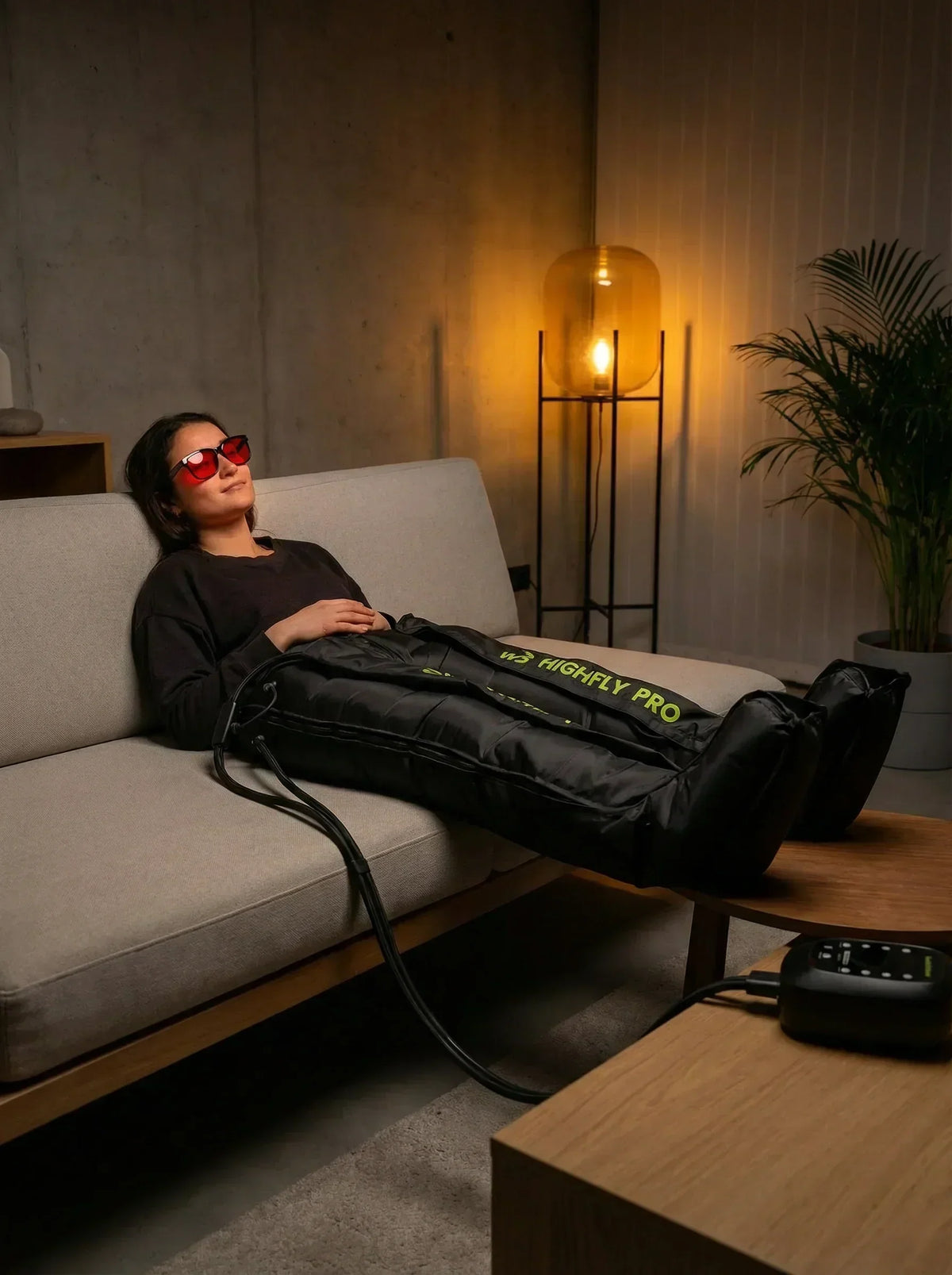


You search for “how much does pressotherapy cost?” and find two answers that look nothing alike: a twenty-five-euro session or equipment costing several hundred euros. It seems like you are comparing different things, and in a way, you are.
Because pressotherapy is not something you do just once. It is a maintenance treatment: it works as long as you repeat it and stops working when you stop. So the useful question is not how much a session costs, but how much it costs you per year to have your legs looking the way you want them to. With that approach, the numbers change quite a bit. Let’s work them out.
| Option | Typical price in Spain | What it includes |
|---|---|---|
| Single session at a center | 20-40 € | 30 minutes on the machine and in the treatment room |
| 10-session package | 150-300 € | Discounted session price |
| Session with manual drainage | 40-70 € | Physiotherapist included |
| Basic home equipment | 80-200 € | Few chambers, limited pressure |
| Professional home equipment | 500-700 € | Sequential compression and programs |
| Clinical equipment | 1.500-6.000 € | Intensive multi-user use |
How long until your equipment pays for itself?
Compare what you would spend at a center with having it at home.
 Measurable health · Compression therapy
Clinic-grade compression therapy, at home and cable-free
Trousers with six chambers that compress in sequence from foot to hip, including glutes and lower back.
6 chambers · pressure adjustable from 0 to 200 mmHg · 5 programmes: circulation, sport and mixed
View the HighFly Pro Max€675,00
Measurable health · Compression therapy
Clinic-grade compression therapy, at home and cable-free
Trousers with six chambers that compress in sequence from foot to hip, including glutes and lower back.
6 chambers · pressure adjustable from 0 to 200 mmHg · 5 programmes: circulation, sport and mixed
View the HighFly Pro Max€675,00
How much a session at a center costs
In Spain, a single pressotherapy session usually costs between 20 and 40 euros for about 30 minutes on the machine. The range is wide because it depends on three things: the city, the type of establishment, and whether a professional attends to you or simply seats you on a treatment table.
| Where | Approximate price | What to expect |
|---|---|---|
| Beauty center | 20-30 € | Aesthetic focus, standard sessions |
| Physiotherapy clinic | 30-50 € | Parameters adjusted to your case |
| Sports or rehabilitation center | 15-25 € | High pressures, short sessions |
| With manual lymphatic drainage | 40-70 € | Physiotherapist's hands + machine |
Almost all centers sell packages, which is where the real price lies. A package of ten sessions usually brings the cost per session down to between 15 and 25 euros. The usual small print: they expire. Buying ten sessions valid for three months and using six means paying twenty-five euros per session while thinking you were paying fifteen.
What you are really paying for at a center
It is worth breaking this down, because part of that price is real value and part of it is simply overhead.
What your money is really buying: having someone trained assess your case, choose the right pressure, and identify anything that would make the treatment inadvisable. The first session at a good center is worth the price on its own.
What you pay for that isn’t treatment: the premises, reception, treatment table, depreciation of a machine costing several thousand euros spread among its users, and the hour of room time you occupy.
What it costs but doesn’t appear on the bill: travel, parking, and, above all, time. A 30-minute session can easily become an hour and a half from door to door. That’s the real reason many people quit after six weeks, not the price.
How much it costs to have one at home
Here, the price is a one-time payment and then practically nothing. Broken down:
- The device. Between 500 and 700 euros for a home device with genuine sequential compression and adjustable pressure. Below 200 euros, you enter a different category, which we’ll look at below.
- Electricity. A device with a rechargeable battery uses so little power that you won’t notice it on your bill. We’re talking cents per month.
- Maintenance. None beyond cleaning the boots and avoiding kinks in the hoses. Reliable devices come with a two- or three-year warranty.
- Optional accessories. A hip extender, if you need one, costs around 15 euros.
In other words: high upfront cost, zero usage cost. Exactly the opposite of a clinic.
The calculation explained
The calculation is simple, and you don’t have to take anyone’s word for it. Multiply what you pay per session by the number of sessions you would have each month. That is your monthly treatment cost. Divide the price of the device by that figure, and you have the number of months it would take to break even.
A typical example: two sessions a week amount to just over eight and a half per month. At 25 euros, that’s around 217 euros per month, or nearly 2,600 euros a year. A 565-euro device pays for itself in just over two and a half months. After that, each session is free.
And if your case is one that requires consistency—legs that swell every day, working on your feet all year—the difference over two years stops being a figure and becomes an obvious decision.

HighFly Pro — Pressotherapy boots
Six sequential chambers and up to 260 mmHg, completely wireless. One payment and as many sessions as you want, whenever you want, with no package expiration.
View productWhen a clinic is worthwhile
Buying does not always win, and saying otherwise would be dishonest. A clinic makes sense in these cases:
If you are going to do a short, one-off course. Ten sessions before an event, or to recover after a particular race. Buying a device for that does not make sense.
If you need hands, not a machine. Properly performed manual lymphatic drainage cannot be replicated by any device. If you are in a recovery overseen by a professional —after an operation, for example— the physiotherapist sets the plan and the machine, if anything, goes alongside it.
If you still do not know whether it will help you. Three or four sessions at a clinic are an inexpensive trial before deciding.
If you have a condition requiring supervision. It is worth reviewing the indications for pressotherapy first and consulting a professional.
When buying is worthwhile
Buying wins as soon as continuity comes into play. If your problem is chronic or lasts throughout a long season —legs that swell every day, training all season, working eight hours on your feet—, no package of sessions stands up to comparison.
There is also a factor that does not appear in any table: adherence. A device at home gets used while you watch a series. A clinic requires you to leave the house. And the treatment that is always done beats the perfect treatment that is abandoned. We explain this in at-home pressotherapy.
Why to be wary of €80 devices
They exist, sell particularly well in summer, and are the main source of disappointment with pressotherapy. What usually goes wrong:
| What the advertisement says | What it usually means |
|---|---|
| «Air leg massage» | 2–4 chambers that inflate at the same time, without sequencing |
| «Powerful pressure» | No stated mmHg or genuine regulation |
| «Multifunction» | Programs that change the rhythm, not the technique |
| «Professional use» | Without medical certification to support it |
The compression that provides drainage is sequential: from the foot upward, chamber by chamber. A device that inflates the entire leg at once compresses but does not direct the flow. It is money spent on a pleasant sensation, not on a treatment.
What really makes a device more expensive
To determine whether a high price is justified, this is what you are paying for:
- Number of chambers. Six allow a genuinely progressive wave; two or three do not.
- Pressure range and fine adjustment. Being able to lower it to 30 mmHg for gentle drainage and raise it to 200 for sports recovery is what makes the device suitable for you and someone with different needs.
- Coverage. Reaching the hips, buttocks, and lower back changes the result for generalized fluid retention and cellulite.
- Battery and runtime. It is not a gimmick: it determines whether you use it on the sofa or depend on having an outlet nearby.
- Certification and warranty. CE marking, medical device classification, years of coverage, and someone to call.
What should not make it more expensive: a flashy screen, an app that adds nothing, or fifteen programs when in practice you use two.
Frequently asked questions
Between 20 and 40 euros per individual session of around 30 minutes, depending on the city and type of center. With a ten-session package, it usually comes to between 15 and 25 euros. If it includes manual lymphatic drainage with a physiotherapist, it rises to 40–70 euros.
The relief from heaviness usually appears after the first session. Sustained change requires two to four weeks of consistency, with two to five sessions a week depending on the case. That is exactly the point where the package runs out and the bill starts to hurt.
It depends on how many sessions you would have. Three months at three sessions a week is nearly forty sessions: at 25 euros, about a thousand euros. More than paid for itself. If, on the other hand, you would have five or six sessions over the entire summer, the package is more reasonable.
As a wellness treatment, no. When it is part of a prescribed physiotherapy treatment—for example, rehabilitation after an operation—some policies cover the physiotherapy sessions during which it is applied. Check with your insurer before taking anything for granted.
A professional-grade home device reaches perfectly comparable pressures. The real difference lies in durability for intensive daily use with many users and in calibration precision, which is what justifies a clinic machine costing several thousand euros.
With normal home use and proper care of the hoses, it will last several years without any problems. Reputable devices come with two- or three-year warranties, which is a good indirect indication of how long the manufacturer expects them to last.
Yes, and this is what ultimately tips the balance for many families. If two people at home use it, the payback calculation is divided by two. You just need to check that the sizes fit both of them.
It is the worst option. A device without sequential compression does not reproduce the treatment, so it is not useful even for finding out whether pressotherapy works for you. If you want to try it, spend that money on four sessions at a clinic: the trial will be representative.
If your swelling stays below the knee or you are looking for sports recovery, the boots are more than sufficient. If the problem extends to the hip and buttocks—cellulite, generalized fluid retention—the trousers cover an area the boots cannot reach, and that is where the price difference is justified.
Most retailers offer installment payments, which in practice makes the purchase very similar to paying for a monthly package, with the difference that once you finish paying, the device is yours. Compare the installment with what you would spend at a clinic over those same months.
The quick calculation
Pressotherapy at a clinic costs between 15 and 40 euros per session, and that expense never ends because the treatment depends on repetition. A professional-grade home device costs between 500 and 700 euros once, and from then on it costs nothing.
The break-even point is around twenty to twenty-five sessions. Below that, go to a clinic. Above that, buy. And if your situation requires consistency for years, the comparison is no longer debatable.
Before deciding, check which format suits you in the best pressotherapy machine for home use and what to look for before buying in the pressotherapy boots buying guide.
The numbers are what they are. You just have to run them.
Redacción y revisión del artículo
Share:
Sports recovery: the method used by a world champion
How much protein does an egg contain (table by size)