


It is almost eight in the evening. You clock out, enter the changing room, and let yourself drop onto the bench. Off come the clogs. And there it is: the sock mark two fingers above the ankle bone, the swollen ankle, the hot foot, and that heaviness rising from the calf. You have been standing for eight hours, barely sitting down. And it is not the first time this week.
Tired legs after a long shift are not weakness or a lack of fitness. They are what happens when you ask your circulation to work against gravity for hours without the help you give it when walking. Blood and fluid remain down below, build up, and you arrive home like that. The good news is that there are specific habits to keep it from reaching that point, with a 15-minute routine you can do at home.
| Shift hour | What is happening inside | How you notice it |
|---|---|---|
| Hour 1–2 | The muscle pump activates with every step, and venous return works well | Practically nothing; your legs feel normal |
| Hour 3–4 | If you stand still for a long time, the pump activates very little and venous pooling begins in the calf | Slight heaviness, localized warmth in the calf, an urge to move |
| Hour 5–6 | Venous return reaches its limit, and interstitial fluid leaks into the tissue | Sock mark, swollen ankle, tight footwear, dull ache |
| Hour 7–8 | Real muscle fatigue and accumulated dehydration add to it | Truly tired legs, hot feet, and an urgent need to sit down |
| At the end | If you do not drain them, the load remains accumulated for the next day | Tomorrow you start your shift with your legs already only halfway recovered |
What do your legs need right after your shift?
Tell us how many hours you have been standing and what you do for work, and we will give you your at-home routine.
What happens to your legs after 5 hours of standing
Every step you take while walking squeezes the calf veins and pushes blood upward. That is your muscle pump, and it is what prevents blood and fluid from pooling in your legs all day. And here is the catch. It needs real movement. Standing does not count. You have to walk or move your ankle.
That is precisely the problem with working on your feet. You are at your workstation but barely move. A nurse at the desk, a hairdresser beside the chair, a cashier scanning items, a sales assistant folding clothes. The muscles hold the posture but barely pump. And that is where the cycle begins.
The veins in your legs have internal valves that prevent blood from flowing back down once it has risen. They work well when the muscle pushes behind them. When that push fails for hours, blood pools, the vein dilates, more fluid leaks into the tissue, and the sensation you already know appears. Sock marks, a thicker ankle, and the shoe that fit in the morning now feels tight.
There is also a second system that suffers: the lymphatic system. It collects the fluid that leaks into the tissues and returns it to the bloodstream. It also needs movement. That is why, at the end of the shift, you notice not only heaviness but also increased volume. Your leg is literally thicker than it was in the morning.
Why the system cannot cope with 5 hours or more
Standing is more demanding for your circulation than sitting, even though it may seem the opposite. When you sit, your veins are working against a shorter vertical distance. When you stand, the entire column of blood weighs down from your heart to the floor. All that pressure has to be pushed back upward with very little help from the muscles.
Five hours is more or less the point at which most people begin to notice the buildup, even when they are healthy. It is not an exact clinical figure; it is what is observed in jobs with long shifts. From then on, every extra hour adds to it. And if you also add poorly designed footwear, tight uniforms, inadequate hydration, and eating quickly and saltily because of lack of time, tired legs at the end of the shift are almost inevitable.
Add age to the equation. From the age of 40, venous return and lymphatic drainage are slightly less efficient than they were at 25. The same shift you worked at 28 without noticing anything is “paid for” in your calf at 45. In women, hormonal factors increase baseline fluid retention. If you recognize yourself in this paragraph, you may also be interested in the companion article Why Your Legs Feel Heavy After the Age of 40, which focuses precisely on that.
The jobs where this is most noticeable
They are all variations of the same pattern: many hours standing with little actual movement and consecutive shifts without recovery time in between. But each has its own nuances, and it is worth recognizing them because the useful strategies vary slightly.
Nursing, pharmacy, healthcare assistant
Long shifts, frequent changes between standing still (at the counter, at the pass) and short walks along the corridor. The uniform is usually loose-fitting, which is an advantage. Footwear (clogs, trainers) is usually well chosen. The problem is the duration. Eight- or twelve-hour shifts with no real opportunity for breaks, and often with night work. Nighttime is when the body naturally drains fluid, and if you work at night, you are asking your venous system to make twice the effort.
Hospitality, kitchen, dining-room server
Hard floors, kitchen heat, lots of moving around while carrying weight. These are the kinds of shifts when you lose the most through sweating, so dehydration builds up. And dinner is usually late and eaten standing up. The heat factor is important because heat dilates the veins and worsens the feeling of heaviness, especially in summer.
Retail, sales assistant, cashier
There is less actual movement than in healthcare or hospitality, so the muscle pump is activated less. Many hours are spent almost on the same spot. Footwear is often poorly chosen—it looks good with the uniform but is not functional. And sales and holiday campaigns mean long days back to back without recovery in between, which is when tired legs are felt most.
Hairdressing, beauty, styling
Here, several sources of strain come together. You spend hours standing with your torso leaning over the client, your arms raised, and almost always the same foot supporting you. The strain is not just circulatory; it also affects the lower back and neck. The constant heat from the hairdryer and products does not help leg circulation either. This is one of the profiles where doing a little leg-strength training outside work makes a big difference after five years.
Teaching, classrooms, childcare
Many hours standing and talking, with short walks around the classroom. In early-years education, bending down and carrying children adds to the strain, with low-level activities that force an awkward posture. In secondary schools and universities, the work is more static. This is a group in which tired legs often appear later, around ages 45–50.
When your legs are warning you of something more serious
Almost everything we have described so far is typical tired legs from standing at work. They appear at the end of the shift, improve when you elevate them, and get worse with heat or several consecutive days without proper rest. This can be managed with a daily routine and the specific habits we will look at below.
But some signs are not fatigue; they are warning signs. And in jobs that involve standing, especially if you combine them with hours of driving or flying, it is worth knowing what they are.
- Swelling in one leg only that appears suddenly, especially if it hurts or changes color.
- Severe calf pain, with local warmth and redness in a specific area.
- Varicose veins that hurt, bleed, or appear suddenly.
- Ulcers or wounds on the lower leg that do not heal.
- Swelling that does not go down, even in the morning after sleeping with your legs elevated.
- You are pregnant, take contraceptives or hormone therapy, and notice sudden changes in your legs.
- A direct family history of thrombosis or advanced venous insufficiency.
The 15 minutes immediately after your shift are pure gold
Now for the part that gets neglected the most and delivers the greatest benefits. The 15 or 20 minutes from the moment you walk through the door until you sit down to dinner are the golden window. This is when the body shifts from “standing against gravity” mode to “recovery” mode, and anything you do to help that transition will be noticeable the next day.
| When | What to do | How long |
|---|---|---|
| As soon as you get home | Take off your shoes and tight uniform. Take a warm shower, finishing with cool water on your legs, from ankle to knee | 10 minutes |
| First 10 minutes | Lie on the bed with your legs raised against the wall, or elevated on the headboard. Breathe slowly | 10 minutes |
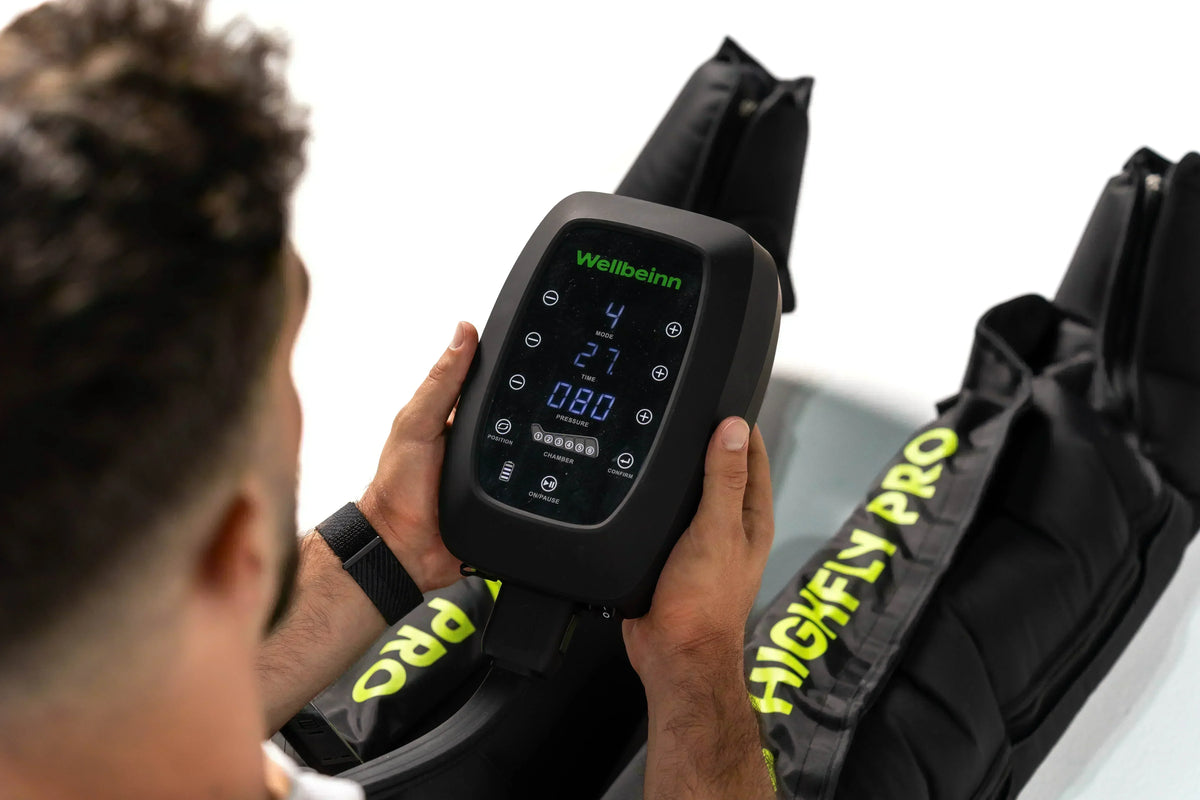
| After your shower | Pressotherapy session with HighFly Pro or Pro Max, using the drainage or relaxation program | 10–20 minutes |
| Before going to bed | Drink water without overdoing it (so you do not interrupt your sleep). Have dinner without too much salt | Zero cost |
With this routine, after three or four weeks, how you feel when you wake up changes noticeably. The key is not the intensity of the session, but consistency. Four properly completed days a week are more effective than two Sunday marathons with your legs elevated.
Socks that do not bother you during your shift (and that you notice when it ends)
Let’s move on to the product that delivers the most for its price and that almost nobody discovers in time: a light-compression sock. And something needs clarifying here, because when someone hears “compression,” they think of medical compression stockings—the stiff white ones you have to pull up with both hands. This is nothing like that.
The Wellbeinn compression socks are technical sportswear. Lurbel is a Spanish brand that has been making socks for trail and ultradistance runners for years—people who spend all day with their feet inside their shoes and cannot afford a blister. Building on that experience, they created a version designed to complement pressotherapy and long days spent standing. And it works very well.
The compression they use is called graduated: tighter at the ankle and gradually looser further up. That is what pushes the blood toward the heart throughout your entire shift, helping the muscle pump that is not working fully for you. The ranges are measured in mmHg. These socks provide 15–20 mmHg, which is what is recommended for prevention during healthy standing work and on long trips. They do not feel tight or uncomfortable and can be worn comfortably all day.
A couple of details you’ll appreciate when you’ve been wearing them for eight hours. They have flat anti-chafing seams, so the toe doesn’t bother you inside clogs or trainers after hours of wear. The fabric is also breathable and quick-drying, which is especially welcome in a kitchen or during a summer shift.
You notice it in two ways. During your shift, you finish the day with less heat in your foot and less of a tight-boot feeling. And when you get home and take them off, the sock mark isn’t as deep as it used to be. Your ankle feels more comfortable, your foot isn’t as swollen, and the pressotherapy session works better afterward because you start with less accumulated strain.

Lurbel x Wellbeinn compression socks ·
Graduated compression of 15–20 mmHg, flat anti-chafing seams, and breathable quick-drying fabric. Designed to support you throughout your shift and enhance your pressotherapy session when you get home.
View Lurbel socksPressotherapy after your shift: your best friend on the sofa
Pressotherapy isn’t a massage, although it’s often described that way. It is sequential mechanical drainage. Air chambers inflate one after another from the ankle upward, pushing blood and lymph in the natural direction of return. It replicates what your muscle pump does when you walk, but without you having to walk. And that’s the trick: it does what your legs haven’t been able to do throughout your entire shift.
Let me describe the real sensation so you know what to expect the first time. You lie down or sit on the sofa wearing the boots or trousers. You start the program and feel a gentle warmth around your ankle as the first chamber inflates. It stays that way for a few seconds, releases, and the next chamber starts higher up. You can feel the fluid “moving up” your leg. After 15 minutes, when you finish, your legs feel empty, as if an actual weight had been lifted from them. Your ankle is slimmer, your foot feels less hot, and your legs are genuinely rested—not merely parked.
You can’t replicate this by sitting on the sofa with your legs raised. Raising your legs helps (a lot), but it’s passive drainage. Pressotherapy is active and genuinely pushes fluid along. That’s why professional athletes have been using it for years after training, and why more and more people who work on their feet now have one at home.
At Wellbeinn, we have two models, both based on the same underlying principle but designed for slightly different profiles. I’ll explain which one suits you best depending on your situation.
HighFly Pro compression boots, for most standing jobs
If you work 6-, 7-, or 8-hour shifts in nursing, retail, hospitality, or a similar field, and you want the most straightforward way to recover when you finish without making things complicated, this is the one for you. Boot-style design, from the feet to the hips, with coverage up to the buttocks and lower back (where most of the key venous and lymphatic circulation from the leg ends).
It has 6 sequential air chambers, enabling genuine drainage from the bottom upward rather than general squeezing like more basic models. It comes with 6 preset modes, from gentle lymphatic drainage for the heaviest days to full compression when you arrive exhausted. No programming or adjusting chamber by chamber—choose the mode and get started.
The pressure reaches up to 260 mmHg, the highest in the range. That may sound like a lot, but it is especially useful on the days you arrive feeling worse, with really heavy legs after a 10-hour shift or a busy weekend. On normal days, you can use a gentler mode.
One particularly useful detail is that they are completely wireless, with a battery lasting more than 3 hours. You can lie down on the sofa wherever you like, or even take them to bed if you have to leave late. No cables and no being stuck next to an outlet.
And if you have questions about how to use them (which mode to choose depending on how you feel that day, how long to use them, and when to avoid them), you can contact support, which is staffed by licensed physiotherapists.

HighFly Pro compression boots ·
6 sequential chambers, adjustable pressure up to 260 mmHg, 6 preset modes, and a wireless battery lasting more than 3 hours. Coverage up to the hips, buttocks, and lower back. Support from licensed physiotherapists.
View HighFly ProHighFly Pro Max pants for your at-home recovery routine
This is a whole other level. If you work 12-hour shifts, arrive with significant swelling that clearly extends up the thighs, buttocks, and lower back, or train intensely in addition to working and want a tool that also supports sports recovery, the HighFly Pro Max pants are what you’re looking for.
It is a full-length pair of pants that you put on like regular pants (with a side zipper) and that covers the area from the feet up to the hips, buttocks, and lower back. It comes in one size up to 120 cm around the hips, and includes an extender that reaches up to 130 cm, so it fits a range of body types well.
The heart of this model is its control. It has an LCD screen on the controller, so you can see exactly which chamber is working at any given moment and change the pressure or program without stopping the session (which is not possible with the boots). It also includes 5 programs designed by Wellbeinn’s team of physiotherapists. Two circulatory programs (gentler and longer, ideal after a shift), two sports programs (more intense, for after training), and one mixed program. Each program defines which chamber is activated, in what order, and for how long. You can also manage everything from your phone with the Wellbeinn Mate. app.
And if you like to fine-tune things, there is a customized program. You can decide, chamber by chamber, what pressure to apply, how long to hold it (from 0 to 10 seconds), and how long to rest between repetitions (from 30 to 90 seconds). You can also save your settings as favorites. It’s the difference between putting the microwave on “reheat” and slow-cooking while controlling the temperature.
The pressure control here is more granular. It ranges from 0 to 200 mmHg across 6 levels (L0 to L5), so you can adjust it much more precisely to how you feel each day. The battery is larger (5,000 mAh, with USB-C charging and up to 6.5 hours of use), and it has Class II CE certification with a 3-year warranty.

HighFly Pro Max compression therapy pants ·
6 chambers, pressure from 0 to 200 mmHg across 6 levels, 5 programs created by physiotherapists plus a customized chamber-by-chamber program, LCD screen, and USB-C battery lasting up to 6.5 hours. Adjustable size for hips up to 130 cm. Class II CE certification, 3-year warranty.
View HighFly Pro MaxMicro-habits during your shift that add up to more than you think
The best thing you can do for your legs is not to take action when you get home. It’s to prevent the strain from building up so much during your shift. These micro-habits take 30 seconds, go unnoticed at work, and add up by the end of the month.
- Ankle flexions and extensions every 90 minutes. Even if it’s just a set of 20 while you wait for the elevator, load the printer, or put the receipt in the cash register. It activates the muscle pump without anyone noticing.
- Shift your weight from one leg to the other. If you have to stand and talk to someone for 10 minutes, alternate your weight between your legs. Never keep both knees locked and straight.
- Walk instead of standing still. If you’re waiting for something, walk slowly in place. It makes a big difference for your veins.
- Drink real water. Coffee and the cold drinks you have during your shift don’t count as hydration. A real glass of water every two hours improves drainage.
- Light compression socks. Put on at the start of your shift, this is the most effective habit for its cost (the one we explained above).
Common mistakes that make things worse
When you’ve been working on your feet for years and notice that your legs are no longer recovering, it’s easy to resort to solutions that sound logical but worsen the sensation in the short term. These are the most common mistakes.
- Taking a very hot bath when you get home. After a cold shift, it’s tempting, but heat dilates the veins and temporarily increases the feeling of heaviness. A lukewarm shower is better, finishing with cool water on your legs from the ankles to the knees.
- Crossing your legs when you sit down after arriving home. It blocks venous return just when you need it most. Try putting your feet up on another chair or a pouf.
- Eating a salty dinner. It’s tempting when you get home hungry, but sodium worsens fluid retention that night, leaving you more swollen the next day.
- Drinking only coffee during your shift. It provides little hydration. Replace one of your coffees with a large glass of water and you’ll notice the difference when you finish.
- Unfunctional footwear. If your uniform requires a mid-height heel or a flat shoe without cushioning, your legs start feeling tired sooner. Sometimes it’s worth taking it up with human resources or looking for insoles that provide compensation.
- Not moving during breaks. The instinct is to sit down because you’re tired, but five minutes on a hard chair don’t help with drainage. If you can, spending those minutes walking slowly helps much more than sitting.
The essentials in four lines
Frequently asked questions about tired legs after standing
Because standing without walking leaves the muscle pump almost inactive. Blood pools in the calf veins, fluid leaks into the tissue, and after 4–5 hours you already notice heaviness, a swollen ankle, and that sock mark you did not have in the morning. It is not weakness; it is physiology. The effect is more pronounced after 40 and in women undergoing hormonal changes, but it can happen to anyone who works long shifts standing with almost no movement.
Standing still is much worse. When you walk, each step activates the calf muscle pump and helps venous return. When you stand still, your muscles hold your posture but barely pump. That is why a nurse who walks around the ward a lot will usually finish with less leg discomfort than a cashier who spends the same number of hours almost on the same spot.
The first 15 to 20 minutes have the greatest impact. The most effective routine is to take off your shoes and tight uniform as soon as you get in, take a lukewarm shower finishing with cool water on your legs, spend ten minutes with your legs raised against the wall, and have a 10- to 20-minute pressotherapy session with the HighFly Pro or Pro Max. Eating dinner without too much salt and not drinking excessively before bed completes the routine.
Yes, and it is probably the most cost-effective measure. Graduated compression socks rated 15–20 mmHg, such as Lurbel x Wellbeinn, support venous return throughout the shift without being too tight or showing under your uniform. You can feel the difference when you get home from the very first day. Nurses, flight attendants, and people who work long shifts on their feet have been using them for years, although many women discover them late because they associate compression with uncomfortable medical stockings. These socks are completely different: they are technical sportswear from a brand that makes high-end trail-running socks.
For prevention in healthy people who work standing up, light compression of 15–20 mmHg is the standard. It is comfortable to wear all day, helps circulation back to the heart, and does not require a prescription. Higher compression (Class II, 23–32 mmHg or more) does require a prescription and assessment by your doctor or vascular specialist, because it is intended for specific venous conditions, not for general use while working standing up.
Yes, it’s one of the measures with the most immediate benefits after a long shift. It replicates the drainage your legs haven’t been able to achieve for hours and prevents the strain from carrying over into the next day. With 10- to 20-minute sessions, 3 to 5 times per week, most people notice a clear difference from the first week and a baseline improvement after 4–6 weeks of regular use.
Both cover the same area (from the foot to the hip, buttock, and lower back) with 6 sequential chambers. The difference lies in the format, controls, and pressure. The HighFly Pro units are boots, with a maximum pressure of up to 260 mmHg, 6 preset modes, and a wireless battery lasting more than 3 hours. They cost €565. The HighFly Pro Max is a full-length garment, with an LCD screen, pressure from 0 to 200 mmHg across 6 levels, 5 physiotherapist-designed programs plus a customizable chamber-by-chamber program, a USB-C battery lasting up to 6.5 hours, and an adjustable size for hips up to 130 cm. It costs €645. For most workers with standard shifts, the Pro is more than sufficient. The Pro Max makes sense for 12-hour shifts, swelling that extends up the thigh and buttock, or if you also exercise and want precise control.
You can, although for most people, 3–5 sessions per week are enough and provide good recovery between shifts. The HighFly Pro Max technical specifications recommend this range. If your shift is particularly demanding, you can use it daily without any problem, while always respecting the recommended range of 10–20 minutes per session and the usual contraindications (pregnancy, recent thrombosis, uncontrolled heart failure, among others listed in the product specifications).
A lot, and it’s free. Ten minutes with your legs straight up against the wall, lying on the floor or bed, lets gravity do the work that your shift has been working against. It pairs well with compression therapy (legs elevated first, then the session) or works on its own if you don’t have time for anything else one day.
Because you work long shifts back to back without real recovery in between, and the strain builds up day after day. A single shift can be offset by getting good sleep. Five long shifts in a row start leaving residual strain from the second day onward. During those periods, a post-shift routine becomes non-negotiable, and compression during the shift goes from “nice to have” to essential.
Yes, and it is often counterintuitive. Many people who work on their feet drink little to avoid going to the bathroom so often, but when you are dehydrated, your body retains sodium as a defense mechanism, which worsens fluid retention in the legs. A large glass of water every two hours helps drainage and does not require as many bathroom trips as you might think. Coffee and sugary drinks do not count.
In most cases, no; they are a consequence of the type of workday itself. But if you notice asymmetric signs (in only one leg), intense pain with localized heat and redness, swelling that does not go down by the next day, ulcers, or bleeding varicose veins, you should consult a healthcare professional. Deep vein thrombosis and advanced venous insufficiency are medical diagnoses that require specific treatment, not a home routine.
Yes, and it is one of the most underrated factors. Your footwear needs to provide cushioning (a sole with some structure, not a flat one), have enough room for your foot to spread out over the course of the day (feet increase by several millimeters by the end of a shift), and be well suited to your gait. Good technical footwear or supportive clogs designed for healthcare workers are more effective than many expensive solutions if the rest of the system fails.
A lot, and it is the only lever that works on the future of your legs. Two short sessions per week of squats, calf raises, and glute bridges strengthen the muscle pump. A stronger calf pumps more effectively, and that difference becomes very noticeable after five years, when other workers in the same role start developing venous problems and you do not.
Redacción y revisión del artículo
Share:
Why do your legs feel heavy after the age of 40?