


You get back from a five-hour ride with two climbs, leave your bike in the garage, and your legs feel like two blocks. Nothing in particular hurts, you don’t have muscle soreness, but climbing the stairs at home feels like a long haul. And you want to ride again tomorrow or the day after.
That feeling is quite different from what a runner feels after a long run, so recovery is different too. Cycling involves very little impact or braking, so there is little muscle damage. What gets depleted is your tank: glycogen, fluid, salt, and sleep. In this article, we explain what to do in the hours and days afterward, including the figures from the guidelines and what is actually known about the stationary bike, stretching, cold therapy, and compression therapy.
| Type of ride | Carbohydrates that day | Priority on arrival | What else helps |
|---|---|---|---|
| An easy 1-hour ride | 5-7 g per kilo | Eat and drink as usual | Nothing special. It’s almost recovery in itself |
| A 2- to 3-hour ride, flat or rolling terrain | 6-10 g per kilo | A meal with carbohydrates and 20 g of protein within the next 2 hours | Weigh yourself before and after to find out how much to drink |
| Long ride with climbs or a sportive (4-6 hours) | 8-12 g per kilo | Carbohydrates as soon as you get off the bike, 1.25-1.5 L per kilo lost, with some salt | Sleep more that night. Compression if your legs feel heavy |
| Two rides on the same day or less than 8 hours between them | 1-1.2 g per kilo per hour for the first 4 hours | Eat little and often as soon as you get off the bike | Protein every 3-4 hours |
| Several consecutive days (stage race, cycling trip, training camp) | 8-12 g per kilo each day | Arrive at dinner with your tank already half full | Consistent sleep routine. Compression or massage in the afternoon |
Carbohydrate and fluid ranges from the joint position statement by the Academy of Nutrition and Dietetics, Dietitians of Canada, and the American College of Sports Medicine (Thomas et al., 2016), which defines them by hours of moderate- or high-intensity exercise per day. Assigning them to each type of ride is our guideline. A very easy four-hour ride uses less than a two-hour all-out ride.

Why cycling tires you out differently than running
Muscle is damaged mainly when it works while lengthening under load, which is called an eccentric contraction. This happens with every downhill stride or every time you brake. A review from Queensland University of Technology sums it up this way: unaccustomed eccentric exercise is what causes muscle damage, with loss of strength, soreness, and swelling that can last for days.
Pedaling is almost the opposite. The quadriceps pushes by shortening, without impact against the ground or braking. That’s why cyclists rarely get the soreness runners do, and why what works for one doesn’t always work for the other.
A Spanish study illustrates this well. A team from the University of Valladolid compared 18 professional cyclists with professional basketball and volleyball players, two sports involving lots of jumps and stops. After twenty days of demanding competition, blood markers of muscle damage—creatine kinase and myoglobin—rose in everyone, but they rose the least in the cyclists.
Here’s the nuance that matters. Over that same period, cortisol fell in the court-sport players and rose significantly in the cyclists. The authors interpret this as a limited adaptation to the effort. In other words, cyclists accumulate less muscle damage and more general fatigue: energy, hormones, sleep. It’s a small study involving men only, but it fits with what anyone who’s done three consecutive days in the mountains will recognize.

What to eat after a bike ride, and how much
On a long ride, muscle glycogen—the carbohydrate reserve in your legs—drops a lot. Replenishing it is what matters most for how you’ll feel on your next ride. The practical question is when you have to ride again.
If you’re resting or riding easy tomorrow
You don’t need to rush to the kitchen. The ACSM position statement sets daily targets based on training volume: 6 to 10 g of carbohydrates per kilo on days with one to three hours of training, and 8 to 12 g on days with more than four or five hours. For a 70-kilo cyclist returning from a six-hour ride, that’s between 560 and 840 g of carbohydrates for the day. Much more than most people eat without thinking about it.
What works is spreading it out. Have a meal with rice, pasta, potatoes, or bread when you get home, some fruit or a sandwich in the afternoon, and a dinner with carbohydrates. What you ate and drank on the bike counts too. For rides lasting one to two and a half hours, the guide recommends 30 to 60 g of carbohydrates per hour, and for efforts lasting more than two and a half hours, a review by the same group of authors raises the upper limit to 90 g per hour.
If you’re cycling again in less than eight hours
Here, timing matters. For recovery periods of less than eight hours between two demanding sessions, the ACSM recommends 1 to 1.2 g of carbohydrates per kilo per hour for the first four hours, in small, frequent servings. The International Society of Sports Nutrition takes a similar approach and adds that if you can’t reach that amount, combining 0.8 g of carbohydrates with 0.2 to 0.4 g of protein per kilo per hour also helps replenish your stores.
In its consensus document, the Spanish Federation of Sports Medicine recommends starting with carbohydrates in the first 30 minutes and having more every two hours for up to six hours, because this achieves higher glycogen levels than waiting two hours to eat.
Protein
After exercise, the ACSM recommends 0.25 to 0.3 g of high-quality protein per kilo, which works out to about 15 to 25 g for most people. The ISSN recommends 20 to 40 g per serving and 1.4 to 2 g per kilo per day, spread out every three or four hours. A chicken dish, some eggs, Greek yogurt, or a shake all work equally well. If you want to fine-tune your daily amount based on your weight, see how much protein to eat per day, and if you’re looking for what to combine after a workout, check out our guide to supplements for muscle recovery.
In cycling, protein plays a different role than it does at the gym. It’s not there to build muscle, but to repair the little damage that’s been done and, along with carbohydrates, to help replenish your stores when you don’t have time to eat much. A shake like Proteinn Whey Isolate is convenient after a ride, but it doesn’t do anything a meal with protein can’t.
How much to drink after cycling
The most useful and cheapest trick in the whole article is a scale. Weigh yourself without clothes before you leave and when you get back. Every kilo you’re down is almost entirely fluid you’ve sweated out.
The ACSM guidelines call for replacing between 125 and 150% of what you lost, that is, 1.25 to 1.5 liters per kilogram. You drink more than you lost because you keep sweating and urinating as you recover. If you return from a summer ride 1.5 kilos lighter, that means between almost two liters and a little over two liters over the next few hours.
And this is where salt comes in. In a classic trial at the University of Aberdeen, twelve men who were 2% dehydrated after cycling drank varying amounts of beverages with different sodium levels. The conclusion was twofold. You need to drink more than you’ve sweated out, but if the drink doesn’t contain enough sodium, much of that fluid ends up in the toilet. A salty meal, broth, or sports drink solves the problem.
How to loosen up your legs: easy spinning, stretching, cold, and compression socks
This is the part where we hear the same old advice most often and look at the evidence least. Let’s go through the tools one by one.
| Tool | What the evidence says | For cyclists |
|---|---|---|
| Roller or easy spin | Speeds up lactate removal from the blood, but barely improves soreness, strength, or next-day performance | Useful for loosening up your legs and clearing your head. It’s no substitute for eating |
| Stretching | No demonstrated effect on strength recovery or muscle soreness at 24, 48, or 72 hours | Do them if they feel good, especially hip flexors, but not for recovery |
| Massage | The most effective technique for reducing muscle soreness and perceived fatigue in a meta-analysis of 99 studies | Very useful on consecutive days of cycling |
| Compression socks or tights | Small benefit overall, and one of the clearest effects was on cycling performance 24 hours later | A good option for the trip back or the afternoon |
| Cold water | Improves power, soreness, and perceived recovery 24 hours after intense efforts. Always using it after strength training blunts gains | For competition or consecutive days. Not after the gym |
| Compression therapy | Benefit ranging from trivial to moderate for soreness, small for muscle function, with no effect on glycogen | Lighter legs and lying-down rest. We’ll look at it in the next section |
Van Hooren and Peake (Sports Medicine, 2018), Afonso et al. (Frontiers in Physiology, 2021), Dupuy et al. (Frontiers in Physiology, 2018), Brown et al. (Sports Medicine, 2017), Moore et al. (Sports Medicine, 2022), Roberts et al. (Journal of Physiology, 2015), and Maia et al. (Biology of Sport, 2024). Almost all are small studies, with mostly young men and very different protocols.
Easy spinning
Half an hour at an easy pace after a hard ride sounds like a pro’s protocol. But a review by Van Hooren and Peake on cool-downs concludes that they are largely ineffective for most recovery markers. They lower blood lactate sooner, which is the only thing almost everyone measures, but they don’t clearly improve muscle soreness, strength, or next-day performance. And there’s something else worth knowing: they may interfere with glycogen replenishment. If you’re short on carbs, it’s better to sit down and eat than go for another spin.
So it’s no good at all? It is good for loosening up, calmly lowering your heart rate, and switching off mentally. And some studies have found some benefit for performance in the following days. It’s simply not as powerful a recovery tool as it’s made out to be.
Stretching
A meta-analysis of randomized trials found no effect of stretching after exercise on either strength recovery or muscle soreness at 24, 48, or 72 hours, compared with doing nothing. The authors caution that the data are limited and low quality, so the honest conclusion is that there’s no evidence that stretching speeds up recovery. Posture is another matter. After hours hunched over the handlebars, stretching your hips and back can feel good, and that’s reason enough.
Cold and compression
Cold water has good evidence for short-term benefits. A meta-analysis of 52 studies found that after high-intensity efforts, it improved power, muscle soreness, and perceived recovery at 24 hours. The problem comes if you make it a habit after the gym. In a twelve-week trial, people who spent ten minutes in cold water after strength training gained less strength and muscle than those who did active recovery. If you combine cycling and weight training in winter, save the cold for hard cycling days.
Compression socks and tights, the traditional kind, have an interesting fact for cyclists. In a meta-analysis of 23 studies, the overall effect was small, but among endurance exercises, the biggest benefit was seen in cycling performance 24 hours later. The studies are small, and it’s not clear what pressure is best, but they’re cheap and you can wear them in the car on the way back. Graduated compression socks rated at 15-20 mmHg fit the bill.
Compression therapy in cycling: what it does and doesn’t do
Pneumatic compression boots and pants have become popular in elite sports, including professional cycling. A 2024 Portuguese systematic review starts right there: the technique is becoming increasingly popular, but still lacks strong scientific support. So let’s separate what we know from what people say.
What the studies say
That review brought together 17 studies with 319 participants. It found a trivial-to-small benefit for muscle function, a trivial-to-moderate effect on pain and muscle soreness, and highly variable results for markers of muscle damage. The most commonly used protocols lasted 20 to 30 minutes at around 80 mmHg. The authors’ conclusion was cautious: it may have an effect, mainly by reducing perceived pain.
There are two studies conducted specifically with cyclists that are worth knowing about. In the first, 21 trained cyclists did 20 minutes of hard cycling, rested for half an hour with or without compression boots, then completed a four-minute time trial. The difference in power was trivial. The only hint of an effect was a small, non-significant improvement in how recovered they felt.
In the second study, ten active men cycled for 90 minutes to deplete their glycogen, then spent four hours recovering with pneumatic compression pants switched on or off, while drinking the same carbohydrate beverage. Biopsies showed the same glycogen replenishment in both groups: 6.9 mmol per kilogram per hour. In other words, compression therapy doesn’t refill the tank faster. What does that is what you eat.
Where it really fits
Where it makes the most sense is in the situations that define endurance cycling: consecutive days, long drives to the start of a race, or weeks of high-volume training. In the evening, after showering and eating, a 20-minute session at moderate pressure is a good way to end the day. You’ll find guidance for different session types and the most common mistakes in our sports compression therapy guide, and information on how pressure affects circulation in the legs in compression therapy for legs.
If you have a history of thrombosis, significant varicose veins, or any diagnosed circulatory or heart condition, consult your doctor first. We review cases where compression therapy isn’t recommended in contraindications to compression therapy.

HighFly Pro Max
Wireless compression pants with six sequential compression chambers from foot to hip, including the glutes and lower back. Adjustable pressure from 0 to 200 mmHg across six levels, five programs (two of them for sports), and an LCD screen. Sessions last 10 to 20 minutes.
573,75 €
View HighFly Pro MaxSleep: the part of recovery you can’t buy
The expert consensus on sleep and athletes, published in the British Journal of Sports Medicine in 2021, with researchers from France’s INSEP among the authors, notes that elite athletes are especially prone to sleeping less than seven hours and having fragmented sleep. It also notes that regularly sleeping less than seven hours is associated with more respiratory infections in the general population.
Amateur cyclists face the same issue for other reasons: rides that start at seven on Sunday morning, events that mean getting up early to catch the bus or drive, and late dinners with the group. Experts don’t give a magic number, because the seven-to-nine-hours-for-everyone formula probably isn’t ideal. Instead, they recommend adjusting sleep to what each person feels they need. The practical takeaway is this: the night after a long ride and the night before your next one matter most. If you can, protect those two nights.
There’s a pyramid that clearly lays out the priorities: sleep first, then food and drink, and only then cold, compression, and massage. We explain it in why your recovery routine isn’t working.

If you ride several days in a row
A bike tour in the Pyrenees, a week of training camp in Mallorca, or a multi-stage ride changes the rules. There’s no time to recover at your own pace, because you’ll be riding again tomorrow. The key is to make recovery part of your routine:
As soon as you get off the bike. Carbs right away, in small servings, and a salty drink or food. If the next stage starts in less than eight hours, follow the guideline of 1 to 1.2 g per kilo per hour for four hours.
Within the next two hours. Shower, a complete meal with 20 to 25 g of protein, and a scale to find out how much fluid you still need.
In the afternoon. Put your legs up and, if you have them, use compression or massage. These do the most to ease the feeling of heavy legs.
At night. Have a carb-rich dinner even if you’re not very hungry, because whatever you don’t eat that night will catch up with you in the next stage, and go to bed at the same time every day.
Remember the data on professional cyclists in Valladolid. During competition periods, it wasn’t muscle damage that spiked, but cortisol. If after the third day you’re sleeping worse, feeling less hungry and your heart rate is rising sooner than usual, your body is asking you to take it easy for a day.
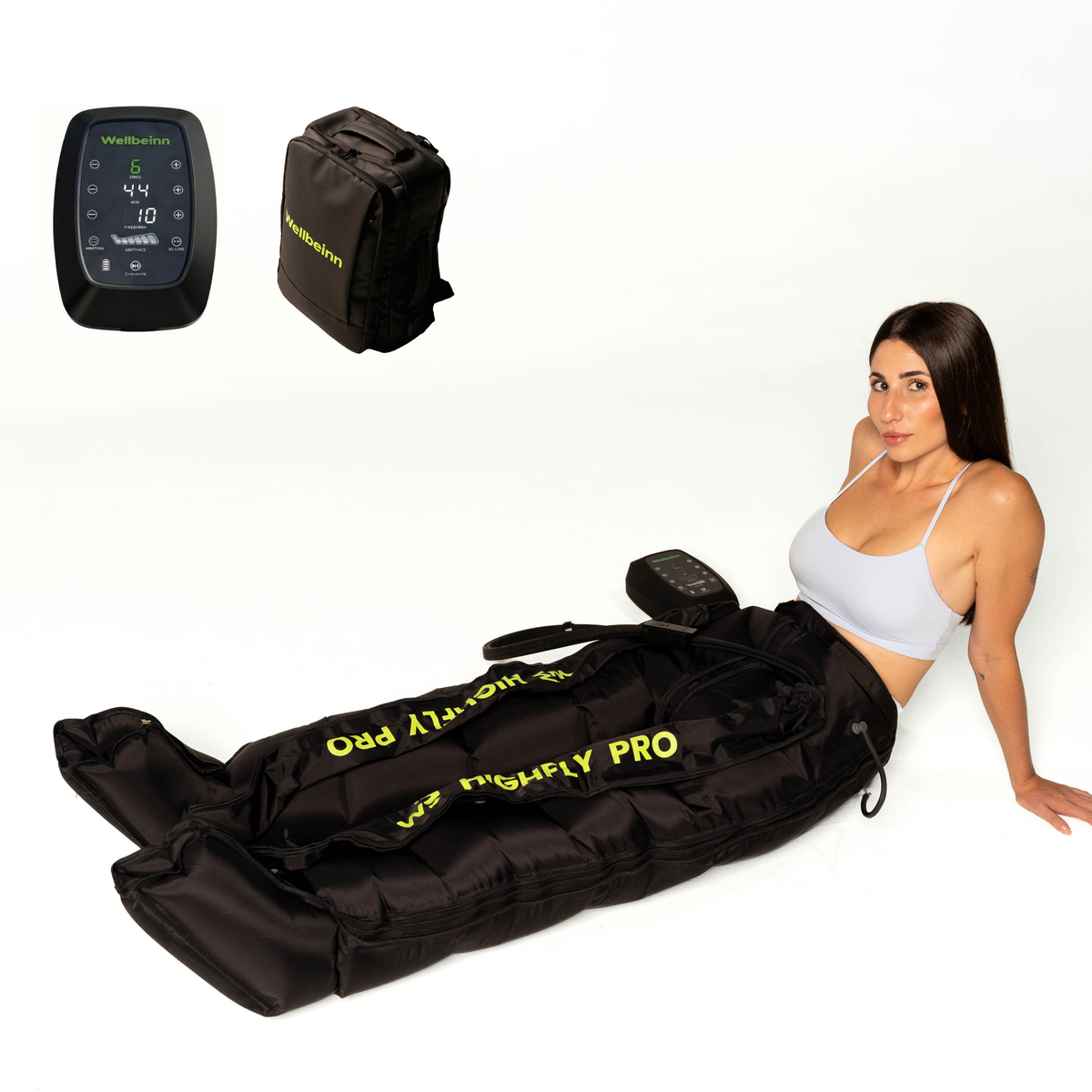
For days like these, a device you can pack in your suitcase and use without plugging it in is more practical than a large one.

HighFly Pro
Six sequential air chambers from feet to hips, with coverage for the glutes and lower back. Adjustable pressure up to 260 mmHg, six modes and over three hours of battery life, completely wireless. Customer support from licensed physical therapists.
449,00 €
View HighFly ProWhen it’s more than fatigue and you should seek advice
Heavy legs after a long ride are normal and go away in a day or two. But some problems won’t be fixed with pasta and compression therapy.
The essentials in five lines
Frequently asked questions
How long does it take for your legs to recover after a long bike ride?
It depends mainly on how much you depleted your reserves and how well you eat and sleep afterward. After a two- or three-hour ride at a comfortable pace, with a good meal and a normal night’s sleep, most people are ready to ride the next day. After a five- or six-hour cycling event with climbs, you’ll usually need one or two easy days before pushing hard again. Since cycling causes very little muscle damage, the biggest factor is replenishing glycogen, which depends on reaching the 8-12 g of carbohydrates per kilo recommended by the ACSM for high-volume days. If your legs still feel empty on the third day, you’re sleeping poorly, and your heart rate is high, don’t push yourself.
What’s good to eat after cycling?
A meal with carbohydrates and some protein. Rice, pasta, potatoes, bread, or fruit to replenish your stores, and chicken, eggs, fish, legumes, or dairy for protein. The guidelines recommend 0.25 to 0.3 g of protein per kilo after exercise, about 15 to 25 g for most people, and spreading carbohydrates throughout the day depending on the length of the ride. If you’re going out again the same day, start taking in carbohydrates as soon as you get off the bike, in small, frequent portions. And don’t forget salt, which helps your body retain the fluid you drink. A proper meal works just as well as a specialized product.
Is it bad to have a beer after a bike ride?
One beer isn’t a problem. The joint ACSM guidelines advise against excessive alcohol consumption during recovery because of its diuretic effect, which is the opposite of what you need after sweating for several hours. The sensible thing is to drink water or a beverage with salt first, eat something with carbohydrates, and then, if you feel like it, have a beer with the group. The problem comes when beer replaces food and water, or when you have several and go to bed late, because alcohol worsens the quality of that night’s sleep, which is exactly what matters most for recovery.
Is it better to rest or go for an easy ride the next day?
Both options are valid, and the evidence doesn’t clearly favor either one. The review by Van Hooren and Peake concludes that active recovery is largely ineffective for most markers, although some studies find a small benefit to performance in the following days. The practical approach is this: if you feel like it, ride very easily for 30 to 60 minutes on flat roads, without looking at your power meter; if you don’t feel like it, rest without feeling guilty. An easy ride doesn’t mean heading out with friends and ending up sprinting on every climb. That’s a different workout and will add fatigue.
Should you stretch after cycling?
There’s no evidence that stretching helps you recover faster. A meta-analysis of randomized trials published in Frontiers in Physiology found no effect of stretching after exercise on strength recovery or muscle soreness at 24, 48, or 72 hours, compared with doing nothing. The authors acknowledge that there is little data and that its quality is low. That said, after several hours bent over the handlebars, stretching your hip flexors, hamstrings, and back may feel good and help you regain your posture. Do it because it feels good, not because it will change how your legs feel tomorrow.
Why do my legs feel heavy after cycling if I’m not sore?
Because when you’re cycling, your muscles work almost always while shortening, without the impact or braking that cause muscle soreness when running or walking downhill. A study by the University of Valladolid found that professional cyclists’ markers of muscle damage increased less than those of basketball and volleyball players during the same stages of the season. For cyclists, heavy legs are more often due to depleted glycogen, fluid loss, and general fatigue. That’s why a good meal, water with salt, and a good night’s sleep usually help a lot.
Do compression socks help cyclists recover?
Probably, although the effects are modest. A meta-analysis of 23 studies published in Sports Medicine found that compression garments generally had a small benefit for recovery, with a large effect on cycling performance 24 hours later among endurance activities. The studies are small, and it’s unclear what the ideal pressure is or whether training level makes a difference. They have the advantage of being inexpensive and wearable for hours, for example on the ride home from an event, and they complement a compression therapy session well.
Does compression therapy work for cyclists?
It helps your legs feel lighter and less uncomfortable, but does much less for performance. A systematic review by Maia and colleagues, covering 17 studies and 319 participants, found an effect ranging from trivial to moderate on soreness and a small effect on muscle function. In trained cyclists, half an hour in compression boots between two tests did not change power in a four-minute time trial, and another study found they did not speed up glycogen replenishment after 90 minutes of cycling. They’re most useful on consecutive cycling days, when you can lie down and ease that heavy-legged feeling, always after eating and drinking enough and getting good sleep.
Is an ice bath good after a hard ride?
There’s good evidence of short-term benefits after intense exercise. A meta-analysis of 52 studies found improvements in power, muscle soreness, and perceived recovery 24 hours later, with greater effects from colder and shorter immersions. It makes sense during a cycling event with another ride the next day or a week of stages. What you should avoid is using it every time after strength training, because in a 12-week trial, those who did so gained less strength and muscle mass. If you have heart problems or don’t tolerate cold well, check with your doctor first.
How much protein does a cyclist need?
The International Society of Sports Nutrition recommends a daily intake of 1.4 to 2 g per kilo of body weight for most people who train, spread across servings of around 20 to 40 g every three to four hours. After a ride, the ACSM recommends 0.25 to 0.3 g per kilo, around 15 to 25 g for most people. Protein is important in cycling, but not as important as carbohydrates, which replenish your fuel stores. If you eat protein with every meal, you’ll usually get enough without supplements. A shake is about convenience, not effectiveness.
How do you recover during a multi-day cycling tour?
Stick to a routine. Start taking in carbohydrates as soon as you get off the bike, and if the next stage starts in less than eight hours, aim for 1 to 1.2 g per kilo per hour for four hours. Have a complete meal with protein, weigh yourself to work out how much to drink, and replace 1.25 to 1.5 liters per kilo lost, along with some salt. In the afternoon, put your legs up and use compression or massage if you have it. In the evening, have a carbohydrate-rich dinner even if you’re not hungry, and go to bed at the same time. Watch for signs of accumulating fatigue, such as sleeping worse or having a higher heart rate, and don’t hesitate to take it easier on one of the stages.
When and for how long should you use the HighFly Pro Max after a ride?
The product listing recommends sessions of 10 to 20 minutes, three to five times a week. After a long ride, it works best once you’ve showered and had something to eat, lying down or with your legs slightly elevated, and using moderate pressure. Studies on pneumatic compression mostly use sessions of 20 to 30 minutes at around 80 mmHg. It has five programs, two of them designed for sports, and you can adjust the pressure chamber by chamber. It’s a wellness and sports recovery product, not a medical device, and it doesn’t replace medical diagnosis or treatment.
Does compression therapy replace eating well and sleeping after cycling?
No, and it’s important to be clear about that. In a study with cyclists who rode for 90 minutes to deplete glycogen, four hours of pneumatic compression made no difference to replenishment, which depended solely on the carbohydrate drink they consumed. What gets you ready for your next ride is what you eat, what you drink, and how much you sleep. Compression therapy comes afterward, to make your legs feel lighter, reduce discomfort, and get you to lie down and rest for a while. If your recovery is being held back by food or sleep, no machine can make up for it.
Sources and references (19)
Nutrition and hydration (6)
- Thomas DT, Erdman KA, Burke LM. American College of Sports Medicine Joint Position Statement. Nutrition and athletic performance. Med Sci Sports Exerc. 2016;48(3):543-568. doi.org/10.1249/MSS.0000000000000852
- Kerksick CM, Arent S, Schoenfeld BJ, et al. International Society of Sports Nutrition position stand, nutrient timing. J Int Soc Sports Nutr. 2017;14:33. doi.org/10.1186/s12970-017-0189-4
- Jäger R, Kerksick CM, Campbell BI, et al. International Society of Sports Nutrition position stand, protein and exercise. J Int Soc Sports Nutr. 2017;14:20. doi.org/10.1186/s12970-017-0177-8
- Burke LM, Hawley JA, Wong SH, Jeukendrup AE. Carbohydrates for training and competition. J Sports Sci. 2011;29(Suppl 1):S17-S27. doi.org/10.1080/02640414.2011.585473
- Shirreffs SM, Taylor AJ, Leiper JB, Maughan RJ. Post-exercise rehydration in man, effects of volume consumed and drink sodium content. Med Sci Sports Exerc. 1996;28(10):1260-1271. doi.org/10.1097/00005768-199610000-00009
- Palacios Gil-Antuñano N, Manonelles Marqueta P, Blasco Redondo R, et al. Nutritional ergogenic aids for people who engage in physical exercise. Consensus document of the Spanish Federation of Sports Medicine. Arch Med Deporte. 2012;29(Supl 1). archivosdemedicinadeldeporte.com
Cycling and muscle damage (2)
- Córdova-Martínez A, Caballero-García A, Bello HJ, Perez-Valdecantos D, Roche E. Effects of eccentric vs. concentric sports on blood muscular damage markers in male professional players. Biology (Basel). 2022;11(3):343. doi.org/10.3390/biology11030343
- Peake JM, Neubauer O, Della Gatta PA, Nosaka K. Muscle damage and inflammation during recovery from exercise. J Appl Physiol. 2017;122(3):559-570. doi.org/10.1152/japplphysiol.00971.2016
Compression and pressotherapy (4)
- Maia F, Nakamura FY, Sarmento H, Marcelino R, Ribeiro J. Effects of lower-limb intermittent pneumatic compression on sports recovery, a systematic review and meta-analysis. Biol Sport. 2024;41(4):263-275. doi.org/10.5114/biolsport.2024.133665
- Overmayer RG, Driller MW. Pneumatic compression fails to improve performance recovery in trained cyclists. Int J Sports Physiol Perform. 2018;13(4):490-495. doi.org/10.1123/ijspp.2017-0207
- Keck NA, Cuddy JS, Hailes WS, Dumke CL, Ruby BC. Effects of commercially available pneumatic compression on muscle glycogen recovery after exercise. J Strength Cond Res. 2015;29(2):379-385. doi.org/10.1519/JSC.0000000000000772
- Brown F, Gissane C, Howatson G, van Someren K, Pedlar C, Hill J. Compression garments and recovery from exercise, a meta-analysis. Sports Med. 2017;47(11):2245-2267. doi.org/10.1007/s40279-017-0728-9
Other recovery techniques (5)
- Dupuy O, Douzi W, Theurot D, Bosquet L, Dugué B. An evidence-based approach for choosing post-exercise recovery techniques to reduce markers of muscle damage, soreness, fatigue, and inflammation, a systematic review with meta-analysis. Front Physiol. 2018;9:403. doi.org/10.3389/fphys.2018.00403
- Van Hooren B, Peake JM. Do we need a cool-down after exercise? A narrative review of the psychophysiological effects and the effects on performance, injuries and the long-term adaptive response. Sports Med. 2018;48(7):1575-1595. doi.org/10.1007/s40279-018-0916-2
- Afonso J, Clemente FM, Nakamura FY, et al. The effectiveness of post-exercise stretching in short-term and delayed recovery of strength, range of motion and delayed onset muscle soreness, a systematic review and meta-analysis of randomized controlled trials. Front Physiol. 2021;12:677581. doi.org/10.3389/fphys.2021.677581
- Moore E, Fuller JT, Buckley JD, et al. Impact of cold-water immersion compared with passive recovery following a single bout of strenuous exercise on athletic performance in physically active participants, a systematic review with meta-analysis and meta-regression. Sports Med. 2022;52(7):1667-1688. doi.org/10.1007/s40279-022-01644-9
- Roberts LA, Raastad T, Markworth JF, et al. Post-exercise cold water immersion attenuates acute anabolic signalling and long-term adaptations in muscle to strength training. J Physiol. 2015;593(18):4285-4301. doi.org/10.1113/JP270570
Sleep and warning signs (2)
- Walsh NP, Halson SL, Sargent C, et al. Sleep and the athlete, narrative review and 2021 expert consensus recommendations. Br J Sports Med. 2021;55(7):356-368. doi.org/10.1136/bjsports-2020-102025
- MedlinePlus, U.S. National Library of Medicine. Rhabdomyolysis. Medical Encyclopedia. medlineplus.gov
Redacción y revisión del artículo
Share:
Magnesium for cramps: which type works and how much to take