


We live longer than ever. Your grandparents were born in a country where life expectancy was around 35 years at the beginning of the last century. Today, Spain is among the three longest-lived countries on the planet.
And yet, ask anyone over 70 and they will tell you the same thing. The problem is not how long you live, but how you get there. This article is about that: the healthy lifestyle habits that are genuinely backed by evidence and how to know whether what you are doing is working.
| Indicator in Spain | Latest available figure | What it means |
|---|---|---|
| Life expectancy at birth | 84.0 years | 81.3 for men and 86.6 for women. Among the highest in the world |
| Healthy life years at birth | 80.2 years | Years without severe activity limitations. 95.4% of life |
| Years with severe limitations | 3.8 years | In 2006, it was 3.7. The figure has barely improved in 18 years |
| Life expectancy at age 65 | 22.0 years | Of which 19.4 are without severe limitations, 88.4% |
| Rate of improvement | It is slowing down | Between 2006 and 2012, we gained 1.7 years. Between 2012 and 2019, just 1.0 |
Ministry of Health, Life Expectancy in Spain 2024, published in September 2026 with data from the INE. Healthy life years are calculated using the Sullivan method based on the European activity limitation indicator. The data are from 2024 because they are the latest definitive figures; mortality statistics have a lag of around two years.
We live longer, but we do not reach old age in better shape
Before getting into it, a note about the dates that will save you some confusion. The data you are about to see are from 2024 and are the latest definitive figures available. They are not outdated. Mortality statistics require closing the year's death register, cross-referencing it with population figures, and validating it, so they are always about two years behind. The report we cite was published in September 2026 with data from 2024.
And there is another tangle of figures worth clarifying, because you will find very different numbers depending on where you look, and both are correct.
The Ministry of Health says that in 2024, Spaniards had 80.2 healthy life years out of a life expectancy of 84.0. In other words, 3.8 years with limitations. That sounds pretty good.
Eurostat, on the other hand, puts healthy life years in Spain at around 62. A difference of 22 years. How can that be?
Because they do not measure the same thing. Both use the same European question about activity limitations, but the Ministry counts only severe limitations, while Eurostat counts any limitation, severe or otherwise. The Spanish report itself explains that it changed its criterion in 2018 precisely because the series covering any limitation was very unstable.
So the honest interpretation is this. If we are talking about years lived without a limitation that prevents you from living a normal life, it is almost 4. If we are talking about years lived with some discomfort that affects your life, even though you can continue living normally, it is many more. Both things are true, and the second is what people feel in their bodies.
A warning about comparisons between countries, because it is important. The Eurostat indicator is based on a single survey question about whether you feel limited. And people do not answer that in the same way everywhere. Consider this oddity: Bulgaria has the lowest life expectancy in the European Union yet appears among the top countries for healthy years, while Denmark is among the last. A validation conducted in fourteen European countries concluded that the indicator accurately measures perceived limitation, but called for caution when comparing its level between countries. So use it to see Spain's trend, not to create a ranking.
And from age 65 onward, the picture changes considerably
Here is the figure that interests us, from an analysis by the BBVA Foundation and Ivie published in November 2025 using 2023 data.
A 65-year-old person in Spain lives an average of 10.3 years without disabilities. They live the rest of their life expectancy at that age, 11.4 years, with some functional limitation. In other words, 52.7% of the years after age 65 are lived with some disability, and those 11.4 years are above the European Union average of 10.8.
And there is one detail that explains a lot about the difference between men and women. The years without disabilities are practically identical: 10.3 for men and 10.2 for women. What changes is the rest. Women live 3.9 more years with disabilities.
There is another figure in the Ministry's report that almost nobody mentions. Between 2006 and 2012, life expectancy in Spain increased by 1.7 years. Between 2012 and 2019, only 1.0. In other words, the rate at which we are gaining years is slowing down, and this is not unique to Spain; it is happening in many developed countries.
In other words, the easy part is already done. What remains to be gained now depends much more on how each of us lives. And that is where habits stop being magazine advice and become the main variable.
Why we live so long in Spain
If you search for this online, you will always be told the same thing. Mediterranean diet, public healthcare system, and good weather with plenty of social life.
It is not that it is false. It is that it is incomplete, and one of the three parts is considerably weaker than it appears. Let us take them in order.
What really put us on the podium
The best-documented cause is none of the three. It is the decline in cardiovascular mortality, measured using demographic decomposition techniques, which basically means accounting for which cause each additional year of life is attributable to.
Between 1980 and 2009, Spain gained more than six years of life expectancy. Of that gain, the reduction in cardiovascular mortality accounted for 63% in women and 53% in men. More than half of the total. First because of the decline in strokes and, from the mid-1990s onward, because of the decline in heart attacks.
García-González JM, Revista Española de Cardiología, 2013.
On top of that, there is something measured by the OECD that reflects well on the healthcare system. In 2022, Spain had 124 preventable deaths and 62 treatable deaths per 100,000 inhabitants among people under 75, among the lowest rates in the European Union. What is interesting is that it achieves this with per-capita healthcare spending around one-fifth lower than the European average.
And now for the uncomfortable part of the Mediterranean diet
There is something here that almost nobody mentions, and it is important.
The landmark study on the Mediterranean diet is the PREDIMED trial, published in 2013 in the New England Journal of Medicine. It is behind almost all the headlines you have read. Well, that article was retracted in 2018, because an audit found problems with how participants had been assigned to groups. There were deviations involving 1,588 of 7,447 people, or 21%, including one center that assigned participants by entire clinics instead of individually.
It was reanalyzed and republished the same year. And here is the honest version. The results held up in essence, with a reduction of around 30% in combined cardiovascular events among high-risk people. But when each outcome is examined separately, the only clear benefit is a reduction in strokes. There was no significant difference in heart attacks, cardiovascular death, or overall mortality.
The Cochrane review, which is the independent arbiter in these matters, classifies it as low-quality evidence for mortality and heart attack, and moderate-quality evidence only for stroke. Its literal conclusion is that some uncertainty remains.
Estruch et al., New England Journal of Medicine, 2018, republished version following the retraction of the 2013 article. Rees et al., Cochrane Database of Systematic Reviews, 2019.
The problem is that we no longer eat this way
And this is the piece that finally dismantles the narrative. The ANIBES study found that 94.6% of the Spanish population does not reach five daily servings of fruit and vegetables, and that 83.5% eats less than half a serving of whole grains per day, while consuming more meat than recommended.
The figure is worse among children. The 2023 ALADINO study, with 12,678 schoolchildren aged 6 to 9, puts childhood obesity at 15,9 %, and Spain repeatedly ranks among the European countries with the highest rates of excess weight in children. One detail should not be overlooked: in households with annual incomes below €18,000, childhood obesity is 23.4%, while in households earning more than €30,000 it falls to 10.9%.
What this means is that the traditional diet may have helped the generations who are older today, which are precisely the ones determining current life expectancy. Using it to explain the present, or as a guarantee of the future, is not supported by the data on what we eat today.
Two factors that nobody mentions but that do matter
Road traffic. In 2024, 1,785 people died on Spanish roads, 37 per million inhabitants, below the European Union average. Road mortality peaked around 1989 and has fallen dramatically since then. Decomposition analyses identify traffic accidents as one of the causes holding back life expectancy among young Spaniards in the 1980s, and their subsequent reduction as a real gain. That did not come from diet; it came from regulations, the penalty-points driving licence system, and infrastructure.
Tobacco, and especially when each person started smoking. Between 1990 and 2018, tobacco caused 1,717,150 deaths among people over 35 in Spain, 12.7% of the total. But look at the breakdown by sex, because it is revealing. It accounted for 22.3% of deaths among men and just 2.3% among women.
The reason is that Spanish women took up smoking much later. And that has a consequence worth knowing. During that same period, lung cancer mortality rose by 151.7% in women and fell by 12.1% in men. Much of the current female advantage comes from the fact that women now over 75 barely smoked, while the cohorts who did start are now reaching the ages when mortality is highest.
Directorate-General for Traffic, 2024 annual road accident report. European Journal of Public Health, 2022, trends in tobacco-attributable mortality in Spain.
And a myth worth dispelling
The wine and Mediterranean drinking-pattern myth. According to the OECD’s 2025 health profile, alcohol consumption in Spain rose from 10.4 liters per adult in 2015 to 11.1 liters in 2023, the fifth-highest in the European Union and around 10% above the European average. There is no basis for presenting Spanish alcohol consumption as a protective factor.
Healthy living habits that actually make a difference
Let’s get practical. Of everything you’re going to hear about healthy living, these are the ones backed by serious studies, ordered by what they really contribute.
| Habit | What the evidence says | Strength |
|---|---|---|
| Social relationships | People with strong social ties had a 50% greater likelihood of survival in a meta-analysis of 148 studies and 308,849 people | Very high |
| Strength and balance exercise | Reduces the rate of falls by 23% in older adults, with high certainty according to Cochrane | Very high |
| General physical activity | The WHO recommends 150 to 300 minutes of moderate-intensity activity per week, plus strength training two days a week | High |
| Combining several habits | Not smoking, maintaining a healthy weight, half an hour of daily activity, moderate alcohol consumption, and a healthy diet were associated with 14 more years of life expectancy at age 50 in women and 12.2 in men | High, observational |
| Sleeping seven hours or more | The consensus of the two major sleep societies says seven or more, not eight | High |
| Supplements and biohacks | Nothing has evidence comparable to the above | Low |
Holt-Lunstad et al. (2010), Sherrington et al. (Cochrane, 2019), Bull et al. (WHO, 2020), and Li et al. (Circulation, 2018). The Li study is observational, showing an association rather than causation.
Look at what tops the list. It’s not a supplement or a device. It’s the people around you. And second is lifting weights.
Sleep
Let's start by debunking the first point. Not everyone needs eight hours. The joint consensus of the American Academy of Sleep Medicine and the Sleep Research Society, developed by fifteen experts, recommends that adults sleep seven or more hours on a regular basis. It also recognizes that the need varies from person to person due to genetics, health, and environment.
What is associated with worse health outcomes is consistently sleeping fewer than seven hours. In a British cohort of nearly 8,000 people followed for around 25 years, sleeping six hours or less at ages 50 and 60 was associated with a higher risk of dementia than sleeping seven hours. Be careful with this: it is an association, and the authors themselves warn that short sleep could also be an early sign, not just a cause.
And there is one thing that surprises many people. Waking up during the night is normal. There are brief awakenings between sleep cycles that are usually not remembered, and the amount of time spent awake after falling asleep increases with age in perfectly healthy people. If you wake up once and fall back asleep, you do not have a problem. You have one if you cannot get back to sleep and it affects you the next day.
Recovering
Sleeping and recovering are not the same thing. You can spend eight hours in bed and get up without having recovered at all.
Recovery has to do with how your nervous system shifts from activation mode to rest mode. And that can be observed. Heart rate variability, which is the small difference in time between one heartbeat and the next, reflects that balance. When you are rested, your heart beats with more variation between beats. When you accumulate strain, that variability tends to decrease.
Here is an important nuance that hardly anyone explains. Heart rate variability is not compared with the population average; it is compared with yourself. There are healthy people with values of 20 and healthy people with values of 120. What matters is whether today's number is above or below your own normal, and you can only know that by measuring for several nights.
The same goes for body temperature or resting pulse. They are wellness indicators that provide useful information about your trends, not diagnoses. A bracelet does not detect or prevent diseases, and it is worth stating that clearly.
Understanding your body
And we come to the point where the data comes in, with a warning first.
Consumer health wearables work reasonably well for distinguishing when you’re asleep and when you’re awake. A comparison of seven devices against polysomnography, the reference test in a sleep lab, concluded that they performed well at detecting sleep and that most matched or outperformed traditional actigraphy.
But the same study points to something you should know. This is where they fail: sleep stages. A wearable estimates whether you’re in deep sleep or REM based on movement and heart rate, not brain activity, which is what truly defines those stages. So when an app tells you that you got 52 minutes of deep sleep, that’s a rough estimate. Useful for spotting trends, not for obsessing over.
From data to habit with Wellbeinn Mate
Having said all that, here’s the honest argument for measuring.
Most people who abandon a habit do so because they don’t see results. You start going to bed earlier, don’t notice anything after three weeks, and eventually give up. The problem is that you’re using the worst measuring instrument there is: your own perception, which adapts within days.
A six-week series teaches you things a feeling can’t. For example, that your recovery consistently drops on the days you eat dinner late. Or that your Friday glass of wine fragments the second half of the night, which is exactly what the literature on alcohol and sleep describes. Or that your body has its own schedule, different from the one imposed by your calendar.
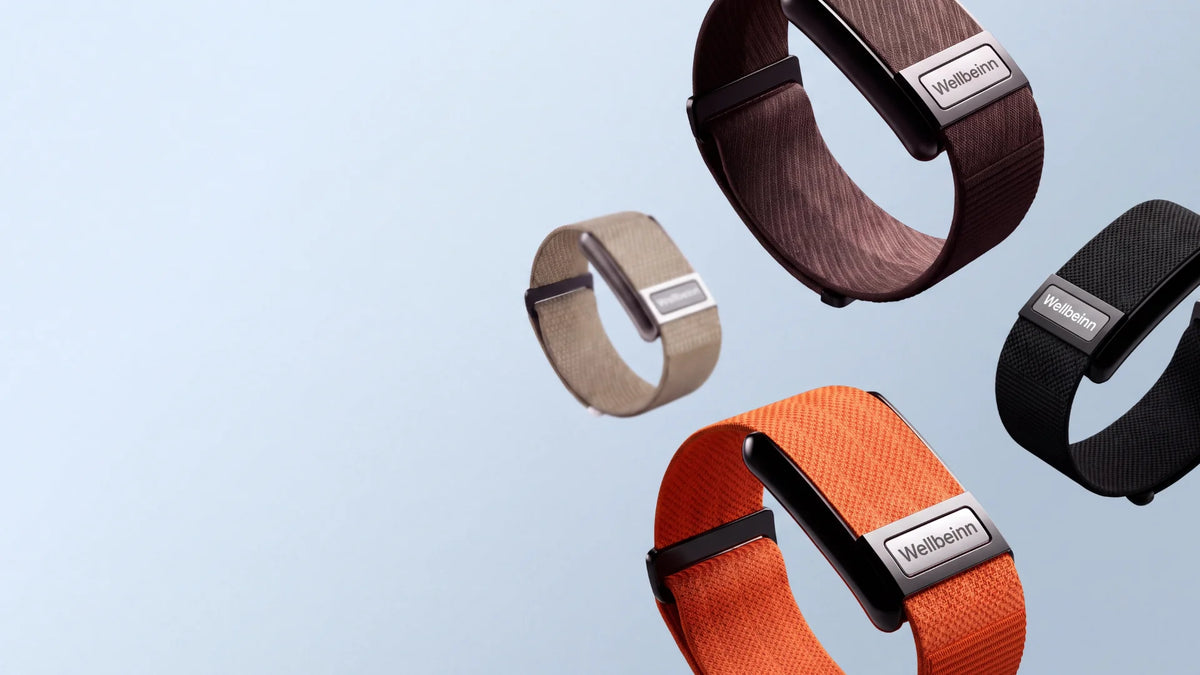
That’s what the Wellbeinn Band does with the Wellbeinn Mate app. While you sleep, work, or exercise, it records your heart rate, sleep, movement, and temperature, and the app translates it into something you understand at a glance.
The first thing you see every morning is your Wellbeinn Score, a number from 0 to 100 that never stays still. It recalculates every ten minutes. It drops when you push yourself, rises during calm moments, and the app breaks down what moved it. The night you had, the meeting that stressed you out, the afternoon workout. A number you can understand, not a number that falls from the sky.
And there is one thing worth knowing from the outset. The app needs a few days to learn what is normal for you. The first figures are indicative and become more precise over time. That is not a defect; it is how any system works when it compares you with yourself rather than with an average.

Wellbeinn Band
Screen-free bracelet that measures sleep, heart rate, heart rate variability, temperature, and activity. Connected to Wellbeinn Mate, free and with no subscriptions. Five profiles and thirteen metrics that you can add, remove, and reorder.
175,00 €
View Wellbeinn BandBut there is more. You can also understand your body composition: the Wellbeinn Balance connects to the same app and gives you ten metrics every time you weigh yourself. Both, together with pressotherapy, are in the measurable health collection.
And if what is failing is your nighttime ritual
No supplement can resolve insomnia. If you have been sleeping poorly for months, the way forward is what we mentioned earlier: talk to a professional. That said, European regulations do recognize two specific things, and it is worth knowing exactly what they are, because the list of authorized claims is considerably shorter than advertisements suggest.
The Night Recovery Pack combines Magnesium Matrix and liquid Melatonin with B6. It supports your nighttime ritual; it is not a sleeping pill or a substitute for fixing your schedule.

Night Recovery Pack
Magnesium Matrix (60 tablets, 30 days) plus liquid Melatonin B6 (50 ml, 50 doses). Melatonin contributes to reducing the time needed to fall asleep with 1 mg shortly before bedtime. Magnesium contributes to the normal functioning of the nervous system.
39,90 €
View the packThe essentials in five lines
Frequently asked questions
What are 5 habits for better sleep?
Ordered by what the evidence really supports. First, regular schedules, especially your wake-up time, including weekends. Second, use the bed only for sleeping, and if you do not fall asleep after a while, get up and do something quiet in dim light until you feel sleepy again. Third, limit caffeine in the afternoon and alcohol at night. Fourth, take a warm shower or bath one or two hours before going to bed. And fifth, move during the day. That said, it is worth knowing that the guidelines of the American Academy of Sleep Medicine expressly recommend not using sleep hygiene as the sole treatment for chronic insomnia. For that, the first-line treatment is cognitive behavioral therapy.
How can I sleep for 8 hours straight without waking up?
Starting from the fact that not everyone needs eight hours and that briefly waking up at night is physiologically normal. The time spent awake after falling asleep increases with age in healthy people. What you can do is get up at the same time every day, avoid staying in bed tossing and turning if you have been unable to fall asleep for a while, do not look at the clock, and reserve the bed for sleeping. If you wake up in the early hours and cannot get back to sleep, get up, go to another room with dim light, and do something quiet until you feel sleepy again. This is called stimulus control and is one of the best-supported techniques.
What can I do to sleep deeply all night?
We’ll be clear: that’s not possible, and it’s not your fault. Deep sleep is concentrated in the first cycles of the night, while REM predominates in the latter part, so the night always alternates between phases. In addition, the percentage of deep sleep naturally decreases with age, and that is not pathological. What does increase sleep pressure and promote more consolidated rest is moving during the day, keeping regular schedules, and not extending your time in bed beyond the time you actually sleep. Chasing the deep-sleep minutes reported by an app usually causes more anxiety than rest.
How do you relax your brain to sleep?
Relaxation techniques in general, including slow breathing and progressive muscle relaxation, have a conditional recommendation from the American Academy of Sleep Medicine as a standalone treatment. They work best if you practice them during the day, calmly, until you master them, rather than only when you're already desperate at three in the morning. There is one specific trick supported by research: writing down the next day's to-do list for five minutes before going to bed. In a polysomnography trial, those who wrote down their pending tasks fell asleep in about 15.8 minutes, compared with 25.1 minutes in the comparison group. That said, it was just one night and involved healthy young adults, not people with insomnia. And regarding the famous 4-7-8 breathing technique, there are no trials specifically validating that count over any other form of slow breathing.
What home remedy is good for sleeping well all night?
The option with the strongest evidence, by quite a margin, is a warm bath or shower before bed. A meta-analysis of 17 studies found that with water between 40 and 42.5 degrees, taken one or two hours before bed and even for just ten minutes, people fell asleep about ten minutes earlier on average. The mechanism is interesting: heat dilates the blood vessels in the hands and feet, the body loses heat through the skin, and this amplifies the natural drop in body temperature that accompanies sleep. That's why timing matters; doing it right before getting into bed leaves little time for this to happen. As for valerian, meta-analyses find, at most, a subjective improvement and have not demonstrated effectiveness using objective measures. Herbal teas are safe rituals for most people, but don't expect them to do what they can't.
What should you take or eat to feel sleepy?
There's quite a bit of myth here. The idea that turkey and milk make you sleepy because of their tryptophan is more complicated than it's often made out to be, because the tryptophan in food competes with other amino acids for the same transport into the brain, and protein-rich foods also provide many of those competitors. Measurable effects in studies have been seen with isolated tryptophan supplements, in amounts you can't reach through eating. There is one study on kiwifruit involving 24 people with no control group, which is far too little to draw any conclusions. And as for tart cherries, a recent meta-analysis found no significant overall effect on sleep quality. What does make sense is not going to bed after a very large or very fatty dinner, especially if you tend to have reflux.
What vitamin are you lacking when you can't sleep?
In the vast majority of cases, none. Framing insomnia as a vitamin deficiency is an oversimplification that may delay you from receiving the treatment that actually works and diverts attention from much more common causes such as stress, anxiety, pain, irregular schedules, or medications. Regarding magnesium, the available review found only three trials involving 151 older people, and its authors themselves conclude that the quality of the literature is inadequate for making well-founded recommendations. Regarding vitamin D, the evidence consists of observational associations, which do not prove causation. There is one exception that does warrant testing: restless legs syndrome, the compelling need to move your legs that worsens at rest and at night. In that case, guidelines recommend checking ferritin levels. If this sounds familiar, make an appointment and discuss it; do not take supplements on your own.
Why does Spain have such a high life expectancy?
The best-documented cause is not the one usually cited. It is the decline in cardiovascular mortality, which between 1980 and 2009 accounted for 63% of the gain in life expectancy among women and 53% among men, according to a demographic decomposition analysis published in the Revista Española de Cardiología. In addition, Spain has one of the lowest rates of avoidable mortality in the European Union, with 124 preventable deaths and 62 treatable deaths per 100,000 inhabitants in 2022, and achieves this with healthcare spending below the European average. There are two other factors that almost nobody mentions but that do matter: the sharp decline in traffic mortality since the late 1980s and the fact that Spanish women took up smoking late. There is no study that apportions this advantage into percentages for diet, healthcare, and climate, so be wary of anyone who gives you such figures.
Does the Mediterranean diet extend life?
It probably helps, but far less than the headlines suggest. The landmark study is the PREDIMED trial, and it is worth knowing that its 2013 publication was retracted in 2018 because of problems with how participants were allocated among the groups, with deviations affecting 1,588 of 7,447 people. It was reanalyzed and republished, and the results essentially held up: around 30% fewer combined cardiovascular events in people at high risk. However, when each outcome is examined separately, the only clear benefit is a reduction in strokes. There was no significant difference in heart attacks, cardiovascular death, or overall mortality. The Cochrane review rates the evidence as low quality for mortality and heart attacks, and moderate quality only for strokes. And there is one detail that clashes with the narrative: 94.6% of Spaniards currently fail to eat the recommended five daily servings of fruit and vegetables.
Why do women live longer but with more limitations?
It has a technical name: the health-survival paradox between the sexes, and Spanish data illustrate it very well. According to an analysis by the BBVA Foundation and Ivie using 2023 data, at age 65, the years lived without disability are practically identical: 10.3 for men and 10.2 for women. The difference lies in the remaining years, because women live 3.9 more years with a disability. The best-supported explanation is that women accumulate more diseases that are limiting but not fatal, while men accumulate more diseases that kill them earlier. Added to this are historically more common risk-taking behaviors among men, such as smoking, alcohol consumption, and accidents, and the fact that women tend to report more limitations and use health services more.
How can you live to be 100?
Honestly, no one can promise you that, and you should be wary of anyone who does. What we do know is what is associated with living longer and better. In a study involving large U.S. cohorts, combining five low-risk factors - not smoking, a healthy weight, at least half an hour of moderate or vigorous activity a day, moderate alcohol consumption, and a high-quality diet - was associated with 14 additional years of life expectancy at age 50 for women and 12.2 for men, compared with those who met none of the criteria. It was an observational study, showing an association rather than causation, and the cohorts consisted mostly of U.S. health professionals. Add social connections to that: in a meta-analysis of 148 studies, they were associated with a 50% greater likelihood of survival, a magnitude comparable to quitting smoking.
How can you live well after the age of 80?
Preserving function, which is different from preserving life. The intervention with the strongest support is exercise. A Cochrane review concludes with high certainty that exercise reduces the rate of falls by 23% among older adults living at home, and that programs combining balance and functional exercises with strength training probably reduce it by 34%. The 2020 WHO guidelines recommend that adults over 65 get between 150 and 300 minutes of moderate activity per week, strength training at least two days a week, and, in addition, multicomponent activity prioritizing balance and strength at least three days a week. One new aspect of these guidelines is that this is recommended for all older adults, not just those who already have reduced mobility. And add social connections, which matter more than people think.
Are health bands reliable for measuring sleep?
It depends on what you measure. For distinguishing whether you are asleep or awake and estimating total sleep time, they work reasonably well. A study comparing seven consumer devices with polysomnography concluded that they performed well at detecting sleep and that most matched or outperformed actigraphy. Where they fall short is in sleep stages, because they estimate them from movement and pulse, not brain activity, which is what actually defines them. So the deep-sleep or REM minutes shown by an app are an approximate estimate. What matters is the trend over several weeks, not the number from one particular night.
Does the Wellbeinn Band diagnose health problems?
No, and it is important to make that clear. It is a wellness device, not a medical product. The metrics it displays, such as sleep, heart rate variability, stress, and temperature, are wellness indicators that help you understand your trends and maintain healthy habits. They do not detect, diagnose, or prevent any disease, and they do not replace an assessment by a healthcare professional. If you have concerning symptoms, such as insomnia lasting more than three months, snoring with pauses in breathing, or fatigue that does not improve, consult your doctor.
Do I need to pay a subscription to use the app?
No. Wellbeinn Mate is free and included with your purchase, with no subscriptions. It is available on the App Store and Google Play, and in addition to the Band, it connects to the Wellbeinn Balance scale and the pressotherapy device, so you can see on the same calendar what you have done each day with each device.
Sources and references (20)
Why does Spain live so long (6)
- García-González JM. Contributions of cardiovascular mortality to life expectancy in the Spanish population from 1980 to 2009. Rev Esp Cardiol. 2013. revespcardiol.org
- OECD, European Observatory on Health Systems and Policies. Country Health Profile 2025, Spain. State of Health in the EU. 2025. eurohealthobservatory.who.int
- Estruch R, Ros E, Salas-Salvadó J, et al. Primary prevention of cardiovascular disease with a Mediterranean diet supplemented with extra-virgin olive oil or nuts. N Engl J Med. 2018;378(25):e34. Republished version following the retraction of the 2013 article. doi.org/10.1056/NEJMoa1800389
- Rees K, Takeda A, Martin N, et al. Mediterranean-style diet for the primary and secondary prevention of cardiovascular disease. Cochrane Database Syst Rev. 2019;(3):CD009825. doi.org/10.1002/14651858.CD009825.pub3
- Trends in smoking-attributable mortality in Spain, 1990-2018. Eur J Public Health. 2022. doi.org/10.1093/eurpub/ckac165
- BBVA Foundation and Ivie. Essentials 07/2025, Life expectancy and quality of life of older people. November 2025. fbbva.es
Official statistics and guidelines from organisations (4)
- Ministry of Health. Life expectancy in Spain, 2024. Madrid, General Secretariat for Digital Health, Information and Innovation of the National Health System, 2026. sanidad.gob.es
- Bull FC, Al-Ansari SS, Biddle S, et al. World Health Organization 2020 guidelines on physical activity and sedentary behaviour. Br J Sports Med. 2020;54(24):1451-1462. doi.org/10.1136/bjsports-2020-102955
- Watson NF, Badr MS, Belenky G, et al. Recommended amount of sleep for a healthy adult, a joint consensus statement of the AASM and Sleep Research Society. Sleep. 2015;38(6):843-844. doi.org/10.5665/sleep.4716
- Commission Regulation (EU) No. 432/2012 of 16 May 2012 on authorised health claims made on foods. boe.es
Clinical guidelines and reviews on sleep (4)
- Edinger JD, Arnedt JT, Bertisch SM, et al. Behavioral and psychological treatments for chronic insomnia disorder in adults, an American Academy of Sleep Medicine clinical practice guideline. J Clin Sleep Med. 2021;17(2):255-262. doi.org/10.5664/jcsm.8986
- Riemann D, Espie CA, Altena E, et al. The European Insomnia Guideline, an update on the diagnosis and treatment of insomnia 2023. J Sleep Res. 2023;32(6):e14035. doi.org/10.1111/jsr.14035
- Haghayegh S, Khoshnevis S, Smolensky MH, Diller KR, Castriotta RJ. Before-bedtime passive body heating by warm shower or bath to improve sleep, a systematic review and meta-analysis. Sleep Med Rev. 2019;46:124-135. doi.org/10.1016/j.smrv.2019.04.008
- Ohayon MM, Carskadon MA, Guilleminault C, Vitiello MV. Meta-analysis of quantitative sleep parameters from childhood to old age in healthy individuals. Sleep. 2004;27(7):1255-1273. doi.org/10.1093/sleep/27.7.1255
Longevity, habits, and aging (3)
- Holt-Lunstad J, Smith TB, Layton JB. Social relationships and mortality risk, a meta-analytic review. PLoS Med. 2010;7(7):e1000316. doi.org/10.1371/journal.pmed.1000316
- Sherrington C, Fairhall NJ, Wallbank GK, et al. Exercise for preventing falls in older people living in the community. Cochrane Database Syst Rev. 2019;1:CD012424. doi.org/10.1002/14651858.CD012424.pub2
- Li Y, Pan A, Wang DD, et al. Impact of healthy lifestyle factors on life expectancies in the US population. Circulation. 2018;138(4):345-355. doi.org/10.1161/CIRCULATIONAHA.117.032047
Devices, data, and their limitations (3)
- Chinoy ED, Cuellar JA, Huwa KE, et al. Performance of seven consumer sleep-tracking devices compared with polysomnography. Sleep. 2021;44(5):zsaa291. doi.org/10.1093/sleep/zsaa291
- Baron KG, Abbott S, Jao N, Manalo N, Mullen R. Orthosomnia, are some patients taking the quantified self too far? J Clin Sleep Med. 2017;13(2):351-354. doi.org/10.5664/jcsm.6472
- Mah J, Pitre T. Oral magnesium supplementation for insomnia in older adults, a systematic review and meta-analysis. BMC Complement Med Ther. 2021;21:125. doi.org/10.1186/s12906-021-03297-z
Redacción y revisión del artículo
Share:
Photobiomodulation: what it is, what it is used for, and what science says
Exoskeleton: what it is, types, and who each one is for