
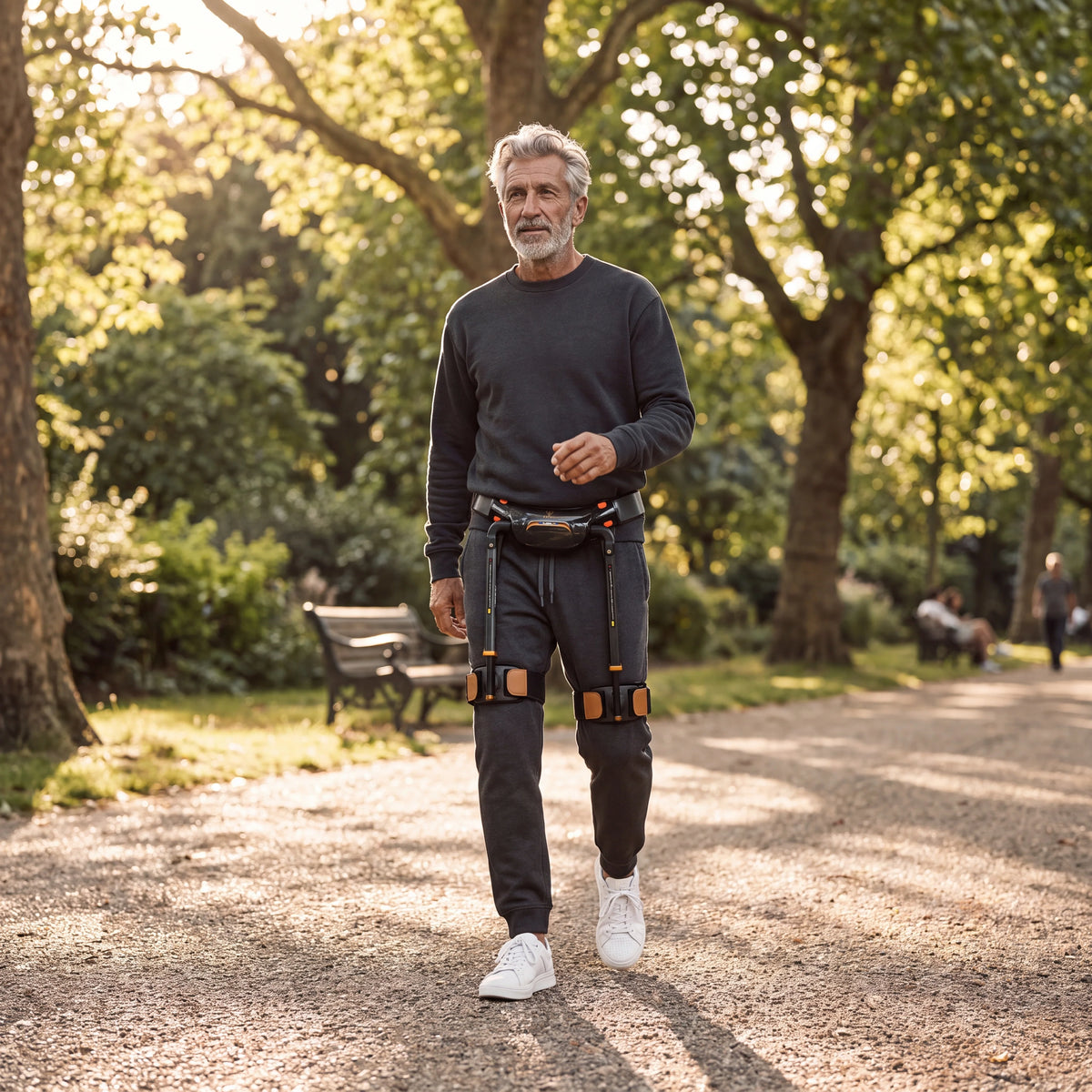


Until recently, saying “exoskeleton” meant talking about science fiction or a beetle’s shell. Today, warehouse workers wear them to avoid wrecking their backs, patients take their first steps again in hospitals, and people in their 70s climb to their usual hilltop shrine while getting less tired. They’re three very different devices with the same name.
Here’s what an exoskeleton is, the three types available, how the hip-worn one works, and, above all, who each one makes sense for. Right below, a five-question quiz tells you which one is right for your situation.
| Type | What it does | Where it is used | Who it is for |
|---|---|---|---|
| Industrial | Takes the strain off the back, shoulders, or legs when carrying heavy loads or working with the arms overhead | Warehouses, factories, construction sites, assembly lines | Workers performing repetitive tasks or working in awkward postures |
| Rehabilitation clinician | Moves or guides the legs (or arm) to retrain movement | Hospitals and rehabilitation centers, under supervision | People with spinal cord injuries, stroke, or other neurological conditions, as part of a program |
| Gait-assist | Provides hip assistance with every step to use less energy and relieve hip and knee strain | Street, home, trails, and mountains | People who can walk but get tired sooner: older adults, hikers, and people in advanced rehabilitation |
Is an exoskeleton right for you?
Five questions. We’ll tell you which type of exoskeleton suits your situation and whether the Wellbeinn one is a good fit.

What is an exoskeleton
An exoskeleton is a structure worn outside the body that accompanies the movement of one or more joints: the hip, knee, back or shoulder. It does not replace your muscles. It takes on part of the work, guides the movement, or both.
The word comes from biology: insects, spiders and crustaceans have their skeleton on the outside, a rigid shell that supports and protects them. The exoskeletons people wear copy the idea, but in reverse: your skeleton remains inside, while the device works outside, secured with straps around the waist, thighs or torso.
They are all divided into two main families according to where the force comes from:
| Passive | Active (robotic) | |
|---|---|---|
| Where the assistance comes from | Springs or elastic materials that store energy and release it | Battery-powered motors controlled by sensors |
| How it decides when to assist | It does not decide: it responds to posture | Detects where you are in the movement and provides force at that moment |
| Weight and maintenance | Usually simpler and does not need charging | Requires a battery; there are very lightweight hip models |
| Where they are common | Industry | Rehabilitation and gait assistance |
Types of exoskeletons
Beyond being passive or active, what truly distinguishes one exoskeleton from another is what they were designed for. A warehouse exoskeleton and a hospital exoskeleton share a name and little else.
Industrial exoskeleton: for work
This is the most widespread type. It is used in logistics, automotive factories, construction and assembly, and almost always has a preventive objective: ensuring that the back, shoulders or knees do not bear all the strain of tasks repeated hundreds of times a day.
- Lower back: they help lift weights and maintain a bent posture. They are the most common.
- Shoulder: they support the arms when working overhead, such as when screwing into a ceiling.
- Leg: they allow you to “sit” while standing or maintain a squatting position for longer.
Workers do not buy them: companies choose them based on the task, as part of their prevention plan. If your problem is ending the workday with tired, heavy legs from standing, an exoskeleton is not what you need; we explain what happens to your legs after standing for five hours in what happens to your legs after five hours of standing.
Medical rehabilitation exoskeleton
These are the ones that make the news: people with spinal cord injuries who stand up and take steps. They usually cover the hips, knees, and sometimes ankles, often with crutches or a harness that supports part of the person’s weight, and are used in hospitals and specialized centers.
Its function is to retrain the gait pattern and keep the person moving, always as part of a program with physiotherapists and rehabilitation physicians. There are also arm and hand versions for use after a stroke. They are not devices to take home and use on your own.
Walking-assistance exoskeleton: for walking
It is the newest type and the one that has taken exoskeletons beyond factories and hospitals. It fits around the waist and thighs, is lightweight, and assists the hips with every step, so walking uses less energy and the hips and knees work under less strain.
It is designed for people who walk but tire sooner than they would like: older people who have gradually lost strength, people who go hiking and want to finish with their legs still fresh, or people in a stage of rehabilitation where they are already walking. This is the category Wellbeinn’s exoskeleton belongs to.
How a hip exoskeleton works
When you walk, the hip is the main engine: it moves the leg forward with each stride and pushes the body forward when the foot is on the ground. A hip exoskeleton adds strength right there.
- Detects. Sensors read the movement of your thighs and recognize which phase of the step you’re in.
- Learns. With the first few steps, the system adjusts to the way you walk: your pace, stride, and asymmetry, if you have any.
- Helps. The motors provide a small boost as you move your leg forward and extend your hip. On descents, some provide damping to help you slow down.
The result isn’t that the device walks for you. It’s that each step costs you a little less, and over an hour-long walk or a mountain ascent, you notice the difference. What it doesn’t do is replace strength you don’t have: if you can’t stand upright, a hip exoskeleton isn’t the right tool.
That is why it makes the most sense with age, when loss of hip strength first becomes noticeable in how difficult walking feels. If you recognize yourself in this, you may also be interested in why your legs feel heavy after age 40.

Who a walking-assistance exoskeleton is for (and who it is not for)
It makes sense if:
- You walk independently but get tired much sooner than you did a few years ago.
- You notice hip or knee pain or overuse during long walks.
- Your walking pattern changed after an injury or neurological condition and you can now walk, even with support, always with the approval of your rehabilitation team.
- You hike, go mountaineering, or jog and want to reduce joint strain, especially on descents.
Talk to a professional first if:
- You have a serious or unstable undiagnosed illness.
- You have been completely unable to walk, even with assistance, in recent months.
- You have wounds, infections, or skin injuries on your hip or thigh, exactly where it is secured.
- You are pregnant or have recently given birth.
Wellbeinn's exoskeleton: the AIR
The Exoesqueleto AIR is a hip-assistance robot designed to improve walking, and it is also suitable for mountaineering, hiking, and jogging. Here is what its specifications say:
| Feature | AIR Exoskeleton |
|---|---|
| Weight | Less than 2 kg |
| Assistance | Up to 10 kg in the π model and up to 15 kg in the π Plus, across 15 levels |
| Adaptation | Smart learning that automatically adjusts to your way of walking |
| Modes | Standard, sports, vertical focus, and mountain, plus resisted training (12 resistance levels) |
| Resistance | IP56, protected against rain and dust |
| Control | With the app or the buttons on the device itself |
| Putting it on | About 30 seconds |
| Before and after purchase | Free assessment by physiotherapists, biomechanical fitting, follow-up, and a 30-day trial |
The resisted training mode deserves a section of its own: instead of helping you, it provides resistance to work the muscle, which is useful when the goal is to build strength rather than simply get less tired. The collection also includes a bigger sibling, the Exoesqueleto 01 Pro, made of carbon fiber (2.4 kg), with a dual 12 Nm motor and designed for walking, climbing stairs, and tackling slopes.

AIR Exoskeleton
Hip assistance for walking with less effort, in everyday life and in the mountains. Less than 2 kg, up to 15 kg of assistance with the π Plus, and a free assessment by physiotherapists before purchase.
View product
What to look for before choosing an exoskeleton for walking
If the test has led you to a gait-assistance exoskeleton, these are the questions that distinguish one you will use from one you will not:
| What to look for | Why it matters |
|---|---|
| Weight | You carry every gram. The lighter it is, the more hours you will wear it without noticing. |
| Assistance level and whether it is adjustable | A flat walk is not the same as a hill, nor is a 60 kg person the same as a 95 kg person. |
| Whether it adapts to your gait | A system that assists out of sync tires you more than it relieves you. |
| Modes | Flat ground, mountains, or training: the more real-world uses it covers, the more you will benefit from it. |
| Water and dust resistance | If you go out into the countryside, rain will come. Check the IP code. |
| Battery life | Always ask about it and compare it with the number of hours you would use it. |
| Assessment and trial | Have someone with healthcare training assess your situation, and make sure you can try it in your real life before keeping it. |
We will discuss the price separately, because it varies widely between types. What is worth knowing is that an exoskeleton should not be judged by its specifications: it should be judged after walking with it for a month.
Frequently asked questions
It is a structure worn outside the body that helps move one or more joints. Depending on the type, it serves three different purposes: protecting the back and shoulders at work, retraining gait in rehabilitation, or walking with less effort in everyday life.
Based on their use, there are three types: industrial, medical rehabilitation, and gait assistance. Based on how they work, there are two: passive, which use springs, and active or robotic, which have motors, sensors, and a battery.
Rehabilitation exoskeletons are used to help people with spinal cord injuries or other neurological disorders stand up and train their gait, always in a center and under supervision. A personal-use hip exoskeleton is something else: it helps people who already walk do so with less effort.
Yes, and it is one of the profiles for which a hip exoskeleton makes the most sense: people who walk but tire sooner or notice strain in the hip or knee. It is advisable for a physiotherapist to assess the case beforehand, especially if there are other conditions or a risk of falls.
The passive one has no motor: it stores energy in springs and returns it depending on the posture. The active one has motors, a battery, and sensors that detect movement and provide force at just the right moment. Industrial models are usually passive; rehabilitation and walking-assistance models are active.
It depends greatly on the type. Full-body rehabilitation models are large devices that are used with assistance. Hip exoskeletons for walking are much lighter: the AIR Exoskeleton weighs less than 2 kg and the 01 Pro weighs 2.4 kg.
Yes, hip models are also designed for that. They help you climb with less effort and, in some models, cushion the impact on the way down, which is where the knees suffer the most. For mountain use, make sure it has a specific mode and protection against water and dust.
Rehabilitation exoskeletons are mainly used inside hospitals and centers, public or private, as part of a treatment. A personal-use exoskeleton, today, is normally paid for by the user. If you are undergoing rehabilitation, ask your provider whether they work with them.
It depends on the model. The AIR Exoskeleton works with or without an app: you can control it using the physical buttons on the device itself.
In summary
Exoskeleton is a word for three types of devices: the industrial one protects the worker, the rehabilitation one helps people walk again inside a hospital, and the walking-assistance one makes each step less demanding for people who already walk. Knowing which one you are looking at is almost the entire decision.
If you are in the third group, take a look at the AIR Exoskeleton and request the free assessment before deciding. And if what you are looking for is better recovery after long outings, you can find ideas in muscle recovery.
It doesn't walk for you. It walks with you.
Redacción y revisión del artículo
Share:
How to live longer and age better: sleep, recovery, and data
Do you sleep as little as you think? What science says about your perception of sleep