
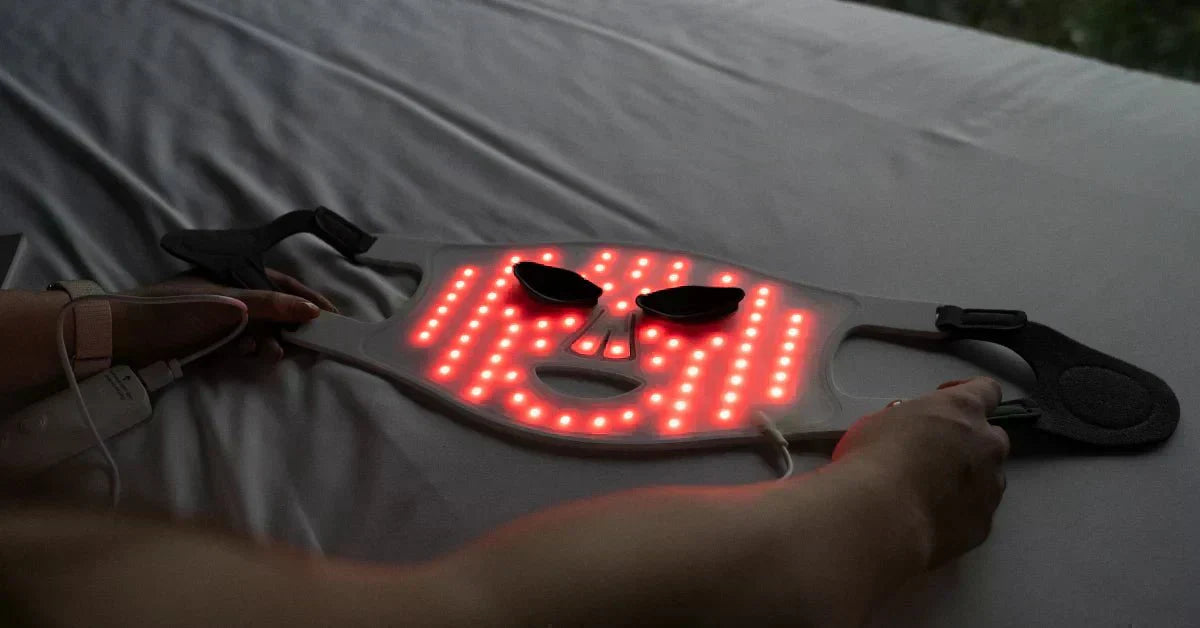


Let’s admit it. The first time you saw a red light mask on Instagram or TikTok, you probably thought two things. First: "It looks like a robot costume from a sci-fi movie". And second, and more importantly: "Does this really work or is it just another passing trend?".
The beauty industry has bombarded us with miracle diets, patches, and creams with secret ingredients that promise to restore your youth in no time. But here’s a key difference. Red light therapy is not an influencer trend. It’s science backed by decades of studies.
Today at Wellbeinn we’re going to explain why your facial care routine falls short if you only use cosmetics, and why a LED facial mask could be the best investment you make for your cellular health in 2026. Let’s get to it.
📑 What you will see in this article:
The problem with using only creams
Imagine you are very thirsty, but instead of drinking a glass of water, you pour the water on your face. It refreshes you, yes, but it doesn’t hydrate you from the inside.
The same thing happens with skincare. Most serums and moisturizers act on the epidermis (the outermost layer). They are great for protecting the skin barrier, but it’s very difficult for them to reach the deep dermis, where collagen and elastin are found.
This is where red light comes into play. Unlike creams, red light has the ability to penetrate through the layers of the skin without damaging it. It’s not magic, it’s physics. Depending on the wavelength, the light reaches one depth or another, stimulating the cells from within.
How does the red light mask work?
To understand why you need a red light mask, think about how plants use sunlight to grow. They transform light into energy. Your cells do something similar.
They have small "batteries" called mitochondria. With stress, lack of sleep, age, and pollution, those batteries run down and your cells start working slower. Result: duller skin, less firmness, and the appearance of fine lines. Our red light mask acts like a charger for those batteries.
When applying specific wavelengths (and this is important: not just any red light, for example from a Christmas bulb), your cells absorb that energy and start producing more ATP (cellular energy). Suddenly, your skin has more "fuel" to repair itself, produce collagen, and reduce inflammation.
Not all red light penetrates your skin
If you’re going to take one technical fact from this article, let it be this. For an LED mask to be effective, it must combine two very specific types of light:
- Red light (633nm): Acts on the surface and middle layers. It improves tone, reduces inflammation, and gives that "glow" effect or luminosity.
- Infrared light (830nm): This is invisible to the human eye but the most powerful. It penetrates deeply into the dermis and subcutaneous tissue. It’s responsible for waking up fibroblasts to produce collagen and elastin, tightening the skin from the foundation.
Our red light mask combines both types of red light in each session. Without this combination, you’re only doing half the job.
Is a silicone mask or a plastic one better?
Here we reach the critical point. If you search for face masks online, you’ll see rigid plastic options that look like hockey masks. They are cheaper, yes, but they have a serious design flaw. The distance. The farther the red light is from the skin, the less power it has.
A plastic LED facial mask only touches your skin on the forehead and chin. On the rest of the face, the light stays several centimeters away. That means you’re losing much of the therapeutic energy before it reaches your skin. That’s why at Wellbeinn we rely on flexible medical-grade silicone.
Our red light mask fits your face like a second skin. Being in direct contact (stuck to your face) ensures that the dose of light your cells receive is maximum and even. Plus, it’s infinitely more comfortable. You can lie down, sit reading, or watch a show without feeling a rigid weight crushing your nose.

“Red light doesn’t cover imperfections; it penetrates to awaken your cells so they can start producing collagen on their own.”
Caetano — WellbeinnWho is this mask ideal for?
We often think these devices are only for treating deep wrinkles. WRONG. Red light therapy is a health tool, not just an aesthetic one.
- For the "Biohacker": If you care about your diet and sleep, taking care of your body’s largest organ (the skin) is the next step. Red light reduces oxidative stress in cells.
- For stressed skin: If your face looks tired, with redness or inflammatory breakouts, red light is a powerful natural anti-inflammatory.
- Prevention (from ages 25-30): We start losing collagen long before the first wrinkle appears.
15 minutes is all you need to transform your well-being
We live against the clock. And let's be honest. Sometimes taking care of yourself feels more like a chore on an endless list. This is where our red light mask comes in. It’s 100% wireless, doesn’t stain or drip, and doesn’t hurt. You only need 15 minutes to use it.
Make it your sacred daily pause. A few minutes where you not only improve your skin on the outside but also recharge your cells from within. Your best ally against aging is at Wellbeinn.
Redacción y revisión del artículo
Share:
Cold and hot knee brace, your best ally against knee pain
Cold Plunge: How to Recover Professionally Without Leaving Home