


It's eight in the evening, you take off your socks, and there it is: the mark. A pink groove around your ankle that wasn't there in the morning. Your legs feel heavy, your shoe feels tighter than it did first thing, and all you want to do is lie down and put your legs up against the wall.
Pressotherapy has become the trendy answer to that situation. And it works, but not for the reason many people think. It doesn't «burn» anything, it doesn't make you lose weight, and it doesn't cure a diseased vein. What it does is push fluid: move upward what gravity and several hours of standing have left down below. This article is about that: what exactly happens to your leg inside the boot, who really benefits from it, and who won't have their problem solved by it.
| Why your legs swell | What pressotherapy can do |
|---|---|
| Many hours standing or sitting | A lot. It's the ideal scenario for it: it does the work your muscle pump hasn't been doing |
| Heat and vasodilation | A lot. Immediate relief from heaviness in summer |
| Occasional fluid retention | Quite a lot. Reduces circumference and the feeling of tightness |
| Training load | Quite a lot. Less heaviness the next day |
| Localized fat | Nothing. It isn't a treatment for losing fat |
What can it do for your legs?
Tell us what your legs are like and we'll tell you what to expect.
 Measurable health · Compression therapy
Clinic-grade compression therapy, at home and cable-free
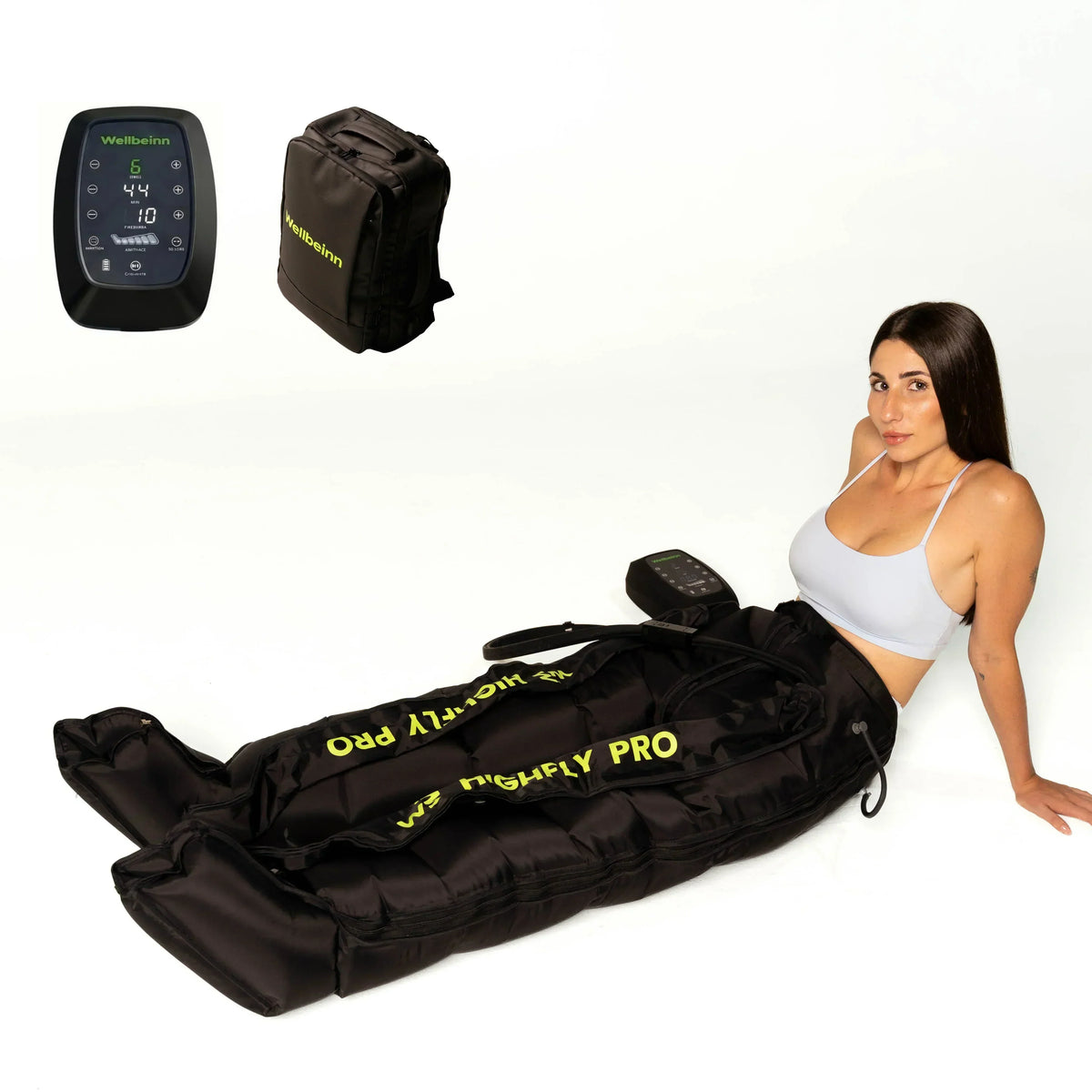
Trousers with six chambers that compress in sequence from foot to hip, including glutes and lower back.
6 chambers · pressure adjustable from 0 to 200 mmHg · 5 programmes: circulation, sport and mixed
View the HighFly Pro Max€675,00
Measurable health · Compression therapy
Clinic-grade compression therapy, at home and cable-free
Trousers with six chambers that compress in sequence from foot to hip, including glutes and lower back.
6 chambers · pressure adjustable from 0 to 200 mmHg · 5 programmes: circulation, sport and mixed
View the HighFly Pro Max€675,00
What pressure really does to your leg
Your leg has a design problem: blood flows down on its own, but to get back up it has to overcome a full meter of gravity. It relies on two aids for that.
The first is the muscle pump. Every time you contract your calf, that muscle compresses the deep veins and squeezes the blood upward, like squeezing a tube of toothpaste. Valves inside the vein prevent it from flowing back down. The second is the lymphatic system, a parallel network that collects fluid leaking from the capillaries into the tissues and returns it to the circulation. The lymphatic system has no heart of its own: it moves with movement.
Now think about an eight-hour day standing behind a counter, or sitting in a chair and barely getting up. The muscle pump is hardly activated. Lymphatic drainage becomes sluggish. And the fluid stays where gravity leaves it: in the ankle, calf, and instep.
Pressotherapy fits the bill precisely. The air chambers inflate sequentially, from the foot up to the hip, replicating what your own muscles would do if you were walking. They push the fluid in the only direction the valves allow it to flow. It is not magic: it is plumbing.
Who it really helps
This is where it helps to be specific, because not all swollen legs are the same.
You work many hours standing or sitting
This is the profile that benefits the most. Hairdressing, hospitality, operating rooms, retail—or the exact opposite: twelve hours in an office chair. Your problem is not a disease; it is inactivity. Your leg works properly—you simply have not given it a chance to pump. Twenty minutes of pressotherapy when you get home does the work your calf muscles did not do during the day.
A sign that this is your case: you wake up with normal-looking legs in the morning, and the problem appears from midday onward.
It gets worse in summer
Heat dilates the blood vessels and encourages more fluid to leak into the tissue. That is why many people who notice nothing in winter barely recognize their ankles in July. Here, pressotherapy provides highly welcome, immediate relief, especially if you finish the session with cool legs. We explore this in why your legs hurt more in summer.
You retain fluid and notice it in episodes
Hormonal changes, a day of salty food, a long flight, heat, and too little movement. Occasional fluid retention responds well: even a single session usually reduces the feeling of tightness, and you can measure the change around the ankle with a tape measure. If you want to explore the mechanism in more depth, see swollen legs and fluid retention.
You work out and wake up feeling sore the next day
After a hard leg workout or a long run, the muscle accumulates inflammatory fluid and your leg feels «full». Pressotherapy reduces that heaviness and leaves you feeling looser for your next session. Note: it improves how you feel, which is no small thing, but it does not replace sleeping and eating well.
You have a diagnosed vein condition
Then this is a medical matter. Before you start, ask your specialist for approval and follow their advice.
Who it won’t solve the problem for
This is the part people talk about less, and it is what prevents disappointing purchases.
If what you want is to lose fat, pressotherapy is not the right tool. It may slim your contours while the effect lasts because it moves fluid, and the difference is visible even in a photo. But the fatty tissue remains exactly where it was.
If you wake up with swollen legs, with the same volume as when you went to bed, that does not fit with postural fluid retention. There may be an underlying issue—thyroid, kidney, heart, medication—and you need a medical consultation before making a purchase.
If the swelling is in only one leg and appeared suddenly, accompanied by pain, warmth, or redness, do not use pressotherapy. See a doctor. It could be a thrombosis, and applying compression over a blood clot is exactly what you should not do.
How much pressure you need depending on your situation
Pressure is measured in mmHg (millimeters of mercury), the same unit used for blood pressure. More is not better: excessive pressure does not drain fluid faster; it only causes discomfort and can collapse the superficial vessels you are specifically trying to empty.
| Goal | Recommended pressure | Duration |
|---|---|---|
| Gentle drainage and fluid retention | 30–60 mmHg | 20-30 min |
| Tired legs at the end of the day | 60–90 mmHg | 20 min |
| Sports recovery | 80–120 mmHg | 15-20 min |
| First sessions (adaptation) | Start at the lowest level | 10-15 min |
The practical benchmark: it should feel comfortable. A firm hug, not a tourniquet. If your leg is marked or numb afterward, you’ve gone too high.

HighFly Pro — Pressotherapy Boots
Six sequential chambers from the foot to the hip and adjustable pressure up to 260 mmHg, letting you move from gentle drainage to sports recovery with the same equipment. No cables and more than three hours of battery life.
View productHow far each format reaches
If fluid only builds up from the knee downward, a classic boot will be enough. But many people discover too late that their swelling extends higher and that the equipment doesn’t cover enough.
| Format | How far it covers | Who it’s for |
|---|---|---|
| Leg boot | Foot, calf, and thigh | Ankle and calf swelling, sports recovery |
| Boot with a hip extender | Add the pelvic girdle | Fluid retention that extends above the thigh |
| Full-length pants | Add the buttocks and lower back | Cellulite, generalized fluid retention |
The difference matters because drainage is a chain: fluid from the thigh has to pass through the groin to keep moving upward. If that area isn’t treated, you’re pushing fluid against a bottleneck. That’s why we insist so much on treating the hips and buttocks.
How to tell whether it’s working
Sensation can be deceptive. After twenty minutes with your legs elevated and pleasant compression, anyone would think they had improved. To know for sure, measure.
- Choose a fixed point. The ankle, just above the bone, or the widest part of the calf. Mark the height with a reference finger and always use the same point.
- Measure at the same time. Ideally, when you get home, before the session, when your leg is at its worst point of the day.
- Take notes. Circumference in centimeters, the date, and how you feel it on a scale of 1 to 10.
- Compare after three weeks, not the next day.
A change of half a centimeter to one centimeter in ankle circumference is a real and common result. If someone promises you five, they’re selling you snake oil.
The five mistakes people make most often
Set the pressure to maximum from day one. Your body needs time to adjust. Start low and increase it when needed.
Use it only when you’re already feeling awful. It works much better as part of a routine than as a rescue measure. Three or four sessions spread out are more effective than a one-hour marathon on Sunday.
Using it right after eating. If the equipment covers your abdomen, wait a couple of hours. You will be more comfortable.
Half-sitting. Lying down or elevating your legs lets gravity work in your favor. Sitting on the sofa with your feet on the floor works against you.
Expecting it to replace movement. Pressotherapy imitates the muscle pump. Walking activates it for real—and it is free.
A sustainable routine
The best routine is the one you follow. This one is realistic for a leg that swells during the day:
- When: when you get home or before dinner, while your leg still feels heavy.
- How long: 20 minutes.
- How often: 3 to 5 days a week.
- How: lying down, with your feet slightly above your heart.
- Afterward: drink water and avoid standing still for the following hour.
If you want to fine-tune the frequency for your situation, we explain it in more detail in how many sessions per week you need to notice changes.
Frequently asked questions
No. It reduces the volume caused by retained fluid, which shows in your measurements and in how your trousers fit, but it does not eliminate fat. When someone sees a slimmer leg after a session, what they have lost is water, not fatty tissue.
Relief from heaviness usually appears during the first session, especially if your leg feels very heavy when you start. A measurable, sustained change—such as your ankle not swelling as much in the afternoon—requires two to four weeks of consistency.
If you have varicose veins, previous phlebitis, or a history of thrombosis, talk to your doctor first. It is not an automatic no, but it is not a decision you should make on your own either.
In the evening, when your leg has accumulated the effects of the day. If you use it to recover from a workout, do so in the hour or two following the session. In the morning, when your leg is rested, there is little to drain.
It is a situation in which leg swelling is common and bothersome, but also one in which it is best not to improvise. Consult your midwife or gynecologist before using it: they will tell you whether it is appropriate in your specific case and at what pressure.
For drainage and tired legs, 30 to 90 mmHg is more than enough. For sports recovery, you can increase it to 80–120 mmHg. The reference isn’t the number; it’s how it feels: firm and comfortable. If it feels uncomfortable or leaves your leg numb, reduce the pressure.
Yes, a daily 20-minute session at moderate pressure is perfectly manageable, and that’s what many people who work standing up do. What adds no value is chaining together very long sessions: the lymphatic system has its own pace and can’t be sped up by simply insisting.
No. Manual lymphatic drainage is a technique performed by a physiotherapist with their hands; it is very superficial and highly specific. Pressotherapy uses sequential mechanical compression. They share the same goal, but they aren’t interchangeable: the machine offers consistency and lower cost, while hands offer greater precision.
Asymmetrical swelling, especially if it appears suddenly and comes with pain or heat, warrants medical advice before anything else. Postural fluid retention is usually fairly symmetrical. A difference between one leg and the other is a sign that shouldn’t be ignored.
Not at the same time—they get in each other’s way. They’re complementary strategies for different moments: compression stockings work while you’re standing and prevent fluid from accumulating; pressotherapy works while you’re lying down and moves what has already accumulated.
In summary
Pressotherapy for the legs does one very specific thing, and it does it well: moving fluid in the right direction when your day hasn’t given your leg the chance to do it on its own. If your swelling comes from staying still, heat, or training load, it’s an honest and highly effective tool. If it comes from something else, the useful thing is to find out what.
Start gently, measure with a tape measure instead of relying on how it feels, and treat it as a routine, not a rescue. If you want to see how it fits into everyday life, you’ll find the step-by-step guide in at-home pressotherapy, and the reasoning behind drainage in what lymphatic drainage is.
There’s no miracle. There’s well-directed pressure and consistency.
Redacción y revisión del artículo
Share:
Protein for gaining muscle mass: how much and how
Sports recovery: the method used by a world champion
1 comment
Las botas me quedan algo grandes y no sé como colocarlas correctamente.
Si las coloco bien en el pié, me qedán arrugadas en la ingle y si las colico bien en las caderas, el pie queda a medias entre la cámara uno y dos.
Algún consejo?