
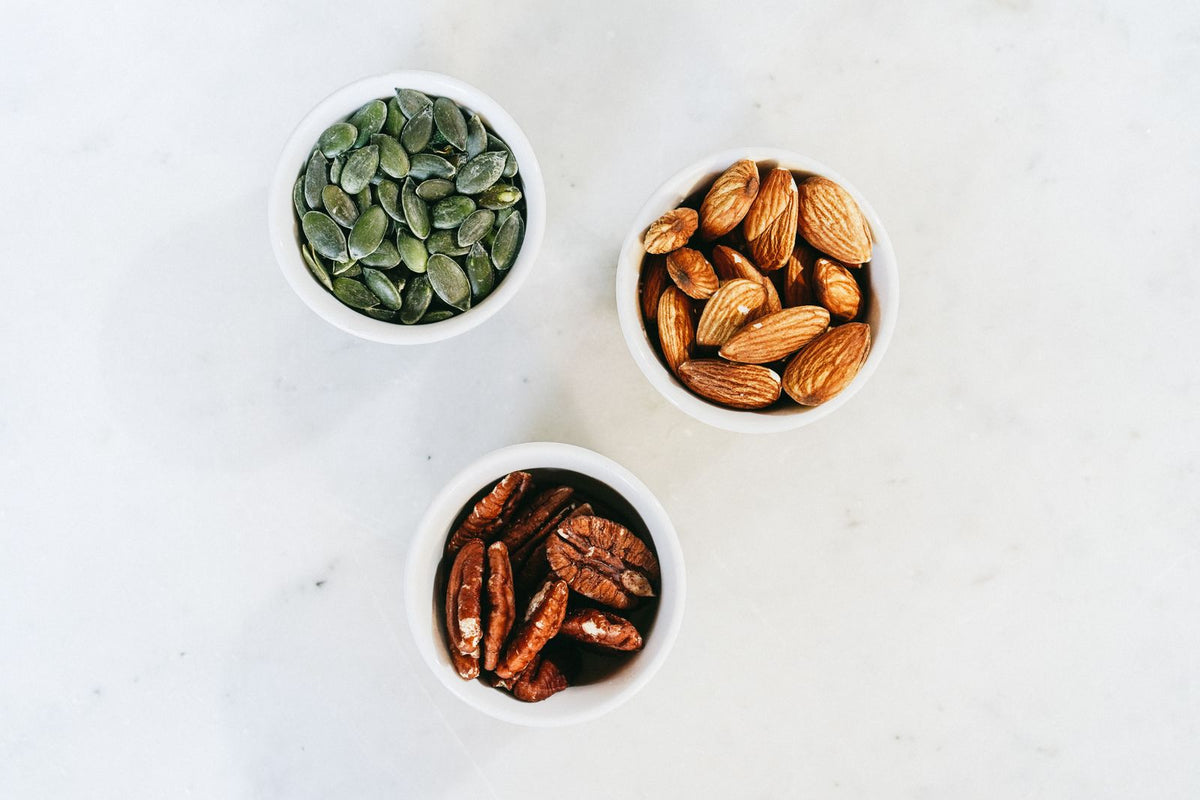


You look for foods that contain magnesium and every list says the same thing: pumpkin seeds have more than 500 mg per 100 grams. True. The problem is that no one eats 100 grams of pumpkin seeds, and that figure leaves you just as you were: not knowing whether what you eat every day gives you enough or not.
Here we calculate it differently: milligrams per actual serving, the amount you put on your plate or carry in your pocket. With that, plus the amount you need based on your sex and age, you can find out in two minutes whether your diet provides enough magnesium or you’re falling short, and what you would change first.
| Food | Actual serving | Approx. magnesium |
|---|---|---|
| Shelled pumpkin seeds | 30 g, one handful | ≈150 mg |
| Cooked spinach or chard | 180 g, one plate | ≈140 mg |
| Cooked beans | 180 g, one plate | ≈110 mg |
| Almonds or cashews | 30 g, one handful | ≈80 mg |
| Quinoa or brown rice | 150 g cooked | ≈65-95 mg |
| Cooked chickpeas or lentils | 180 g, one plate | ≈65-85 mg |
| Rolled oats | 40 g, one bowl | ≈55 mg |
| Dark chocolate (70% or more) | 20 g, two squares | ≈45 mg |
Do you get enough magnesium from what you eat?
Select what you eat on a normal day and how many servings. We’ll tell you the mg and whether you reach what you need.
Servings on a normal day
 New · Measurable health
If you want to know how you sleep, measure it
The Wellbeinn Band tracks your sleep hour by hour, your heart rate variability and your recovery. Put it on and forget about it.
ECG on your wrist · HR, HRV, SpO₂ and temperature · 10-day battery · no subscription
Discover the Band€175,00
How much magnesium you need per day
Before looking at foods, here’s the amount you need to reach. The European reference for adults is 350 mg per day for men and 300 mg for women, including during pregnancy and breastfeeding. It is slightly lower for teenagers.
| Who | Magnesium per day |
|---|---|
| Adult man | 350 mg |
| Adult woman | 300 mg |
| Boys aged 14 to 17 | 300 mg |
| Girls aged 14 to 17 | 250 mg |
| Pregnancy and breastfeeding | 300 mg |
You’ll see another figure on labels: 375 mg. This is the reference value used to calculate package percentages, a single figure for everyone. To find out whether your diet provides enough, use the figure for your sex and age.
If you want to know exactly what magnesium does in your muscles, nerves, and rest, it’s explained in what magnesium is for. Here we’ll focus on the practical question: where to find it.

Magnesium-rich foods per typical serving
Tables per 100 grams are useful for comparing foods with one another, but they can be misleading when you're planning meals. One hundred grams of seeds is three handfuls; one hundred grams of cooked spinach is half a plate. That is why each food here is listed with the amount people actually eat. The figures are rounded average values: the variety, the soil where it was grown, and cooking can move the number up or down.
Nuts and seeds
They are the most nutrient-dense group: lots of magnesium in very little volume. A handful a day already makes a difference.
| Food | Serving | Magnesium |
|---|---|---|
| Shelled pumpkin seeds | 30 g | ≈150 mg |
| Shelled sunflower seeds | 30 g | ≈100 mg |
| Almonds | 30 g (about 22) | ≈80 mg |
| Cashews | 30 g | ≈80 mg |
| Chia seeds | 15 g, one tablespoon | ≈50 mg |
| Peanuts | 30 g | ≈50 mg |
| Walnuts | 30 g (about 6) | ≈45 mg |
Legumes and whole grains
They provide less per gram, but are eaten in larger quantities, making them the real foundation of magnesium in a Mediterranean diet.
| Food | Serving | Magnesium |
|---|---|---|
| Cooked soybeans or edamame | 150 g | ≈90-130 mg |
| Cooked white or pinto beans | 180 g | ≈110 mg |
| Cooked quinoa | 150 g | ≈95 mg |
| Cooked chickpeas | 180 g | ≈85 mg |
| Cooked brown rice | 150 g | ≈65 mg |
| Cooked lentils | 180 g | ≈65 mg |
| Rolled oats | 40 g | ≈55 mg |
| Whole-grain bread | 60 g, two slices | ≈45 mg |
Vegetables, fruit, and others
| Food | Serving | Magnesium |
|---|---|---|
| Cooked spinach | 180 g | ≈140 mg |
| Cooked Swiss chard | 180 g | ≈140 mg |
| Dark chocolate (70-85 %) | 20 g | ≈45 mg |
| Boiled potato with skin | 200 g | ≈45 mg |
| Salmon, sardines, or mackerel | 125 g | ≈35-90 mg |
| Banana | one medium | ≈30 mg |
| Avocado | half | ≈30 mg |
| Milk | one 250 ml glass | ≈25 mg |
| Plain yogurt | 125 g | ≈15 mg |

A day of ordinary meals that meets the magnesium target
The theory is fine, but what matters is whether an ordinary day meets the target. This menu has nothing unusual and easily exceeds 350 mg:
| Time | What you eat | Magnesium |
|---|---|---|
| Breakfast | A bowl of oats with milk and a banana | ≈110 mg |
| Mid-morning snack | A handful of almonds | ≈80 mg |
| Lunch | Chickpeas with spinach | ≈145 mg |
| Snack | Two squares of dark chocolate | ≈45 mg |
| Dinner | Sardines with two slices of whole-grain bread | ≈85 mg |
| Total | ≈465 mg |
Now for the kind of day many people follow without realizing it: white-bread toast with coffee and milk, a mid-morning sandwich, macaroni, steak with fries, and a yogurt. Enough food, but it comes to around 200 mg. The difference is not eating more, but where the refined flour is and where legumes, leafy greens, and nuts are missing.
What makes you get less magnesium from food
Not all the magnesium you eat reaches the bloodstream. Normally, around one third is absorbed, and some things reduce that proportion or increase what you lose:
- Refining. When wheat or rice is milled, the bran is removed, and with it most of the magnesium. This is the main reason modern diets fall short.
- Cooking in lots of water. Magnesium is soluble, and some of it remains in the cooking liquid. You lose less when steaming, sautéing, or using the cooking liquid.
- Phytates and oxalates. Legumes, whole grains, and spinach contain compounds that retain some of the mineral. Soaking legumes and combining foods offsets this; it is not a reason to stop eating them.
- Alcohol and excess coffee. They increase what is eliminated through urine.
- Some medications. Certain stomach-protecting medications taken for a long time and some diuretics encourage levels to drop. If you take them continuously, discuss it with your doctor.
- Sweat. Anyone who trains a lot or works in the heat loses somewhat more. If that is your case, take it into account when doing the math.

What about water? The magnesium you drink
It is rarely taken into account, but water also contributes. Tap water varies greatly depending on the area and usually contains little. Some mineral waters, on the other hand, contain more than 50 mg per liter, the threshold above which the label can say that the water «contains magnesium», and a few exceed 100.
With a liter and a half a day of one of these waters, you add between 75 and 150 mg without changing anything else. To find out, just check the composition on the bottle's label: it appears as Mg or magnesium, in mg/L.
When food isn't enough
With a varied diet, most people can get enough. But there are situations when it is difficult: very calorie-restricted diets, extensive training or heavy sweating, little time to cook, digestive issues that require avoiding legumes or fiber, or age, because absorption worsens after a certain point.
In these cases, a supplement fills the gap. If you are considering one, two things matter more than the brand: the salt, because not all forms are absorbed or tolerated equally (we compare them in types of magnesium), and the actual magnesium dose, not that of the entire compound. How to read a label without being misled is explained in the best magnesium on the market.

Magnesio Matrix — Four magnesium salts
Citrate, bisglycinate, malate, and taurate: 375 mg of magnesium in two tablets. For when food falls short. Suitable for vegans, gluten-free, and lactose-free.
View productFrequently asked questions
Per 100 grams, pumpkin seeds, pure cocoa, and wheat bran. Per typical serving, pumpkin seeds (about 150 mg in a handful) and a plate of cooked spinach or chard (about 140 mg). Legumes provide less per gram, but because they are eaten as a full serving, they add up to a lot.
No fresh fruit is a major source. Bananas and avocados contain around 30 mg per whole or half piece, and a handful of dried figs provides a similar amount. They help you add to your intake, but most magnesium comes from nuts, seeds, legumes, whole grains, and leafy vegetables.
It has that reputation, but a medium banana provides about 30 mg, around 10% of what you need. It is richer in potassium than in magnesium. It is fine as part of your daily intake, but not as a solution.
Yes, with a diet that includes legumes, whole grains, leafy vegetables, and a handful of nuts each day. The difficult part is not the amount, but that many real-world diets rely on refined flours and include few legumes. The calculator above tells you where you stand.
Yes, and the more cocoa, the more. Two ounces of chocolate with 70% cocoa or more provide about 45 mg. It is a good complement, although it comes with sugar and fat, so it is better as part of your daily intake than as a strategy for reaching your target.
Oxalates bind some of the magnesium in spinach, so you absorb less than the table indicates. Even so, spinach still contributes, and Swiss chard or a variety of leafy vegetables spreads the risk more evenly. Steaming or sautéing them results in less mineral loss than boiling them in a lot of water.
Moderate consumption, two or three cups of coffee a day, is not a problem with a diet that provides enough. In high amounts, it slightly increases what is eliminated in the urine, just like alcohol. If you drink a lot of coffee and also eat few foods from the groups on this list, then it works against you.
With healthy kidneys, no: any excess from food is eliminated in the urine. Excess occurs with high-dose supplements, and the first warning comes from the intestines. You can find all the details in magnesium side effects.
Typical symptoms, such as cramps, tiredness, or a twitching eyelid, are very nonspecific and have many other causes. The way to find out is through a blood test, and even then, blood magnesium does not always reflect what is in the body. If you suspect you are deficient, discuss it with your doctor before taking supplements blindly.
In summary
Foods rich in magnesium are neither rare nor expensive: seeds and nuts, legumes, whole grains, and leafy vegetables. With one serving from each group during the day, most people reach their 300 or 350 mg without thinking about it. The problem is usually what has been refined along the way, not what is missing at the supermarket.
Use the calculator to do the math and first change what adds up the most. If you still fall short, then a supplement makes sense, choosing the right salt and dose: start with the types of magnesium and take a look at Magnesio Matrix if you want several salts in a single tablet.
There is no miracle food. There are servings that add up.
Redacción y revisión del artículo
Share:
Pressotherapy before and after: what results are real?
Why do your legs feel heavy after the age of 40?