
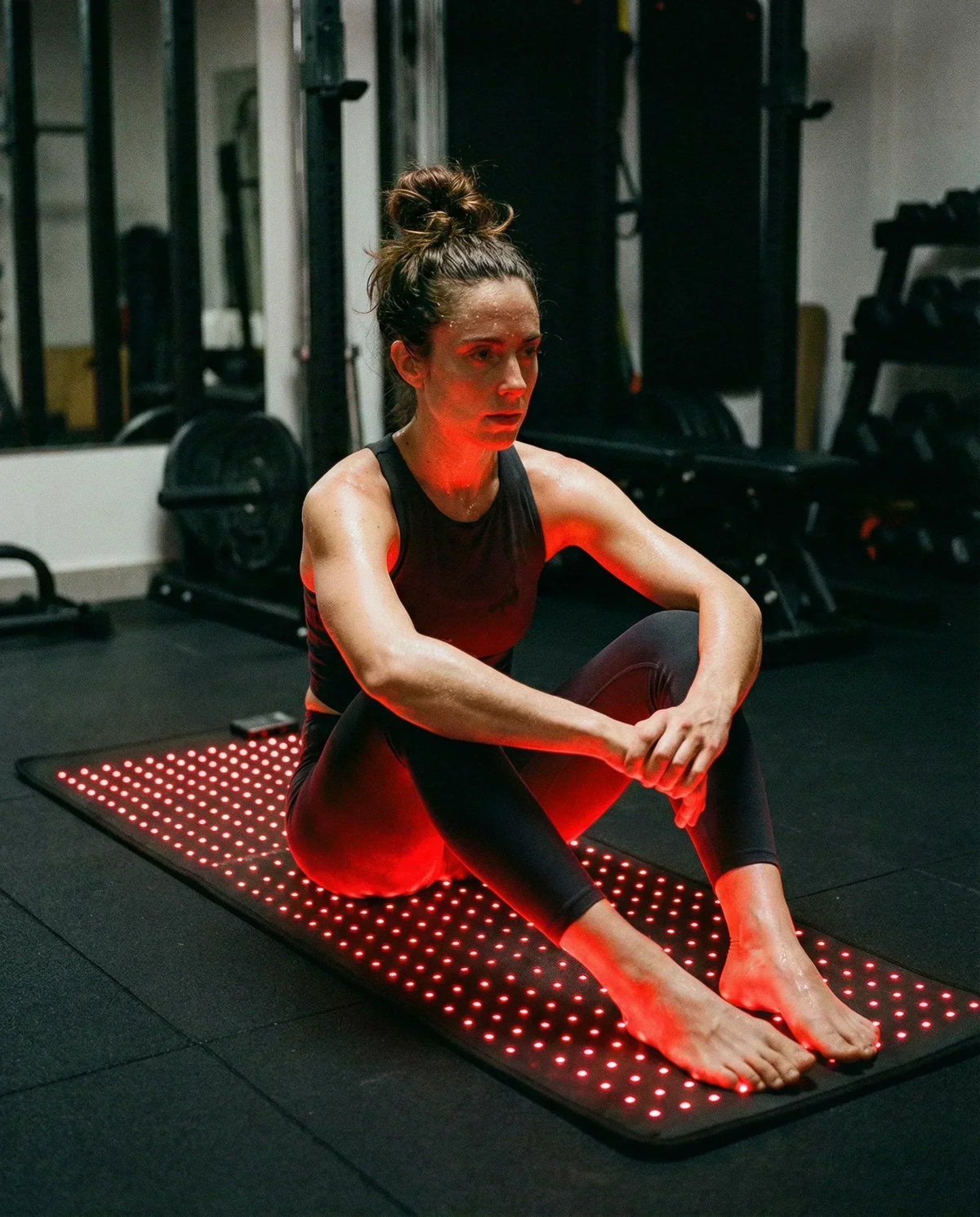


You train hard and know progress isn’t just in the session, but in how you recover from it. The week when your legs from Monday weigh you down on Thursday is a lost week. Among the recovery tools that have moved from clinics to home, red light is one of the loudest and, at the same time, one of the most misunderstood.
Here we get to what matters to the athlete: what red light really does for your muscle, what the evidence says about soreness and performance, when to use it (before or after training), and how to fit it into your overall recovery. No miracle promises: red light is a good tool, not a magic wand, and knowing how to use it makes the difference.
| What it offers athletes | What you can expect |
|---|---|
| Soreness (DOMS) | Less pain and discomfort after training |
| Recovery | Return to training sooner in good condition |
| Joint and tendon pain | Relief for knees, shoulders, elbows |
| When to use it | Best after training |
| Session | 10-20 min per area, several times/week |
Your red light protocol
Tell us your goal and we’ll tell you when, how much, and how to use it.
How red light helps muscle recovery
The technical name is photobiomodulation, but the idea is simple. Certain wavelengths of light — visible red and near-infrared, which you can’t see — penetrate the tissue and are absorbed by the mitochondria, the tiny energy centers inside each muscle cell. That light stimulates them to produce more ATP, the muscle’s energy currency.
And why does it matter to you, who train? Because when you train hard, you cause small damage to the fibers and inflammation that takes time to resolve. With more energy available, cells repair that damage faster and inflammation decreases more quickly. Translated to your week: fewer days dragging the previous session and more room to train again properly. There is no harmful heat or ultraviolet radiation; it’s light working inside the cell.
What the evidence says about athletes
Let's be honest, because this is where the message gets most exaggerated. What has the best support is its effect on muscle soreness and recovery: applied to the worked muscle, red and infrared light reduces post-workout muscle pain (soreness, or DOMS) and helps you regain strength faster. The data for this is solid.
Regarding direct performance, the message is more nuanced. There are indications that using it may help with some strength or endurance markers, but effects are small and highly case-dependent. In other words: red light mainly helps you recover better so you can train more and better, not instantly become stronger. And that sustained recovery over time does show up in your progress. If you want the full framework on why good recovery is training, check out muscle recovery.
Red or infrared: which one works your muscle
This is key for athletes and almost no one explains it. Visible red light and near-infrared are not the same, and the difference lies in how deep they reach.
Visible red light (around 630-660 nm) acts on the surface: perfect for the skin. Near-infrared (around 810-850 nm), which you can’t see, penetrates deeper: reaching muscle and joints. For muscle recovery and joint pain, what really works is the infrared, or better yet, a device that combines both wavelengths. So, if your goal is muscle, make sure the device emits near-infrared, not just surface red light.
Before or after training?
The million-dollar question. The best-supported answer: after training. Applying it to the worked muscle, once you’ve caused damage and inflammation, is when it best aids repair. This is the prime time for most people.
Using it before also makes sense in some contexts: some athletes apply it as part of their warm-up to "prepare" the muscle before a competition or a demanding session. This is a more niche use with weaker evidence. If in doubt, stick to the simple rule: to recover, use it after; and daily or almost daily, because as with most recovery methods, consistency yields better results than a single perfect session.
How much, at what distance, and how often
Three rules and little more. Time: 10-20 minutes per area; longer doesn’t provide more benefit. Distance: close to the skin, as indicated by your device (panels usually work a few centimeters away). Frequency: several times a week, ideally after the toughest sessions. Since repair is a long-term process, results consolidate with weeks of regular use, not after a single day.
And the right area depending on what you work on: for large muscle groups (legs, back) or several areas, a panel covers surface and reaches deeply; for a specific point (a knee, a shoulder), you apply it directed to that area. You can find more about its everyday use in the benefits of using red light at home and about the panel format in the red light panel.

Redinn — Red light panel
Combined red and infrared light: infrared reaches the muscle and joint. Covers a large surface, ideal for recovering legs, back, or shoulders after training.
View productHow to integrate it with the rest of your recovery
Red light does not compete with your other tools: it combines with them. A scheme that works for the serious athlete:
- Pressotherapy for drainage and heavy legs, and red light for tissue repair. They complement each other wonderfully in the same recovery session.
- Cold (cold plunge) occasionally after very intense efforts, keeping in mind that cold right after strength training can somewhat slow adaptation; order them according to your goal.
- Sleep and nutrition as an undeniable foundation: red light speeds things up, but rest and protein build. Without that foundation, no tool performs well.
Seen this way, red light is one piece of a system, not a substitute for anything. The magic is not in a device but in properly linking the basics.
Frequently asked questions
Yes, it is one of its most supported uses. Applied to the worked muscle, it reduces soreness and helps recover strength before and after training because it gives energy to the cells to repair the small damage from exercise. It's not magic, but as a recovery tool, it has solid evidence.
Especially after training, when it best helps repair muscle damage. Some use it before competing as part of warm-up, but that use has less support. For recovery, the simple rule is: after training and regularly.
For muscle and joint, near-infrared (about 810-850 nm), which penetrates deeper. Visible red light (630-660 nm) acts on the surface, ideal for skin. The best is a device that combines both. If your goal is recovery, make sure the device emits infrared, not just surface red light.
Between 10 and 20 minutes per area, with the device close to the skin as indicated by the equipment. More time does not bring more benefit. The key is to do it several times a week consistently, especially after the most demanding sessions.
Indirectly and modestly. There are signs of improvements in some strength or endurance markers, but small and case-dependent. Its real value is helping you recover better to train more and better; sustained recovery does show progress. Do not expect an immediate performance boost.
As support, yes. Near-infrared reaches the joint and tendon, and due to its effect on inflammation and local circulation, it can relieve knee, shoulder, or elbow discomfort. It does not cure underlying injuries or replace treatment, but it is a comfortable aid without side effects.
Yes, they complement each other. Pressotherapy works on drainage and heavy legs, and red light repairs tissue: they work very well together in a recovery session. With cold therapy, keep in mind that applying it right after strength training may slightly slow adaptation, so order them according to your goal.
Yes, it is one of the recovery methods with the best safety profile: non-invasive, no ultraviolet, and no side effects for most people. With powerful panels, avoid looking directly at the LEDs and use eye protection if the manufacturer advises it. Consult before use if pregnant or on photosensitive medication.
For muscle, one panel: covers a large surface (legs, back) and, with infrared, reaches deep. The mask is designed for the face and skin care, not for muscle groups. If your goal is sports recovery, the panel is the right format.
Redacción y revisión del artículo
Share:
How much creatine to take per day according to your weight
Does the red light mask really work or is it just for show?