


You surely know the feeling. On Sunday night, you turn off the light promising yourself this week will be different, but Monday comes, the alarm rings, and when you open your eyes you feel tired.
You drag yourself to the kitchen looking for the first coffee of the day, convincing yourself that you're not a 'morning person,' that stress is taking its toll, or simply that you're getting older.
But the reality is very different. On Monday morning, you're not tired because you hate your job (although maybe that too), you're tired because your body is landing from a “trip” you took over the weekend (even if you didn't leave your city).
Welcome to "Social Jet Lag". It's not a lack of willpower, it's pure biology sabotaging your rest, and we're going to uncover it today at Wellbeinn. Get comfortable and join this journey.
📑 In this article:
- 1. “Traveling” without leaving your city
- 2. The problem with blue light: Your phone tricks your brain
- 3. Why staying up late on Friday is so easy and waking up early on Monday is torture
- 4. How long does it take to recover your schedule? The 1 hour per day rule
- 5. How to cure Social Jet Lag thanks to Wellbeinn
“Traveling” without leaving your city
The term "Social Jet Lag" is a brilliant concept coined by chronobiologist Till Roenneberg. The mechanics of this problem are simple but destructive to your energy.
Here's an example. If during the week you wake up at 7:00 AM to go to work, but on Friday and Saturday you stay awake until 3:00 AM and sleep until noon, you have shifted your schedule by 5 hours.
Biologically, doing this is exactly the same as if you had flown from Madrid to New York on Friday and returned Sunday night. You are subjecting your body to a time zone change without leaving your own home.
The problem with blue light: Your phone tricks your brain
To fully understand this Social Jet Lag, we first need to grasp why a screen barely 6 inches wide can defeat millions of years of human evolution. It all comes down to the famous blue light.
Inside our eyes, we have cells that act like light radars. They don't help us see better, but rather to detect the blue light from screens. As soon as this light hits your retina, it sends a direct signal to the control center of your brain, our biological clock. The message it receives? It's noon, stop the sleep hormone (melatonin) immediately. That's why it's hard for us to sleep at night.
But we have the solution. This is where our protection technology comes into play. Using the Red Horizon Glasses by Wellbeinn radically blocks this artificial blue light before sleep. Wearing them a couple of hours before bed means your brain doesn’t suffer this "blue light sabotage" and you can start releasing the melatonin you need 100% naturally.
Why staying up late on Friday is so easy and waking up early on Monday is torture
You’ve probably wondered why it’s so easy to stay up late on Friday night but a torture to get up on Monday. Biology plays a cruel joke here, since the adaptation process of our internal clock is not the same in both directions.
1 Delaying the clock
It’s a much easier process. Friday nights represent a phase delay (West direction), and our body adapts easily with high adaptability. This happens because the natural human circadian rhythm is not exactly 24 hours, but depends on each person and can be slightly shorter or longer. That’s why, naturally, our body “likes” to stretch the day.
2 Advancing the clock
It’s much harder. Monday morning means a phase advance (East direction), with very low adaptability that causes great systemic suffering in the body. Forcing your body to fall asleep when it’s not yet sleepy, and forcing it to wake up right when body temperature is at its lowest, is a real biological torture.
How long does it take to recover your schedule? The 1 hour per day rule
How do we recover from this time change? Our body follows the rule of "1 hour per day". Is it true that we can adjust our internal clock by 1 hour per day? The answer is yes, because the circadian system is complex but also very slow to adapt to changes.
Think of it this way. If you have set your clock back 3 hours to stay up later over the weekend, your body will need about 3 days of routine to get your body temperature and hormone peaks back to their usual schedule. In other words, you will feel exhausted until midweek.

“True rest isn’t about closing your eyes and crossing your fingers. It’s about understanding your biology and designing a nighttime environment that works for you, not against you. Beating Social Jet Lag starts the night before..”
Miguel Ortín — CEO of WellbeinnHow to cure Social Jet Lag thanks to Wellbeinn
Forget double coffees to survive the week. If you want to beat Social Jet Lag, it’s time to turn your room into the best tool for your rest. Here’s the science-backed recipe to create the perfect sleep environment:
1 Temperature: Your body needs to lower its temperature a few degrees to successfully initiate sleep. If the room is too hot, the brain simply doesn’t receive the "cooling" signal necessary to reach deep sleep.
2 Total Darkness: Your brain is so sensitive it can detect light even through closed eyelids. That little red light from the TV or the streetlamp reflection sneaking through the blinds is enough to abruptly stop your melatonin production. If you want real rest, you need a total blackout in your room.
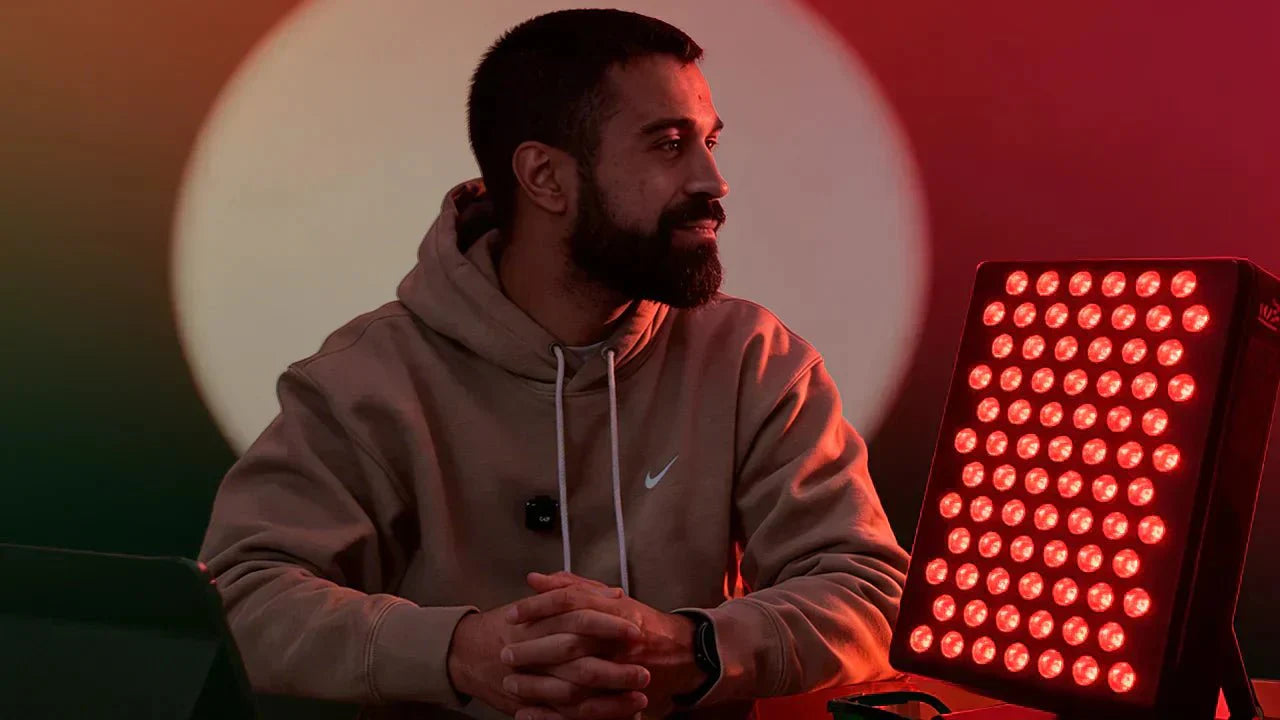
3 Therapeutic Red Light Routine: Replace the white LEDs on your nightstand with lighting that respects your biology. Before sleeping, you can use the Redinn Panel (Red Light Panel). While reading a book or relaxing in bed, its powerful irradiation works on deep muscle recovery without emitting blue light. By not inhibiting melatonin, you simulate an "artificial sunset" for your brain, preparing you for a restorative and deep sleep.
Your biological clock has no idea what Saturday or Sunday is. Start optimizing your room today with the right technology, protecting your eyes from artificial light and say goodbye to Social Jet Lag.
Redacción y revisión del artículo
Share:
Lipedema or cellulite, what is the difference and how can we relieve it?
Swollen legs and fluid retention: Why pressotherapy pants are your best ally