


You look in the mirror and feel frustrated. You’ve been eating healthy for months, cut back on carbs, go to the gym three times a week, yet your legs look the same. While your body tones up and your waist shrinks, your hips and thighs feel heavy and sometimes even hurt to the touch.
That’s when the million-dollar question arises: "Am I doing something wrong?".
Most likely, the answer is no. It’s not your fault, and it’s very possible that you’re not just “fighting” fat, but a chronic condition that affects millions of women and is often confused. Today, at Wellbeinn we will talk about Lipedema and cellulite, to understand their differences and, most importantly, see what tools we have at home to relieve pain and slow its progression.
📑 In this article we will talk about:
The Eternal Confusion: Is it Aesthetic or Health?
For decades, many women have heard the following phrase at their doctor's office: "You just need to lose weight." But the reality is that Lipedema and cellulite are not the same, nor are they treated the same.
Cellulite is an aesthetic alteration of the skin surface (the famous "orange peel skin"). It affects many women, regardless of weight (you can be very thin and have it) and it does not hurt.
On the other hand, Lipedema is a chronic disease of the adipose tissue. Fat cells grow disproportionately and pathologically, usually in the legs and arms. It is an inflammation of the tissue that causes pain, heaviness, and easy bruising.
How do I know if I have Lipedema or cellulite?
If you have doubts, the best thing is to see your doctor and get advice. Look for these warning signs that differentiate Lipedema from cellulite:
1 Pain is the Key
If pressing your thigh causes pain, or if your cat brushing against it bothers you, it's a clear sign of inflammation (Lipedema). Cellulite does not hurt to the touch.
2 The Disproportion
Do you have a size 38 waist and size 44 pants? Lipedema often creates a silhouette where the upper and lower torso look like two different people.
3 "The Bracelet Sign"
In Lipedema, fat accumulates in the leg but abruptly stops at the ankle, creating a "fist" or cup effect. The foot looks normal, while the leg is swollen.
4 It does not respond to diets
If you follow a low-calorie diet and lose chest or face fat, but your legs remain the same, it is likely lipedema, which does not respond metabolically the same way as normal fat.

“The key to success in pressotherapy is not to have one very intense session a month, but to maintain a constant frequency. Your body appreciates daily care much more.”
Caetano — WellbeinnHow can I relieve it?
If you identify with the signs of Lipedema and your doctor has confirmed you have it, the first thing is not to panic. Although it is chronic, it can be managed to live pain-free. The treatment is based on three pillars: anti-inflammatory diet, low-impact exercise (such as swimming or strength training), and fundamentally, compression and drainage.
This is where technology has advanced to help us. The lymphatic system of a leg with Lipedema or cellulite is usually collapsed due to fat pressure. We need to "help" that fluid rise to reduce inflammation and, therefore, pain. That’s why a professional pressotherapy boot is so important.
Why pressotherapy is your best ally at home
Until recently, the only solution was to visit physiotherapists or specialized clinics several times a week. But consistency is key, and we don’t always have the time or money for daily sessions.
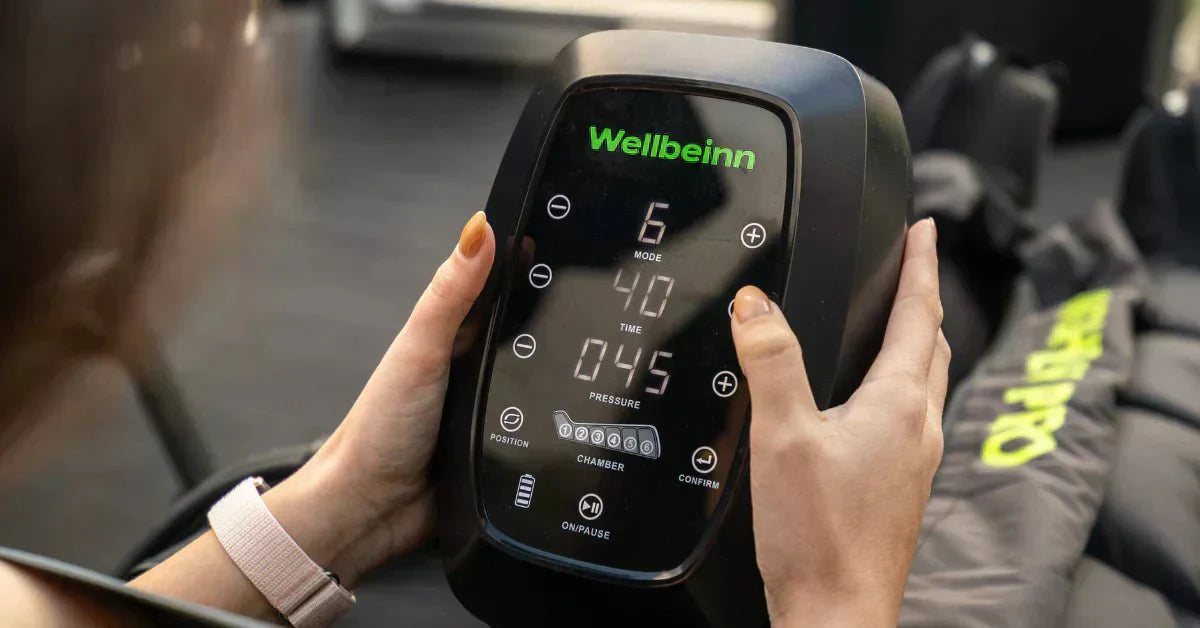
This is where the use of professional devices at home comes into play, such as the Wellbeinn HighFly Pro pressotherapy boots. Why are they different?
- Complete drainage (including abdomen): To drain the legs, you first need to "open" the pathways in the abdomen. The HighFly Pro are not just simple boots, they are full pants that wrap around the hips, buttocks, abdomen, and lower back. This is vital because if you only push the fluid from the legs but the groin and abdomen are blocked, the drainage does not work.
- Adjustable pressure: It can work up to 260mmHg, but in cases of Lipedema or cellulite, the key is to start gently. You need a massage that moves the fluid without causing pain, and its 6 usage modes allow you to customize the session, from a gentle lymphatic drainage to a more intense massage when inflammation decreases.
- Consistency without cables: With a battery life of over 3 hours, you can do your daily session while sitting on the sofa or reading a book in bed. That daily consistency is what makes the difference between heavy legs and light legs.
What our customers say about the HighFly Pro
The quality is very good
The quality is very good and it has great power. Honestly, it surprised me in a good way.
In love with Highfly Pro!!
My legs dance all day!! I’ve only been using them for 4 days and my life has completely changed.
Delighted 😍😍😍
Delighted with my Pressotherapy, I use it several days a week for circulation and it’s great, I recommend it.
Enjoy real relief at home
Knowing how to differentiate between Lipedema and cellulite is the first step to stop feeling pain and find a solution. It’s not a lack of willpower, it’s a problem that requires specific care.
At Wellbeinn we know that knowledge is power. That’s why with the purchase of the HighFly Pro pressotherapy boots we include a Medical Guide to Lipedema developed by our physiotherapists. Because the goal is not just aesthetics, it’s for you to walk light, pain-free, and feeling good in your own skin again.
If your legs feel heavy at the end of the day or you feel that characteristic pain to the touch, don’t normalize it. Give them the massage they need with our Highfly Pro pressotherapy boot.
Redacción y revisión del artículo
Share:
Foam roller: exercises and complete routine for back and legs
Why You Hate Waking Up Early on Mondays: Social Jet Lag and Solutions