
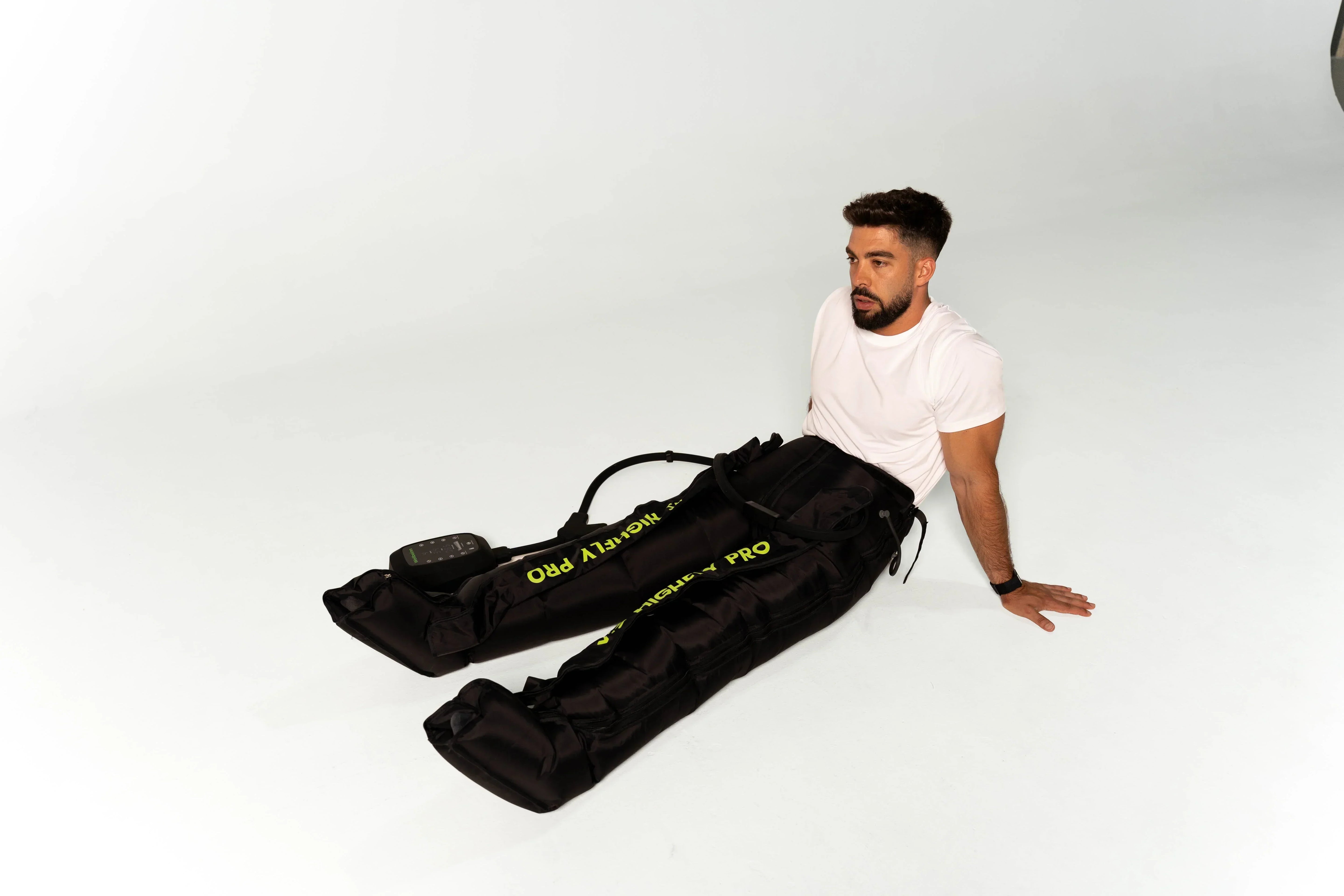


You finish your long run, get home, and put on the boots for twenty minutes. When you get up, your legs feel lighter and you think that’s it—you’ve recovered. Half an hour later, you climb the stairs and discover that the muscle soreness is still there, waiting for you.
That sums up quite well what pressotherapy does and does not do. It greatly improves how you feel and considerably less what your muscle has repaired. That is not insignificant: training the next day with loose-feeling legs changes the quality of that session. But it is worth knowing where the limit lies, and above all, knowing how to use it properly, because when you use it and how much pressure you apply make more difference than most people think.
| Session type | When to use it | Pressure | Duration |
|---|---|---|---|
| Long-distance or endurance run | 1-2 hours later | 80-100 mmHg | 20-25 min |
| Sets or intervals | 1-3 hours later | 90-120 mmHg | 15-20 min |
| Heavy leg strength training | 2-4 hours later, or the following day | 70-90 mmHg | 20 min |
| Competition | That night and the following day | 80-110 mmHg | 20-30 min |
| Rest day | Whenever you like | 50-70 mmHg | 20-30 min |
| Before training | Just before | 40-60 mmHg | 8-10 min |
Your protocol for today
Tell us what you trained and when, and we’ll give you the plan.
 Measurable health · Compression therapy
Clinic-grade compression therapy, at home and cable-free
Trousers with six chambers that compress in sequence from foot to hip, including glutes and lower back.
6 chambers · pressure adjustable from 0 to 200 mmHg · 5 programmes: circulation, sport and mixed
View the HighFly Pro Max€675,00
Measurable health · Compression therapy
Clinic-grade compression therapy, at home and cable-free
Trousers with six chambers that compress in sequence from foot to hip, including glutes and lower back.
6 chambers · pressure adjustable from 0 to 200 mmHg · 5 programmes: circulation, sport and mixed
View the HighFly Pro Max€675,00
What happens to your leg after training
When you finish a demanding session, three things accumulate in the muscle: metabolites from the work performed, inflammatory fluid associated with muscle damage, and a repair response that will last between 24 and 72 hours.
That fluid is responsible for much of what you interpret as having “heavy legs”: the feeling of legs that are full, stiff, and have a reduced range of motion. It is not the same as the muscle damage itself, although the two go hand in hand.
Pressotherapy acts on that component. By compressing sequentially from the foot toward the hip, it accelerates venous and lymphatic return and clears accumulated fluid from the area. It reduces congestion. What it does not do is repair muscle fibers: your body does that with protein, sleep, and time.
What can and cannot be claimed
Let us be specific, because this is often greatly exaggerated.
What is well documented: it reduces the sensation of delayed-onset muscle soreness—DOMS—and improves perceived recovery over the following 24–48 hours. It reduces leg circumference by draining fluid. And it improves range of motion in the short term.
What is more modest: the effect on objective markers of muscle damage and on next-day performance is real but small. Do not expect to run 5% faster just because you used the boots.
What it does not do: it does not prevent injuries, replace a warm-up, or make up for sleeping five hours. If your recovery is impaired by lack of sleep or poor nutrition, no machine will fix it. We cover this in why your recovery routine does not work.
When to use it: the most neglected parameter
This is the part most people get wrong, and it is free to correct.
Immediately after finishing
Tempting, but it is not the best time. Immediately after exercise, blood flow is high and your temperature is elevated; your body is already doing much of what the machine would do on its own. In addition, compressing a muscle that is still highly congested is usually quite uncomfortable.
If you are going to use it at that point, lower the pressure and shorten the session to ten minutes.
Between one and three hours later
This is the window with the best balance. You have showered and eaten something, your temperature has dropped, and inflammatory fluid is beginning to accumulate. At this point, compression does work your body is not doing on its own.
The next day
When the soreness really sets in, between 24 and 48 hours later. A session that day relieves stiffness and improves mobility, which is especially noticeable if you have to train again.
Before training
Yes, it makes sense, but with a different purpose and different settings: a short session at low pressure, eight to ten minutes at 40–60 mmHg. The aim is to stimulate circulation and improve how your legs feel, not to drain them. A long, intense session before competing will leave your legs feeling limp, which is precisely the opposite of what you want.

HighFly Pro — Pressotherapy Boots
From 30 to 260 mmHg with the same device: gentle activation before competing and high-pressure recovery afterward. More than three hours of battery life and no cables, so you can use them wherever you finish training.
View productHow it fits your sport
| Sport | What you accumulate | Recommended protocol |
|---|---|---|
| Long-distance running | Repeated impact and calf congestion | After a long ride and interval-training day. 2–4 times per week |
| Cycling | High volume, little eccentric damage | After long outings. Ideal during multi-day blocks |
| Trail running | High eccentric damage in the quadriceps | Priority. That night and the following day |
| Strength and hypertrophy | Localized muscle damage | Moderate pressure, preferably 2–4 hours later |
| Team sports | Changes of pace and braking | The night of the game and the following morning |
| CrossFit and functional training | Overall fatigue and high frequency | Higher-load days, 3–4 times per week |
The general rule: the more eccentric movement and impact your sport involves, the more you will benefit from it. A trail run with a long descent or a deep-squat session creates much more congestion than a flat bike ride.
Compared with the other tools
| Tool | What it does best | Its limitation |
|---|---|---|
| Pressotherapy | Decongest the entire leg effortlessly | Does not repair tissue |
| Cold bath | Reduce acute inflammation | When always used after strength training, it can hinder adaptations |
| Foam roller | Target specific areas | Requires effort and is localized |
| Massage gun | Precision in a specific muscle | Does not drain the entire limb |
| Red light | Act at the cellular level | Slower, cumulative effect |
| Compression socks | Maintain the effect for hours | Passive compression, with no sequence |
They do not compete; they complement each other. A very reasonable combination is pressotherapy on the same day as a hard session and red light on high-load days; we explain it in red light for muscle recovery. And if you are going to add cold to the equation, it is better to understand when it is appropriate first, in how to use the cold plunge.
How many times per week
It depends on your training load, not a fixed number:
- You train 2–3 days: one or two sessions, on the heaviest training days.
- You train 4–5 days: three or four sessions, prioritizing intervals, long rides, and leg strength.
- Double session or competition block: daily, and even twice a day during stage-race weeks.
There’s no problematic upper limit at reasonable pressures. What is a mistake is saving it only for when you’re completely wrecked: as with all recovery methods, it works best preventively and regularly.
Mistakes that reduce results
Always setting the pressure to maximum. More pressure doesn’t improve drainage. Above a certain point, you may collapse the superficial vessels you’re trying to empty, as well as cause discomfort.
Using it while seated with your feet on the floor. Lying down or with your legs slightly elevated, gravity works in your favor.
45-minute sessions. After 25–30 minutes, diminishing returns are obvious. It’s better to repeat the session another day.
Using it instead of mobility work. Reducing congestion isn’t the same as restoring range of motion or releasing a trigger point.
Neglecting the basics. Sleep, protein, and hydration still account for 80% of your recovery. Pressotherapy works on the remaining 20%. You can find the fundamentals in muscle recovery.
Frequently asked questions
It significantly reduces the sensation of pain and stiffness, especially over the following 24–48 hours, but it doesn’t noticeably accelerate the repair of the muscle damage causing them. Your legs will feel better; the internal process continues as normal.
Afterward, the one-to-three-hour window is when it delivers the most benefit. Beforehand also makes sense, but with a different approach: 8–10 minutes at low pressure to activate. A long, intense session before competing will leave your legs feeling flat.
Between 80 and 120 mmHg covers most sports recovery scenarios. For gentle relief or rest days, 50–70 is more than enough. The reference point isn’t the number but the sensation: firm and sustainable throughout the session.
Yes, at reasonable pressures there’s no problem using it daily, and during stage-race weeks it’s standard practice. What doesn’t add value is stacking one-hour sessions: the benefit plateaus much sooner.
There is no evidence that pneumatic compression dampens the adaptation signal, as can happen with systematic immersion in very cold water after strength training. That is one reason it fits well into hypertrophy blocks.
Not directly. What it does is help you arrive at your next session with less accumulated fatigue and a better overall feeling, and training with less fatigue does reduce risk. But attributing a preventive role to it on its own would be going too far.
The night before, do a gentle 15–20-minute session at medium pressure: it is especially helpful if you have travelled or spent hours sitting down. On race morning, if anything, do 8–10 minutes very gently. Never do an intense session shortly before competing.
For sport, the boots provide more than enough coverage: the work is focused on the calves and quadriceps. The trousers are useful if your sport places a lot of strain on the hips and glutes, or if you will also use them for water retention or cellulite.
They are different things. Compression socks apply constant passive compression, and their advantage is that you can wear them for hours, even while travelling. Pressotherapy applies active sequential compression for twenty minutes. Combining them—boots when you arrive, socks for the rest of the day after a long competition—works very well.
The feeling of lighter legs appears during the session itself. The real benefit to your training becomes apparent through accumulation: after two or three weeks of regular use, the underlying fatigue between sessions clearly decreases.
In summary
Sports pressotherapy is an honest tool with one specific effect: it relieves leg congestion and restores the feeling of fresh legs. That improves how you approach your next session, which is exactly what you want when you train several days in a row.
Use it between one and three hours after a hard session, for twenty minutes, at a pressure that feels firm but comfortable, while lying down. Repeat it several times a week instead of saving it for a crisis. And don’t expect it to make up for poor sleep, because there’s no machine for that.
If you want to build the complete setup, start with muscle recovery and see which equipment suits you in the pressotherapy boot buying guide.
Redacción y revisión del artículo
Share:
Lymphatic massage and lymphatic drainage: they are not the same.
Pressotherapy before and after: what results are real?