


You buy a tracker, set it up, and a week later discover that half the charts shown in the ad are locked. Want to see them? There’s a subscription. And the subscription never ends.
Not all of them work this way, but more and more do. That’s why this guide has two parts. First, what a smart fitness tracker actually measures and how accurately, according to studies that have tested them in the lab. Then, how to choose one that won’t charge you every month to see your own data.
| What it shows you | How reliable it is | What it’s useful for |
|---|---|---|
| Steps | Accurate in the lab for most models studied | Your daily activity level and its trend |
| Resting heart rate during the night | Average error of 1.7% to 3% compared with electrocardiography | See whether you’re more tired, sick, or stressed than usual |
| Nighttime heart rate variability | Average error of 6% to 16%, depending on the device | Track your recovery by comparing yourself with yourself |
| Asleep or awake | Agrees with polysomnography 86% to 89% of the time | Actual hours of sleep and regularity of your schedule |
| Sleep stages | Agrees only 50% to 65% of the time | A guide, never an exact reading |
| Heart rate during exercise | Average error rises by around 30% compared with resting | Training zones during sustained effort, with caution during sudden changes |
| Calories burned | No device had an error below 20% in the reference study | Compare days with each other, not to calculate what you eat |
Fuller et al., JMIR mHealth and uHealth, 2020 (review of 158 studies). Dial et al., Physiological Reports, 2025 (13 adults, 536 nights, five devices compared with electrocardiography). Miller et al., Sensors, 2022 (53 adults, six devices compared with polysomnography). Bent et al., npj Digital Medicine, 2020. Shcherbina et al., Journal of Personalized Medicine, 2017. These are laboratory studies involving healthy people and specific models, so your tracker’s readings may be better or worse.
What an activity tracker actually measures
Before discussing accuracy, it helps to know what’s inside, because almost everything comes from two sensors.
The first is an accelerometer, which tracks your wrist movement. That’s how it gets your steps and distance, and detects much of your sleep, because when you don’t move for a long time, the band assumes you’re asleep.
The second is an optical sensor, those little green lights on the back. It shines light on your skin and measures how the amount of light that returns changes according to the volume of blood passing underneath with each heartbeat. This is called photoplethysmography, and it’s how the device gets your heart rate and heart rate variability, as well as indirectly measuring your breathing rate during sleep.
Some bands add a skin temperature sensor. Be careful here, because it’s not your body temperature. It’s the temperature at the surface of your wrist, which changes with the room, your sheets, and your circulation. What’s useful isn’t the absolute value, but the trend relative to your own baseline night after night.
What is measured and what is calculated
Here’s the distinction that will help you most when reading any app. Some data is measured almost directly by the band, such as steps or the time between heartbeats. Other data is calculated from that, using an algorithm that each manufacturer designs in its own way.
Calories, sleep stages, stress level, recovery score, and fitness age are all calculations. They’re not made up, but they depend on assumptions about your body that may not hold true. That’s why two different bands can give you a 300-calorie difference on the same day and both still be doing their jobs properly.

How accurate is a smart band, according to studies?
Let’s go metric by metric, from most reliable to least.
Steps
The largest review we have analyzed 158 studies on nine brands of bands and watches. Its conclusion is that, in a lab, most of the models studied measure steps accurately. They’re somewhat less accurate in real life, especially if you push a shopping cart or stroller, because your wrist doesn’t move, or if you gesture a lot while talking and sitting down.
Resting heart rate and heart rate variability
A study published in 2025 in Physiological Reports compared five consumer devices with an electrocardiogram during sleep. There were 13 healthy adults and 536 nights in total. The average error in resting heart rate was between 1.7% and 3%. For someone with a heart rate of 55 beats per minute, that’s a difference of one or two beats.
Heart rate variability, the small difference in time between one heartbeat and the next, performed worse. The average error ranged from 6% to 16%, depending on the device, and agreement with the electrocardiogram ranged from good to poor. The authors themselves stress that each model needs to be validated, because the differences between them were statistically significant.
In other words, a wristband’s overnight heart rate variability is useful for comparing yourself with your own readings from week to week, which is what it’s really good for. It’s not useful for comparing yourself with your brother-in-law or a chart of normal values.
Heart rate during exercise
This is where the optical sensor struggles. An analysis by Duke University using consumer and research devices found that errors during activity were 30% higher on average than at rest. They work reasonably well during sustained effort, like cycling at a steady pace, and less well when intensity changes abruptly, like during intervals or a game of padel. In the same study, there were no significant differences in accuracy by skin tone.
If you train by heart-rate zones and need high accuracy, a chest strap is still the gold standard. For everyone else, the wristband gives you a good enough idea.
Sleep
A laboratory study of 53 adults compared six devices with polysomnography, the gold-standard test because it records brain activity. To determine whether you were asleep or awake, all the devices matched the test between 86% and 89% of the time. For sleep stages, light, deep, and REM, the match dropped to between 50% and 65%.
Another comparison of seven devices reached the same conclusion another way. They detect sleep very well, are worse at detecting periods of wakefulness during the night, and their sleep-stage readings are inconsistent. What’s more, they perform worse on bad nights, which are the ones you’re most interested in.
Calories
It’s the least reliable metric, and it’s worth saying so plainly. A Stanford study of 60 volunteers and seven wrist-worn devices, measured simultaneously using indirect calorimetry, found that no device had less than a 20% error in energy expenditure, while most measured heart rate acceptably. A review of 158 studies reached the same conclusion: no brand measured calories accurately.
The hidden cost of subscriptions
Subscriptions for trackers work in two ways. With some, the device is included in the subscription, and if you stop paying, you can no longer see your data. With others, you pay for the tracker, while some features—usually more advanced analyses, longer-term history, or recommendations—are locked behind an optional subscription.
The subscriptions we’ve seen on the market range from around €10 per month to around €200 per year or more, depending on the model and plan. It seems like a small amount each month. What you need to look at is how much it adds up to over the years, because a tracker is used for three, four, or five years.
| Subscription fee | Over 1 year | Over 3 years | Over 5 years |
|---|---|---|---|
| €5 per month | 60 € | 180 € | 300 € |
| €10 per month | 120 € | 360 € | 600 € |
| €200 per year | 200 € | 600 € | 1.000 € |
| No subscription | 0 € | 0 € | 0 € |
Our own calculation of the subscription fee only, excluding the device price and any price increases. The figures of €10 per month and €200 per year are rough estimates based on real plans on the market in 2026. Always check the current terms before buying.
There’s a second cost that isn’t measured in euros. If your data lives on a paid platform, your history depends on you continuing to pay. And the value of a tracker lies precisely in its history—in being able to see how you slept six months ago or how your resting heart rate changed when you started training.
How to choose an activity tracker without a subscription
Taking all of the above into account, these are the criteria that really make a difference, ordered by their importance in everyday use.
| Criteria | What to check | Why it matters |
|---|---|---|
| Payment model | One-time payment with all metrics and the app included | It’s the difference between €0 and hundreds of euros over three years |
| What it measures | Heart rate, heart rate variability, sleep, activity, and, if possible, skin temperature | That covers sleep, recovery, and activity, which are the most commonly used features |
| Battery | A week or more between charges | If you have to charge it every day, you’ll end up not wearing it at night |
| Comfort while sleeping | Small module and soft strap | Sleep accounts for half of the useful data, and it’s only measured if you wear it while you sleep |
| The app | An explanation of what changed each number and a comparison with your own baseline | Data without interpretation doesn’t change any habits |
| Compatibility | iPhone and Android, and how many days it stores data without syncing | Avoid losing nights of data if you don’t open the app one day |
| Privacy | Where the data is stored, whether it’s sold, and whether you can delete or export it | They’re data about your body, and the GDPR gives you rights over them |
| Warranty and water resistance | Warranty length and exactly what its certification covers | You’re going to wear it 24 hours a day for years |
Criteria developed by the Wellbeinn team based on the cited validations and the Sleep Research Society’s review on the use of wrist-worn devices to measure sleep (de Zambotti et al., Sleep, 2024).
With or without a screen
A band with a screen gives you the time, notifications, and data at a glance. A screenless band gives all that up in exchange for three things: longer battery life, a smaller size for sleeping, and fewer distractions.
There isn’t one that’s better than another. If you want to check your pace while running, you need a screen. If you want to understand your sleep and recovery without another device vibrating on your wrist, a screenless band makes a lot of sense. And if you already wear a watch, you can wear the band on your other wrist.
What you shouldn’t pay for
Be wary of bands that promise to detect diseases, measure your glucose without pricking your finger, or give you an exact blood pressure reading from your wrist without being certified to do so. A wellness band can tell you a lot about your habits, but if a manufacturer wants to claim that its device diagnoses anything, it must certify it as a medical device. We’ll cover this below.

Is wearing a band any use? What the evidence says
A review of reviews published in The Lancet Digital Health brought together 39 systematic reviews and nearly 164,000 participants. It concluded that wearing an activity band was associated with about 1,800 more steps a day, around 40 more minutes of walking, and about one kilogram less weight. The effect lasted over time. The effects on blood pressure, cholesterol, and quality of life were small and often not statistically significant.
In other words, the band alone won’t change your health, but it does encourage you to move more. And moving more brings a measurable benefit. A meta-analysis of 15 cohorts with 47,471 adults found that the risk of mortality decreased as daily step counts increased, until leveling off at between 6,000 and 8,000 steps for adults over 60 and between 8,000 and 10,000 for those under 60. It’s an observational study, so it shows an association, not causation, but it also debunks the myth that 10,000 steps is a magic number.
If you want to see how this fits in with the other habits that help you live longer, we share the data in how to live longer and feel better.
And the risk of becoming obsessed
It’s had a name since 2017: orthosomnia. A team at Rush University described cases of people whose sleep worsened as they chased their wristband scores. They spent more time in bed to improve their numbers, which caused more insomnia. Some trusted the device more than a lab test.
Interestingly, the wristband can also correct the opposite perception. Many people think they sleep much less than they actually do, something we explain in if you sleep as little as you think. The key is the same in both cases: look at the trend over several weeks, not the score for one night.
Your data: privacy and what isn’t a medical device
Two things worth knowing before you wear a wristband 24 hours a day.
The first concern is legal. The European Medical Device Regulation states this in Recital 19: software intended for wellness or lifestyle purposes is not a medical device. A wellness wristband can help you understand your habits, but it hasn’t been evaluated for diagnosis, and its manufacturer can’t present it as if it had. If a number worries you, the wristband doesn’t get the final say; your doctor does.
The second concern is privacy. Article 9 of the General Data Protection Regulation treats health-related data as a special category with enhanced protection. Ask any app where it stores your data, whether it shares it with third parties, and how you can export or delete it. If it doesn’t explain, that’s a bad sign.
Wellbeinn Band: pay once and see all your data
That said, here’s our recommendation, assessed by the same standards as the rest of the article.
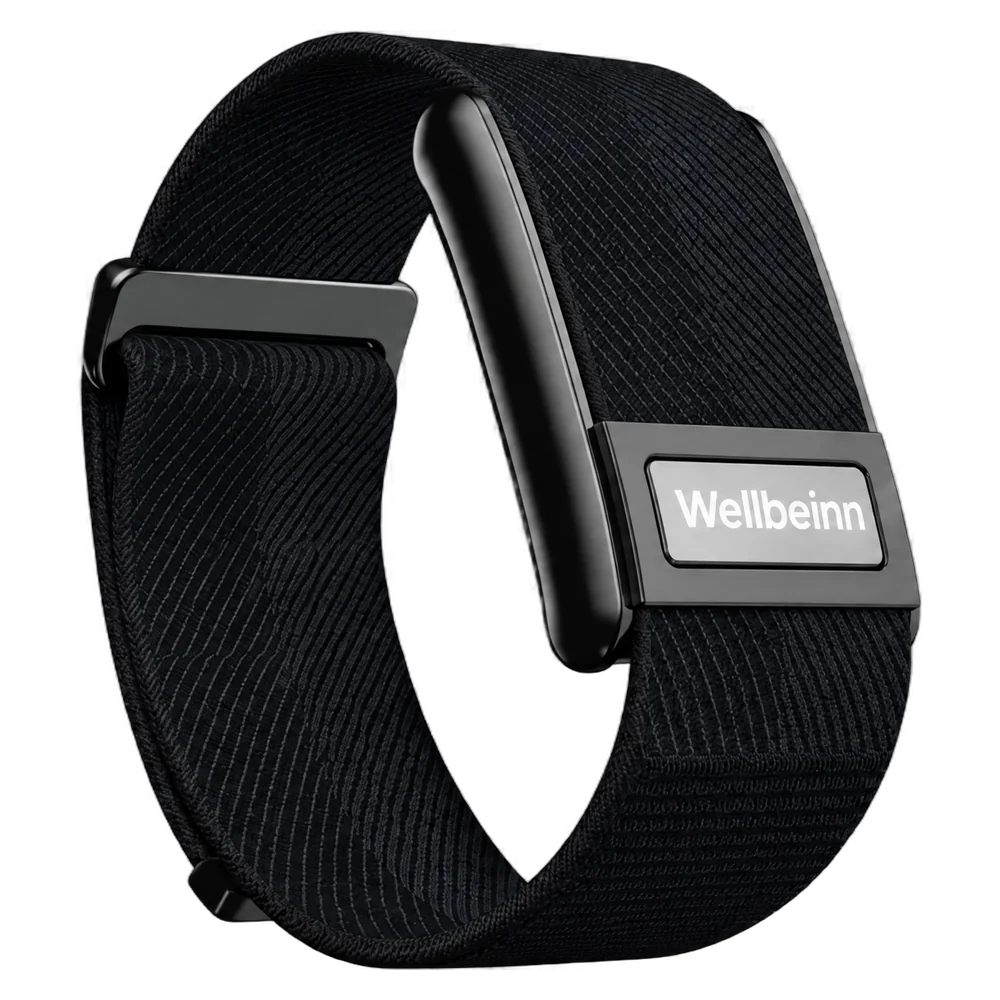
The Wellbeinn Band is a screen-free wristband worn day and night. It tracks your pulse, heart rate variability, sleep and its stages, activity, and skin temperature trends, as well as estimating your stress level and breathing rate during sleep. With normal use, the battery lasts up to 10 days and stores about 30 days of data even if you don’t sync.
The Wellbeinn Mate app and its MATE coach are included, with no fees or commitment. Every morning, you see your Wellbeinn Score from 0 to 100, which recalculates every ten minutes and explains what has changed it. And, in keeping with everything you’ve read, it doesn’t compare you with the average person. It needs a few days to learn what’s normal for you, and gets more accurate over the weeks.
What it isn’t: a medical device. The sleep stages, stress, and recovery it shows are wellness estimates, with the same limitations we’ve described for any wristband. If you want to share your records with a professional, you can export them.

Wellbeinn Band
Screenless band that tracks sleep, resting heart rate, heart rate variability, activity, and skin temperature. Up to 10 days of battery life, iOS and Android. Wellbeinn Mate app and MATE coach included, with no subscription. Three-year warranty.
138,25 €
View Wellbeinn BandIf you also want to know what your changes are made up of when you train or lose weight, the Wellbeinn Balance scale connects to the same app, and your weigh-ins appear in the same calendar as your sleep and activity. We explain how this type of scale works and what it really measures in bioimpedance scales and how to read their data.
Measurable Health Bundle
Wellbeinn Band plus the Wellbeinn Balance scale. Your activity, sleep, and body composition in one app, with no fees. Choose your Band color: Onyx, Sand, Cocoa, or Terracotta.
188,19 €
View the bundleAnd if you’re interested in using the data to train better, we recommend reading why your recovery routine isn’t working, because measuring without changing anything isn’t much use.
The essentials in five lines
Frequently asked questions
Which fitness band doesn’t require a subscription?
More and more manufacturers offer one-time-purchase models, but “no subscription” doesn’t always mean the same thing. With some bands, the basic app is free, while advanced analysis, long-term history or recommendations are part of an optional paid plan. With others, everything is included from day one. Before buying, check the product details and ask three questions: which metrics can you see for free, can you export your data, and what happens to your history if you ever cancel? If the answer to the first question is “all of them,” it’s a fitness band that really doesn’t require a subscription. The Wellbeinn Band, for example, includes the app and coach with no fees.
What’s the difference between an activity band and a smart band?
In practice, the terms are used interchangeably. Traditionally, an activity band tracked steps, distance and sleep based on movement, while a smart band added a heart rate sensor, phone notifications and more metrics. Today, almost all of them have an optical heart rate sensor, so the real differences come down to other things: whether it has a screen, whether it measures heart rate variability and skin temperature, how long the battery lasts, and whether it charges a subscription fee. A smartwatch is a step up, with a larger screen, apps and more features, but also a battery that usually lasts much less and a size that’s less comfortable for sleeping.
Are fitness bands reliable for measuring heart rate?
At rest, fairly accurate. A 2025 study comparing five consumer devices with an electrocardiogram over 536 nights found an average error in resting heart rate of between 1.7% and 3%. During exercise, things change because movement interferes with the optical sensor. A Duke University analysis found that the error during activity was, on average, 30% greater than at rest, especially during sudden changes in intensity. For everyday use and sustained effort, the band gives you a good enough idea. If you train by heart rate zones and need high accuracy, a chest strap is still the gold standard.
Are the calories shown by the fitness band accurate?
They’re a rough estimate, with a fairly wide margin of error. A Stanford study of 60 volunteers and seven wrist-worn devices, measured simultaneously using indirect calorimetry, found that none had less than a 20% error in energy expenditure, although almost all measured heart rate acceptably. A review of 158 studies reached the same conclusion: no brand measured calories accurately. On a 2,500 kcal day, 20% means 500 kcal too high or too low. Use them to compare one day with another or see if you’ve been more active this week than last, but not to decide how much to eat.
Can a band measure deep sleep?
It estimates them; it doesn’t measure them. Sleep stages are defined by brain activity, which can only be recorded with a polysomnography test in a sleep lab. A band infers them from movement and heart rate. In a study of 53 adults, six devices agreed with polysomnography between 86% and 89% of the time when distinguishing sleep from wakefulness, but only between 50% and 65% for sleep stages. So the deep-sleep minutes shown in the app are just a guide. What matters is the trend over several weeks, not the number for any particular night.
How many steps should you take each day?
Fewer than the 10,000 steps people always repeat, depending on your age. A meta-analysis of 15 cohorts involving 47,471 adults, published in The Lancet Public Health, found that mortality risk decreased as daily steps increased, then leveled off at between 6,000 and 8,000 steps for people over 60 and between 8,000 and 10,000 for those under 60. It’s an observational study, so it shows an association, not causation. The practical takeaway is this: if you’re currently getting 4,000 steps, increasing that to 6,000 or 7,000 already makes sense. There’s no need to obsess over a round number, and brisk walking counts too.
What happens if I stop paying for my band’s subscription?
It depends on the manufacturer, which is why it’s worth checking before you buy. With models where the device is tied to a subscription, if you stop paying, you stop being able to see your data. With models where the subscription is optional, you usually keep the basic metrics but lose the advanced analysis, long-term history, or recommendations. Losing the history usually hurts most, because a band’s value lies in comparing how you’re doing today with how you were doing months ago. Always ask whether you can export your data. The GDPR gives you the right to access and portability, but not all apps make it easy.
Is a screenless band worth it?
It depends on what you want it for. If you want to see your pace while running or get notifications, you need a screen. If you’re interested in understanding your sleep, recovery, and activity, a screenless band has clear advantages: it lasts longer between charges, is smaller and more comfortable to sleep in, and doesn’t distract you with alerts. And sleeping with it is exactly what makes the data useful, because sleep and your overnight heart rate account for half of the useful information. Many people who already wear a watch put the band on their other wrist, or wear it only at night.
Can I shower or swim with a fitness band?
It depends on its water-resistance rating and what the manufacturer says, because the same rating can come with different conditions. Many bands can handle sweat, rain, and showers without a problem. For long baths, hot water, saunas, or diving, it’s best to take it off unless the manufacturer expressly says it’s designed for swimming. The Wellbeinn Band has an IP68 rating and can handle sweat, rain, and splashes, but we recommend taking it off for long baths, saunas, or diving. And here’s a tip to extend the life of any band: rinse the strap with fresh water if you sweat a lot or have been in a pool or the sea.
Can a band detect illnesses?
A wellness band can’t. The European Medical Device Regulation makes clear that software intended for wellness or lifestyle purposes is not a medical device, and a device must be certified as such to claim that it can diagnose anything. What a band can do is show you changes from your baseline, such as a higher resting heart rate for several days in a row or a drop in heart rate variability. That’s not a diagnosis; it’s a signal to pay attention. If you notice symptoms such as palpitations, dizziness, shortness of breath, or fatigue that doesn’t improve, consult your doctor even if the band says everything is fine.
Is it safe to give an app my health data?
It can be, if the company complies with the GDPR and explains things clearly. Health data is a special category with enhanced protection under Article 9 of the Regulation, so it shouldn’t be used for purposes beyond those you agreed to. Before installing an app, check where the data is stored, whether it is shared or sold to third parties, whether it is encrypted, and whether you can export or delete it whenever you want. Be wary of apps that request unnecessary permissions, such as access to your contacts. In Wellbeinn Mate, conversations and data are encrypted, we don’t sell your data, and you can view, export, or delete what the coach remembers.
Does the Wellbeinn Band require a subscription?
No. You pay for the band once, and the Wellbeinn Mate app with the MATE coach is included, with no subscription fees or commitment. You can see all your metrics from day one: sleep and its stages, resting heart rate, heart rate variability, recovery, estimated stress, activity, skin temperature, and breathing rate during sleep. It works with iPhone and Android, the battery lasts up to 10 days with normal use, and it comes with a three-year warranty. The same app also connects to the Wellbeinn Balance scale and Wellbeinn compression therapy, so you can see your sleep, weigh-ins, and recovery sessions on one calendar.
Does the Wellbeinn Band diagnose health problems?
No, and it’s important to be clear about that. It is a wellness device, not a medical device. The metrics it displays are indicative measures that help you understand your trends and maintain habits, and they become more precise as the app learns what’s normal for you. They do not detect, diagnose, or prevent any disease, and they do not replace an assessment by a professional. If you like, you can export your records and show them to your doctor. And if you have symptoms that concern you, such as insomnia lasting more than three months, snoring with pauses in breathing, or palpitations, consult your primary care doctor.
Sources and references (12)
Accuracy of wristbands and watches (5)
- Fuller D, Colwell E, Low J, et al. Reliability and validity of commercially available wearable devices for measuring steps, energy expenditure, and heart rate, systematic review. JMIR Mhealth Uhealth. 2020;8(9):e18694. doi.org/10.2196/18694
- Dial MB, Hollander ME, Vatne EA, et al. Validation of nocturnal resting heart rate and heart rate variability in consumer wearables. Physiol Rep. 2025;13(16):e70527. doi.org/10.14814/phy2.70527
- Bent B, Goldstein BA, Kibbe WA, Dunn JP. Investigating sources of inaccuracy in wearable optical heart rate sensors. NPJ Digit Med. 2020;3:18. doi.org/10.1038/s41746-020-0226-6
- Shcherbina A, Mattsson CM, Waggott D, et al. Accuracy in wrist-worn, sensor-based measurements of heart rate and energy expenditure in a diverse cohort. J Pers Med. 2017;7(2):3. doi.org/10.3390/jpm7020003
- Miller DJ, Sargent C, Roach GD. A validation of six wearable devices for estimating sleep, heart rate and heart rate variability in healthy adults. Sensors (Basel). 2022;22(16):6317. doi.org/10.3390/s22166317
Sleep and data use (3)
- Chinoy ED, Cuellar JA, Huwa KE, et al. Performance of seven consumer sleep-tracking devices compared with polysomnography. Sleep. 2021;44(5):zsaa291. doi.org/10.1093/sleep/zsaa291
- de Zambotti M, Goldstein C, Cook J, et al. State of the science and recommendations for using wearable technology in sleep and circadian research. Sleep. 2024;47(4):zsad325. doi.org/10.1093/sleep/zsad325
- Baron KG, Abbott S, Jao N, Manalo N, Mullen R. Orthosomnia, are some patients taking the quantified self too far? J Clin Sleep Med. 2017;13(2):351-354. doi.org/10.5664/jcsm.6472
Physical activity and health (2)
- Ferguson T, Olds T, Curtis R, et al. Effectiveness of wearable activity trackers to increase physical activity and improve health, a systematic review of systematic reviews and meta-analyses. Lancet Digit Health. 2022;4(8):e615-e626. doi.org/10.1016/S2589-7500(22)00111-X
- Paluch AE, Bajpai S, Bassett DR, et al. Daily steps and all-cause mortality, a meta-analysis of 15 international cohorts. Lancet Public Health. 2022;7(3):e219-e228. doi.org/10.1016/S2468-2667(21)00302-9
European regulations (2)
- Regulation (EU) 2017/745 of the European Parliament and of the Council of 5 April 2017 on medical devices. Recital 19. Official Journal of the European Union. 2017;L 117:1-175. boe.es
- Regulation (EU) 2016/679 of the European Parliament and of the Council of 27 April 2016, General Data Protection Regulation. Article 9. Official Journal of the European Union. 2016;L 119:1-88. boe.es
Redacción y revisión del artículo
Share:
Heavy legs after running: how to recover and when to use compression therapy
Heavy legs after running: how to recover and when to use compression therapy