


The Monday after a marathon, everyone goes downstairs sideways. The same goes after your first half marathon, or a 25-kilometer run with the last part downhill. That stiff, heavy, wooden feeling in your legs is your body’s way of telling you that you’ve asked it to do something it doesn’t do every day.
In this article, we’ll separate three things that often get mixed up: what it means to have heavy legs, how that differs from muscle soreness or an injury, and what to do hour by hour over the next two days. We’ll also tell you what studies say about each recovery trick, including compression therapy, even though we sell it ourselves.
| Timing | What to do | Why |
|---|---|---|
| 0-2 hours | Walk for a few minutes, drink water, take a warm shower, and eat something with carbs and 20-40 g of protein | Protein after exercise stimulates muscle repair. The ISSN recommends servings of 20-40 g |
| Same day (afternoon and evening) | Eat normally, including carbs; elevate your legs or use compression if it helps, have dinner early, and go to bed | Massage and compression improve how tired your legs feel in the hours afterward. Sleep matters most |
| 24 hours | Walk, easy cycling, or nothing. If you run, keep it very easy and flat for 20-30 minutes | Movement eases the pain, though the effect doesn’t last long. Better to reduce intensity for a day or two |
| 48 hours | Usually the worst day. Short, easy run if there’s no localized pain. No intervals or hills | Delayed-onset muscle soreness peaks between 48 and 72 hours |
| 72 hours onward | Ease back into your routine. Quality workouts when going downstairs no longer hurts | Pushing hard again while the muscles are still damaged changes how you run and can strain tendons and joints |
Compiled from Hotfiel et al. (Sportverletz Sportschaden, 2018), Cheung et al. (Sports Medicine, 2003), the International Society of Sports Nutrition position stand on nutrient timing (Kerksick et al., 2017), and the meta-analysis by Dupuy et al. (Frontiers in Physiology, 2018). This is a general guideline for healthy runners, not a medical plan.
Why do your legs feel heavy when you run?
Running seems like a simple movement, but with every stride your muscles do two things. They push off, then, on landing, they brake your body as they lengthen. That second action is called an eccentric contraction, and it causes the most microtears in muscle fibers.
A German review of delayed-onset muscle soreness puts it this way: the main mechanism is ultrastructural damage to muscle cells caused by eccentric exercise or exercise you’re not used to, triggering a local inflammatory response. That leads to stiffness, swelling, loss of strength, and that feeling of fullness in your legs.
That’s why some runs leave your legs much more tired than others, even when they cover the same distance:
- Downhills. Running downhill means braking nonstop. Your quadriceps pay for it for days, which is why so many trail runners feel worse after a technical descent than after the climb.
- Something you never do. Your first 30-kilometer run of a marathon training block, switching to pavement after months on trails, or trying out much faster shoes.
- Distance and pace. An all-out run takes more of a toll than a long run at a comfortable pace.
- Getting back to it after a break. Delayed-onset muscle soreness is more common early in the season, when you return after a few weeks off.
And one thing worth clarifying: what you feel 48 hours later isn’t accumulated lactic acid, despite what people keep saying. Lactic acid is one of the old hypotheses that reviews have since discarded. What you feel is damaged tissue being repaired.
Heavy legs, soreness, or injury: how to tell the difference
In everyday speech, we use “heavy legs,” “soreness,” and “overload” almost interchangeably. They’re not quite the same, and knowing which one you have tells you what to do.
Heavy legs
It’s the general heaviness you feel in the hours afterward. Your legs feel stiff, sluggish, and have less range of motion. No one spot hurts; everything aches a little. It usually appears the same day and improves with gentle movement.
Soreness, or delayed-onset muscle soreness
It’s what studies call DOMS. It appears the next day, hurts when you touch the muscle or stretch it, and peaks between 48 and 72 hours. It’s symmetrical, affecting both quadriceps or both calves, and goes away on its own after a few days. It doesn’t need treatment.
Injury
The rules change here. These are the signs that should make you stop:
- Pain in one specific spot that you can point to with one finger, especially if it’s only on one side.
- A sudden sharp pain during a run, like being struck in the calf. This is usually a muscle tear, not muscle strain.
- Bone pain, for example at the front of the foot, that appears when you put weight on it and starts appearing earlier each time. This is the typical pattern of a stress fracture, common in runners who increase their mileage or intensity too quickly. Note that X-rays may look normal for up to two or three weeks after the injury.
- Swelling in one calf only, which is warm and painful, especially if you’ve also taken a long trip sitting down.
- Pain that doesn’t improve at all after five or six days, or that gets worse instead of easing.

What to do in the 48 hours after a long run or race
The table at the beginning is the summary. Here are the finer details for each stage.
The first two hours
After crossing the finish line, don’t sit down right away. Walk for five or ten minutes. Then do three things, in this order.
Drink. There’s no magic number of glasses. The American College of Sports Medicine recommends replacing the fluid deficit you’ve built up, and the easiest way to find out how much that is is to weigh yourself before and after training. Every kilogram you lose is mostly water. If you’ve sweated a lot, a drink with electrolytes is better than water alone.
Eat. The International Society of Sports Nutrition recommends consuming high-quality protein within two hours after exercise, in doses of 20 to 40 grams, equivalent to about 0.25-0.40 g per kilogram of body weight. Greek yogurt with fruit and bread, a turkey sandwich, or a shake will do. Carbs are a little different. Only if you’re going to train again in less than four hours do you need aggressive refueling, which the ISSN puts at 1.2 g of carbs per kilogram per hour. For recreational runners who won’t run again that day, normal meals with a good serving of rice, pasta, potatoes, or bread are enough.
Take a shower. Warm. If you want to try cold water, we’ll tell you when it makes sense and when it doesn’t.
The rest of the day
This is where a lot of people get too clever for their own good. A long nap, legs up on the sofa, and wait it out. That’s fine. If you feel like it, elevating your legs, wearing compression tights, or having a pressotherapy session can make your legs feel lighter. The important thing is nighttime: eat dinner early and get as much sleep as you can. A 2021 international consensus of sleep and sports experts notes that regularly sleeping less than seven hours is common among athletes and that sleep needs vary from person to person.
The next day
Keep moving, but don’t train. A classic review on muscle soreness concludes that exercise provides the most relief, although it’s temporary, and recommends reducing intensity and duration for a day or two after a session that’s left you feeling beaten up. Take a half-hour walk, cycle on flat ground, or go swimming. If you feel like running, keep it very easy for 20-30 minutes, on flat ground and without looking at your watch.
At 48 hours
Don’t panic if you feel worse today than yesterday. That’s to be expected: delayed-onset soreness peaks between 48 and 72 hours. Go for a short, easy run if you like, but no intervals or hills. And don’t do aggressive stretches to “loosen up” the muscle; they won’t make it loosen up any sooner.

What really works to relieve tired legs
A 2018 French meta-analysis by the University of Poitiers reviewed 99 studies on recovery techniques. Its conclusion is the one most often repeated in the literature: massage seems to be the most effective method for reducing muscle soreness and feelings of fatigue, and compression and immersion in water also help with perceived fatigue. Pay attention to that word: perceived. Almost everything in this table improves how you feel. Almost nothing clearly speeds up when you can perform again.
| Technique | What the evidence says | What it does for you |
|---|---|---|
| Sleep | Regularly sleeping less than 7 hours is common among athletes. The 2021 consensus calls for individualized guidelines | It’s the foundation. Nothing can make up for it |
| Eat and drink | 20-40 g of protein after exercise and replace lost fluids | Repair and recharge |
| Massage | 29 studies and 1,012 people: somewhat improves muscle soreness and flexibility. Does not improve strength, jumping, sprinting, or endurance | Feeling better |
| Cold water | Somewhat better than doing nothing for soreness. The most effective approach is between 11 and 15 °C for 11-15 minutes | Relief after races, not every day |
| Foam rolling afterward | 21 studies: reduces perceived soreness by 6%. Small effects, more useful as a warm-up | Short-term relief |
| Compression socks and tights | 23 studies: small benefits, clearer for recovering strength after weightlifting than after running | Comfort, return trips |
| Compression therapy | 17 studies: trivial to small benefit for muscle function and trivial to moderate benefit for perceived soreness | Lighter-feeling legs that day |
| Stretching afterward | 11 trials: no effect on soreness at 24, 48, or 72 hours, or on strength. Very low confidence | If you enjoy it, go ahead. It doesn’t speed up recovery |
Walsh et al. (Br J Sports Med, 2021), Kerksick et al. (ISSN, 2017), Davis et al. (BMJ Open Sport Exerc Med, 2020), Machado et al. (Sports Medicine, 2016), Wiewelhove et al. (Frontiers in Physiology, 2019), Brown et al. (Sports Medicine, 2017), Maia et al. (Biology of Sport, 2024), and Afonso et al. (Frontiers in Physiology, 2021). Most studies are small, involve young men, and use lab protocols that differ from a real race.
Stretching doesn’t relieve muscle soreness
This is probably the most widespread myth among runners. A 2021 meta-analysis brought together trials comparing stretching after exercise with simply resting. The result: no effect on soreness at 24, 48, or 72 hours, or on strength recovery. The authors note that the evidence is limited and low quality, so we can’t say stretching is bad. There’s simply no basis for promoting it as a recovery method. If you stretch because it feels good and helps you maintain mobility, keep doing it. But don’t expect it to relieve soreness.
Cold water: useful, but not every day
Cold-water immersion reduces muscle soreness somewhat, and a meta-analysis found the best dose to be 11 to 15 °C for 11 to 15 minutes. It doesn’t need to be icy.
The caveat is that in a trial involving 21 men who lifted weights for twelve weeks, ten minutes of cold water after each session hindered gains in strength and muscle mass compared with active recovery. This was a strength study, not a running study, and we don’t know whether the same applies to aerobic adaptations. But the sensible takeaway is to use cold water after a race or a very hard day, not as a daily ritual.
Foam rolling and massage
Massage comes out best in reviews for perceived pain and fatigue. A meta-analysis of 29 studies and 1,012 participants found small improvements in soreness and flexibility, but none in strength, jumping, sprinting, or endurance. Foam rolling follows a similar pattern: after exercise, it reduces perceived pain by 6%, and the authors conclude that it makes more sense as part of a warm-up than as a recovery tool. If you use one, keep it gentle and don’t aim for pain. You’ll find a simple routine in this foam roller exercise chart for legs, and the Rollinn if you’re looking for a vibrating one.
What really matters: sleep and nutrition
No device beats sleeping well and eating enough. If your recovery is chronically poor, the problem is almost always there, as we explain in why your recovery routine isn’t working. As for supplements, most offer nothing you can’t get from an ordinary meal, and we review the ones with some evidence behind them in supplements for muscle recovery.
Pneumatic compression therapy after running: where it fits and where it doesn’t
We owe you an honest answer here, because we sell pneumatic compression therapy and it would be easy to tell you only the good parts.
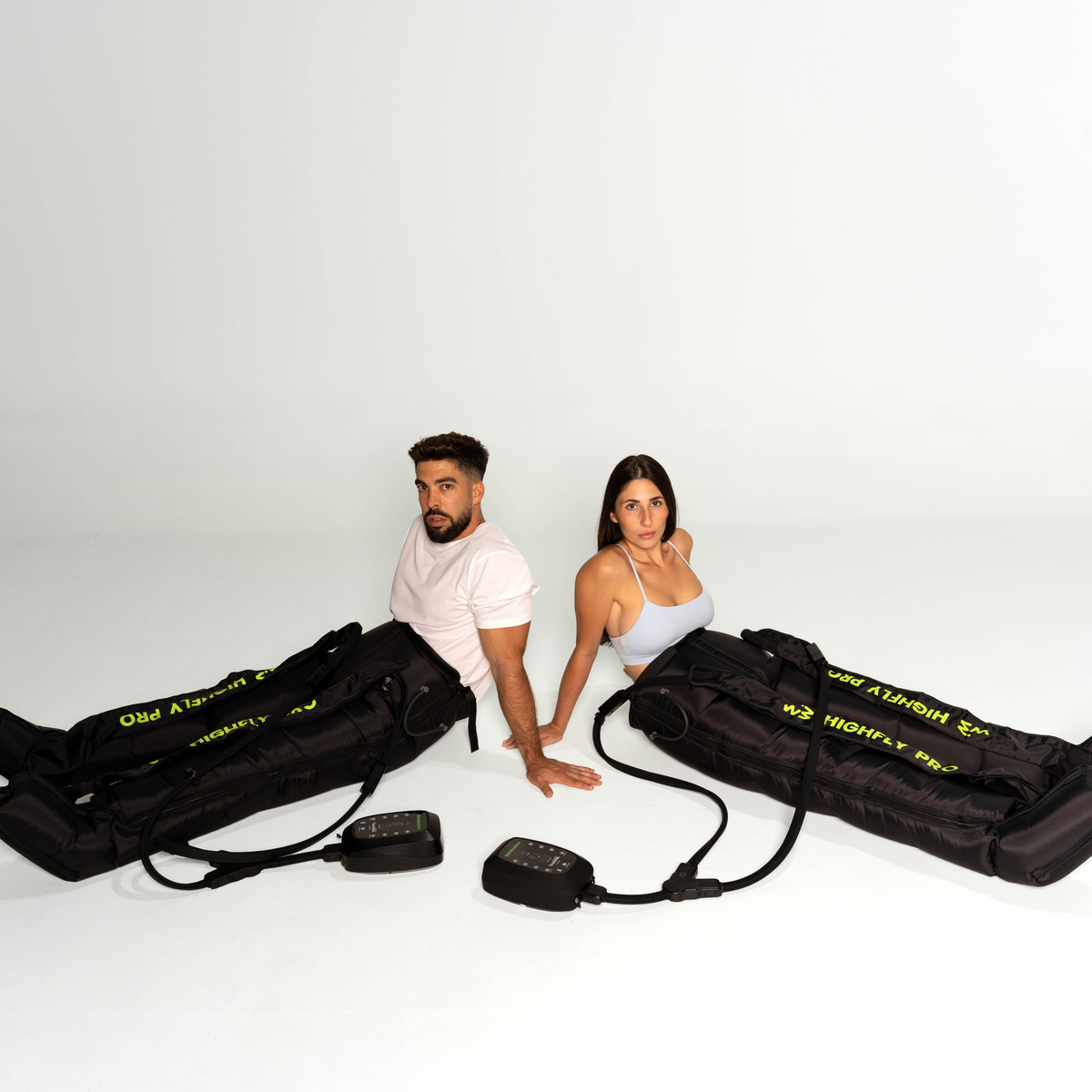
Pneumatic compression therapy, or intermittent pneumatic compression, uses boots or pants with air chambers that inflate sequentially from the foot to the hip. The idea is to help blood and lymph return and reduce congestion in the leg.
What studies on runners say
The best summary is a 2024 meta-analysis of 17 studies and 319 participants. It found a trivial-to-small benefit for muscle function and a trivial-to-moderate benefit for pain and soreness. The most common protocols lasted 20 to 30 minutes at around 80 mmHg. Its conclusion: it may have an effect, especially on perceived pain.
Studies on distance runners refine that picture:
- At the Western States, a 161-kilometer ultramarathon, 72 runners received 20 minutes of massage, compression therapy, or lying-down rest when they finished. Immediately afterward, compression therapy and massage reduced feelings of fatigue. But there were no differences from day 1 to day 7, and 400-meter times at three and five days also remained unchanged.
- In another trial with 56 ultramarathon runners and four sessions a day, compression therapy reduced fatigue immediately after each session and the day after the race, without improving performance.
- In ten runners who completed two 32-kilometer runs, an hour of compression therapy after running and for five days made no difference to pain or a blood marker of inflammation.
- A 2025 review concludes, with moderate certainty despite limited data on this point, that compression therapy does not reduce muscle soreness at 24 hours.
When to use it and when not to
It works best in the evening or at night after a long run or race, and the next day if your legs still feel heavy. It can also help after a long trip home, when swollen legs are most noticeable. The HighFly Pro Max product page recommends sessions of 10 to 20 minutes, 3 to 5 times per week. For guidance on adjusting the pressure and timing to your sport, see our sports compression therapy guide.
When not to use it: over an undiagnosed injury, if you suspect a blood clot (one swollen, warm, painful calf), with wounds or a skin infection, if you have heart failure, or during pregnancy without your doctor's approval. You can find the complete list under contraindications to compression therapy.
At Wellbeinn, we have two models. The HighFly Pro is the cordless, six-chamber pants that reach the hips, glutes, and lower back, with adjustable pressure up to 260 mmHg and six modes.

HighFly Pro
Wireless compression therapy with six sequential chambers from feet to hips, also covering the glutes and lower back. Adjustable pressure up to 260 mmHg, six modes, and over three hours of battery life. Customer support from licensed physical therapists.
449,00 €
View HighFly ProThe HighFly Pro Max doesn't squeeze harder; it squeezes better. It reaches 200 mmHg, which is more than enough when you consider that studies use around 80, and what it adds is control: five built-in programs, two of them for sports, and a custom mode where you adjust pressure and timing chamber by chamber, seeing on screen what each one is doing.

HighFly Pro Max
Six sequential compression chambers from feet to hips, with adjustable pressure from 0 to 200 mmHg across six levels. Five Wellbeinn programs designed by physical therapists, a custom chamber-by-chamber program, LCD screen, and a three-year warranty. Wellness product; does not replace medical diagnosis or treatment.
573,75 €
View HighFly Pro Max
When to run again with heavy legs
Running with muscle soreness isn't dangerous in itself. What you should know is that delayed-onset muscle soreness changes how you move: it reduces range of motion, shock absorption, and strength. A review published in Sports Medicine warns that these changes can put strain on ligaments and tendons in ways they aren't used to if you push too hard too soon.
So the practical rule is to separate easy volume from quality:
- Easy run: whenever you like, as long as there's no localized pain. It often feels good.
- Intervals, pace changes, and hills: once the muscle soreness has passed and you can manage the stairs.
- After a marathon: there is no validated number of days that works for everyone. It depends on your level, how you ran it, and how much you've cut back. The signs are the same: first, daily life returns to normal, then easy runs, and finally intensity.
And if heavy legs are your normal state, not just the day after something strenuous, the problem isn't recovery. It's training load. More miles than your body can handle, too few recovery weeks, poor sleep, or not eating enough. What you need to do is review your plan with your coach or a physical therapist, not look for the next trick.
The essentials in five lines
Frequently asked questions
What should you do when your legs feel heavy after running?
First, in the two hours after your run, walk for a few minutes, drink to replace the fluids you’ve lost through sweating, and eat something with carbohydrates and 20 to 40 grams of protein, as recommended by the International Society of Sports Nutrition. That night, prioritize sleep. The next day, get moving without training: take a walk, ride a bike easily, or do a very short jog on flat ground, since light exercise relieves pain, even if only temporarily. If you like, massage, elevating your legs, or a compression therapy session may make your legs feel lighter, but they don’t do much to speed up repair. And if you notice pain in one specific spot, it’s not just fatigue: it’s a sign to stop and seek advice.
How long do heavy legs last?
The heaviness you feel in the first few hours usually improves within a day or two. Muscle soreness itself, or delayed-onset muscle soreness, peaks between 48 and 72 hours after exercise and usually goes away on its own within a few days. So it’s normal to feel worse on the second day after a race than on the first. If the pain hasn’t eased at all after five or six days, or is getting worse instead of better, it’s no longer consistent with normal training fatigue. In that case, see a physical therapist or your primary care doctor, especially if the pain is in one specific spot or in the bone.
Is it good to run with heavy legs?
A very easy run, yes, and it often feels good. Exercise is one of the few things that relieves muscle soreness, although the effect doesn’t last long. What you should avoid is doing intervals, pace changes, or hill workouts while the muscle is still damaged. A review in Sports Medicine explains that muscle soreness reduces strength, range of motion, and shock absorption, and that these changes can put unusual strain on tendons and ligaments. The recommendation is to reduce intensity and duration for a day or two after a very demanding session. As a home test, if going downstairs still hurts, save the quality workout for later.
Why do my legs feel heavy when I run?
With every stride, your muscles slow your body down as they lengthen. This is called an eccentric contraction, and it causes the most microtears. You’ll feel it much more on downhill runs, on runs that are longer than usual, when you race at full effort, when you switch surfaces or shoes, and when you return after a break. If your legs feel heavy during nearly every workout, not just after hard ones, review your total training load, recovery weeks, sleep, and whether you’re eating enough. A plan with too much volume for your current level is the most common cause.
Is it good to stretch when your legs are sore?
Gentle stretching won’t hurt, but don’t expect it to relieve the soreness. A 2021 meta-analysis of 11 trials found no effect of stretching after exercise on soreness at 24, 48, or 72 hours, or on strength recovery, compared with simply resting. The authors themselves note that the studies are few and of low quality, so it can’t be said to be harmful either. If stretching feels good or is part of your mobility routine, keep doing it, but don’t force it or stretch through pain. Forcefully stretching a muscle with microtears won’t help it repair any faster.
Cold or hot water for sore legs?
Both have their place. Cold water can reduce muscle soreness somewhat, and studies suggest the most effective dose is 11 to 15 minutes at 11 to 15 °C. It doesn’t need to be ice-cold. The downside is that using it after every strength workout reduced strength and muscle gains in a 12-week trial, so it’s better to save it for races or very tough days. Heat, such as a bath or warm shower, relaxes you and eases the feeling of stiffness the next day. Don’t apply heat to a bruise or a recent injury with swelling in one specific area.
How many days should you rest after a half marathon or marathon?
There’s no validated figure that applies to everyone, so be wary of charts that give you exact numbers of days. It depends on your experience, how hard you pushed yourself, and the elevation gain and loss. What is clear is the order. Take it easy or rest for the first two or three days, because that’s when soreness peaks. Then do short, easy runs. Only add intensity, intervals, and changes of pace once the soreness has gone and you can walk down stairs normally. You’ll usually need much longer after a marathon than after a half marathon. If you have a coach, they should set your schedule based on how you respond.
What should you eat after running to help your legs recover?
Protein and carbohydrates, and there’s no need to overcomplicate things. The International Society of Sports Nutrition recommends consuming high-quality protein from immediately after exercise until two hours later, in doses of 20 to 40 grams, and repeating every three to four hours throughout the day. With carbohydrates, you only need rapid replenishment, which they put at 1.2 g per kilo per hour, if you’re training again in less than four hours. Otherwise, regular meals with rice, pasta, potatoes, bread, or fruit. Greek yogurt with a banana, a turkey sandwich, or eggs with toast are all perfectly good options.
Do compression socks help with recovery after running?
A little, but less than the advertising claims. A meta-analysis of 23 studies found small benefits, more pronounced for recovering strength after weight training than after running. Another, broader review does include them among the techniques that reduce the feeling of fatigue. They make the most sense on the trip home after a race, when you spend hours sitting with swollen legs, or if you simply find that they make your legs feel lighter. What they don’t do is speed up muscle repair or replace sleeping and eating well.
Does magnesium help with heavy legs?
There are no studies showing that magnesium relieves heavy legs or muscle soreness after running. What European regulations allow us to say is that magnesium contributes to normal muscle function and helps reduce tiredness and fatigue. This makes sense if your diet doesn’t provide the recommended amount, which can happen with long workouts and lots of sweating, but it’s not a remedy for the day after a long run. If you want to know how much a runner needs and when supplementation makes sense, we explain it in magnesium for athletes.
Is it better to use compression therapy before or after running?
For recovery, afterwards. Studies with runners have used them after a race and found that they reduce the feeling of fatigue in the hours that follow and, in some cases, the next day. The effect on performance in the following days is small or nonexistent, so use them for relief, not as a shortcut. The afternoon or evening after a long run is a good time, once you’ve eaten and showered. Before running, a short, gentle session may make your legs feel looser, but a long, intense session just before a race isn’t a good idea. We cover this in our guide to sports compression therapy.
Do Wellbeinn HighFly pants speed up recovery?
We tell you what the evidence says, not what would suit us. Pressotherapy mainly improves the feeling of fatigue and heavy legs in the hours after exertion, with a trivial-to-small benefit for muscle function according to a 2024 meta-analysis. It does not repair muscle fibers or make you run faster the next day. HighFly products are for wellness and sports recovery, not medical devices, and do not replace medical diagnosis or treatment. If you have an injury, thrombosis, or heart or vascular disease, consult your doctor first. If you simply want to finish long runs with lighter legs, that's where they fit.
Sources and references (20)
Muscle soreness, injuries, and warning signs (5)
- Hotfiel T, Freiwald J, Hoppe MW, et al. Advances in delayed-onset muscle soreness (DOMS), part I: pathogenesis and diagnostics. Sportverletz Sportschaden. 2018;32(4):243-250. doi.org/10.1055/a-0753-1884
- Cheung K, Hume P, Maxwell L. Delayed onset muscle soreness, treatment strategies and performance factors. Sports Med. 2003;33(2):145-164. doi.org/10.2165/00007256-200333020-00005
- Liebert PL. Fatigue fractures of the foot. MSD Manual, consumer version. Reviewed in November 2025. msdmanuals.com
- MedlinePlus in Spanish. Rhabdomyolysis. U.S. National Library of Medicine. Reviewed in 2025. medlineplus.gov
- Lipman GS, Shea K, Christensen M, et al. Ibuprofen versus placebo effect on acute kidney injury in ultramarathons, a randomised controlled trial. Emerg Med J. 2017;34(10):637-642. doi.org/10.1136/emermed-2016-206353
Pressotherapy or pneumatic compression (5)
- Maia F, Nakamura FY, Sarmento H, Marcelino R, Ribeiro J. Effects of lower-limb intermittent pneumatic compression on sports recovery, a systematic review and meta-analysis. Biol Sport. 2024;41(4):263-275. doi.org/10.5114/biolsport.2024.133665
- Hoffman MD, Badowski N, Chin J, Stuempfle KJ. A randomized controlled trial of massage and pneumatic compression for ultramarathon recovery. J Orthop Sports Phys Ther. 2016;46(5):320-326. doi.org/10.2519/jospt.2016.6455
- Heapy AM, Hoffman MD, Verhagen HH, et al. A randomized controlled trial of manual therapy and pneumatic compression for recovery from prolonged running, an extended study. Res Sports Med. 2018;26(3):354-364. doi.org/10.1080/15438627.2018.1447469
- Draper SN, Kullman EL, Sparks KE, Little K, Thoman J. Effects of intermittent pneumatic compression on delayed onset muscle soreness (DOMS) in long distance runners. Int J Exerc Sci. 2020;13(2):75-86. doi.org/10.70252/hspn3402
- Canez MS, da Silva LI, Ferreira GD, de Araújo FX, Luza LP. Effects of photobiomodulation, intermittent pneumatic compression and neuromuscular electrical stimulation on muscle recovery, systematic review with meta-analysis. J Bodyw Mov Ther. 2025;44:570-584. doi.org/10.1016/j.jbmt.2025.06.021
Other recovery techniques (7)
- Dupuy O, Douzi W, Theurot D, Bosquet L, Dugué B. An evidence-based approach for choosing post-exercise recovery techniques to reduce markers of muscle damage, soreness, fatigue, and inflammation, a systematic review with meta-analysis. Front Physiol. 2018;9:403. doi.org/10.3389/fphys.2018.00403
- Davis HL, Alabed S, Chico TJA. Effect of sports massage on performance and recovery, a systematic review and meta-analysis. BMJ Open Sport Exerc Med. 2020;6(1):e000614. doi.org/10.1136/bmjsem-2019-000614
- Wiewelhove T, Döweling A, Schneider C, et al. A meta-analysis of the effects of foam rolling on performance and recovery. Front Physiol. 2019;10:376. doi.org/10.3389/fphys.2019.00376
- Afonso J, Clemente FM, Nakamura FY, et al. The effectiveness of post-exercise stretching in short-term and delayed recovery of strength, range of motion and delayed onset muscle soreness, a systematic review and meta-analysis of randomized controlled trials. Front Physiol. 2021;12:677581. doi.org/10.3389/fphys.2021.677581
- Brown F, Gissane C, Howatson G, et al. Compression garments and recovery from exercise, a meta-analysis. Sports Med. 2017;47(11):2245-2267. doi.org/10.1007/s40279-017-0728-9
- Machado AF, Ferreira PH, Micheletti JK, et al. Can water temperature and immersion time influence the effect of cold water immersion on muscle soreness? A systematic review and meta-analysis. Sports Med. 2016;46(4):503-514. doi.org/10.1007/s40279-015-0431-7
- Roberts LA, Raastad T, Markworth JF, et al. Post-exercise cold water immersion attenuates acute anabolic signalling and long-term adaptations in muscle to strength training. J Physiol. 2015;593(18):4285-4301. doi.org/10.1113/JP270570
Sleep, nutrition, and hydration (3)
- Walsh NP, Halson SL, Sargent C, et al. Sleep and the athlete, narrative review and 2021 expert consensus recommendations. Br J Sports Med. 2021;55(7):356-368. doi.org/10.1136/bjsports-2020-102025
- Kerksick CM, Arent S, Schoenfeld BJ, et al. International Society of Sports Nutrition position stand, nutrient timing. J Int Soc Sports Nutr. 2017;14:33. doi.org/10.1186/s12970-017-0189-4
- American College of Sports Medicine, Sawka MN, Burke LM, et al. American College of Sports Medicine position stand, exercise and fluid replacement. Med Sci Sports Exerc. 2007;39(2):377-390. doi.org/10.1249/mss.0b013e31802ca597
Redacción y revisión del artículo
Share:
Subscription-free activity tracker: what it really measures and which one to choose
Subscription-free activity tracker: what it really measures and which one to choose