
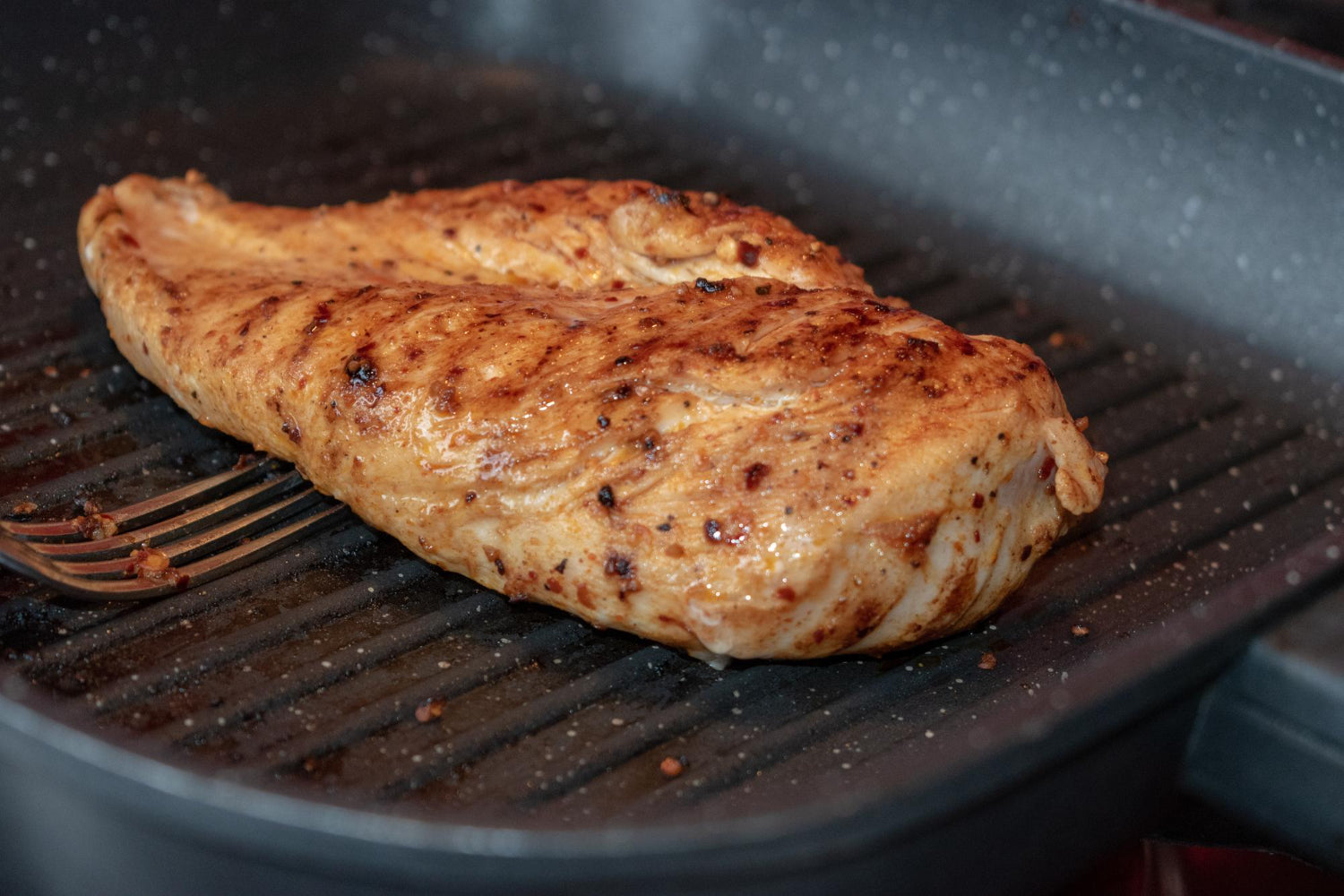


Chicken is the king of protein in any kitchen of people who train. Cheap, versatile, and very low in fat. But when you start counting your day, the question arises: how much protein does a breast really have? Is it the same raw as cooked? And the thigh, does it have less?
Here are the clear figures, cut by cut, with a detail almost no one tells you that changes the calculation: chicken gains protein per 100 grams when cooked, because it loses water. Let’s look at the numbers and then the practical: how much chicken you need to reach your daily goal.
| Chicken cut (skinless) | Protein /100 g | Calories /100 g |
|---|---|---|
| Breast, cooked | ~31 g | ~165 kcal |
| Breast, raw | ~23 g | ~120 kcal |
| Thigh / drumstick, cooked | ~26 g | ~210 kcal |
| Wing, cooked | ~27 g | ~230 kcal |
| Whole half chicken, cooked | ~27 g | ~200 kcal |
How much chicken do you need per day?
Calculate your daily protein and how much breast it equals.
How much protein does a whole breast have
The numbers per 100 grams are great, but you buy and cook whole pieces. Let’s get real. A medium chicken breast weighs about 150 grams raw. When cooked, it loses water and ends up around 110-120 grams. Since cooked breast has about 31 grams of protein per 100, that breast provides you with around 34-37 grams of protein.
In other words: a medium breast covers a protein serving adequately for almost anyone. Two breasts a day and you’re already around 70 grams just with chicken, not counting eggs, dairy, legumes, or fish.
Why raw and cooked don’t give the same result
This is the point that throws off many people's calculations. Raw, the breast has about 23 grams of protein per 100. Cooked, it rises to about 31. Does protein appear out of nowhere? No. What happens is that heat evaporates water, the piece loses weight, and the same protein is concentrated in fewer grams.
The practical consequence: if you weigh the chicken raw, use the raw figure (23 g/100 g); if you weigh it cooked, use the cooked figure (31 g/100 g). Mixing the two is the classic mistake that makes people believe they eat more or less protein than they actually do.
Breast, thigh, or wing: which to choose
The breast wins in pure protein and less fat, which is why it’s the favorite for defining or controlling calories. But it’s not the only sensible option.
The thigh and drumstick have slightly less protein (about 26 g/100 g cooked) and more fat, which also means more flavor and juiciness. For everyday meals, they’re a great option and usually cheaper. The wing has a decent protein ratio but lots of skin and fat, so it’s less efficient as a main source. And if you eat the skin, add fat and calories to any cut. Neither the thigh is "bad" nor the breast the only valid choice: it’s about fitting it into your goal.
Chicken compared to other proteins
Chicken is a staple, but it’s not the only good source nor does it have to be the only one. Seeing it alongside other foods helps create a varied day without obsessing over the breast:
| Food (100 g, cooked) | Protein | Note |
|---|---|---|
| Chicken breast | ~31 g | Lean, versatile, cheap |
| Tuna (natural) | ~29 g | Convenient, provides omega-3 |
| Lean beef | ~27 g | More iron, a bit more fat |
| Salmon | ~25 g | Good fat, omega-3 |
| Egg (2 units) | ~13 g | Reference protein, very complete |
| Cooked lentils | ~9 g | Vegetable; combine it with cereal |
The practical takeaway: chicken and tuna top the list for lean protein; eggs yield less per 100 g but are of very high quality; and legumes, although lower in protein, add fiber and hold their own if you combine varieties throughout the day. It's not about eating only the top of the list, but about distributing well.
How to cook it without ruining the good stuff
Chicken protein holds up well to cooking: you don't destroy it by grilling or baking. What really changes are the calories, depending on how you cook it. Grilled, baked, or boiled, the breast stays lean. Breaded, fried, or drowned in sauce, you add fat and calories that weren't in the chicken.
Two useful notes. One: removing the skin before eating cuts a good part of the fat from any cut. Two: don’t overcook it; overcooked chicken loses juiciness (water), which concentrates more protein per gram but leaves it dry. Protein neither disappears nor is "activated" by cooking it one way or another: what you decide when cooking is how much fat accompanies it.
How much chicken you need for your daily protein
This is where the chicken figure really becomes useful. The amount of protein you need depends on your weight and activity level. Roughly: around 0.8-1 g per kilo if you’re inactive, 1.6 g if you train regularly, and up to 2 g per kilo if you want to gain muscle. You can find the details in how much protein to take per day.
Translated to chicken: a 70-kilo person who trains needs about 112 grams of protein per day. That’s around 360 grams of cooked chicken breast, roughly three medium breasts. And here lies the real problem: eating three chicken breasts every day is not only boring but also hard to maintain.
When chicken alone isn’t enough
No one covers their protein intake with chicken alone, nor should they try. The logical approach is to spread it across several sources: eggs, dairy, fish, legumes, meat… with chicken as a pillar. Still, some days don’t add up: you train hard, you’re away from home, you don’t feel like cooking, or you simply don’t reach your target.
For those gaps, there is protein powder. It’s not "better" than chicken nor does it replace it: it’s the quick and convenient way to add 25-30 grams of quality protein when your meal isn’t enough. A shake takes one minute to prepare and is easy to digest after training. If you wonder how it fits in, we explain it in what protein is for.

Proteinn 100% Whey Isolate
Up to 89% protein per serving, no aspartame, and made in Spain. To complete your daily protein when your meal falls short, in one minute.
View productFrequently asked questions
Cooked and skinless, about 31 grams of protein per 100 grams, with around 165 kcal. Raw, it drops to about 23 grams per 100, because it still retains the water lost during cooking. Use the figure that corresponds depending on whether you weigh the chicken raw or cooked.
A medium breast weighs about 150 grams raw and ends up at 110-120 grams when cooked. That equals about 34-37 grams of protein. With two breasts a day, you’re already around 70 grams of protein from chicken alone, not counting other foods.
No new protein appears: what happens is that heat evaporates water, the piece weighs less, and the same protein is concentrated in fewer grams. That’s why 100 grams of cooked breast has more protein than 100 grams of the same raw breast.
The breast: about 31 g/100 g cooked versus 26 g/100 g in the thigh. The thigh has slightly less protein and more fat, which gives it more flavor and juiciness. Both are high-quality proteins; the choice depends on whether you prioritize protein grams or flavor and calories.
Yes. Chicken provides all the essential amino acids your body can’t produce, including a good amount of leucine, which most stimulates muscle repair. It’s one of the best animal proteins due to its quality and low fat content.
It depends on your weight: to gain muscle, aim for about 1.6-2 g of protein per kilo per day. A 70 kg person would need about 112-140 g of protein, which in chicken breast alone would be 3-4 pieces. In practice, you don’t get all your protein from chicken: it’s spread across various sources and supplemented with a shake if needed.
Skinless chicken breast is one of the foods with the best protein-to-calorie ratio, so it fits perfectly in a fat-loss diet. What adds calories is the skin, breading, and sauces. Grilled or baked chicken without skin is one of the “lightest” proteins available.
They don’t compete: they’re for different moments. Chicken is real food, filling and more nutrient-rich. Protein powder is the quick way to add 25-30 grams when you can’t or don’t feel like cooking, especially after training. Ideally, base your diet on food and use shakes to fill gaps.
Practically none. Freezing and properly thawing chicken doesn’t destroy the protein; at most, it loses some water and juiciness. Its nutritional value remains almost intact, so buying and freezing is a perfectly valid way to always have quality protein on hand.
They’re almost equal: chicken breast has about 31 g per 100 g cooked, and natural tuna about 29 g. The difference is minimal. Tuna wins in convenience (ready-to-use can) and provides omega-3; chicken wins in versatility and price. Both are top lean protein options for everyday.
No. Protein holds up well to cooking; neither grilling nor baking destroys it. What changes depending on how you cook it are the calories: grilled, baked, or boiled stays lean, while breaded or fried adds fat. Removing the skin cuts a good part of that fat in any cut.
As a reference, about 25-40 grams per meal, depending on your weight and goal. A medium chicken breast already puts you in that range. Spreading protein across several meals a day makes better use of each intake than concentrating it all in one, especially if you want to gain or maintain muscle.
Yes, it’s a perfectly suitable food for everyday use. Still, varying between chicken, fish, eggs, lean beef, and plant sources gives you a wider range of nutrients (iron, omega-3, fiber) and prevents boredom, which is what usually makes people give up on a diet.
Redacción y revisión del artículo
Share:
Magnesium for athletes: how much you need and how to take it
Pressotherapy Boots: A Buying Guide to Help You Choose Right