


You've been on the sofa for a while and realize you've put your feet up on the armrest without thinking about it. You've been doing it for months. You've also noticed that your trousers feel tight around the ankle at seven in the evening but not in the morning. And the other day, while crossing your legs at dinner, you noticed that one of them went numb within five minutes.
What people call poor circulation in the legs is almost never a diagnosis. It's a collection of sensations: heaviness at the end of the day, swelling that comes and goes, tingling in the legs... And after the age of 40, it appears earlier and lasts longer, for reasons that make quite a lot of sense when you look at them together.
I'll explain what's happening inside your body, what you can do at home starting today, and when this stops being a matter of habits and it's time to have a professional take a look.
| What you notice | When it appears | What is usually behind it |
|---|---|---|
| Heaviness at the end of the day | From the afternoon onward, improves when you lie down | Accumulation from spending hours with your legs below your heart |
| Sock mark | When you take your shoes off at night | Some fluid accumulates in the ankle throughout the day |
| Your shoe feels tight in the afternoon | Progressively throughout the day | The foot expands slightly after hours of standing or sitting |
| Tingling when crossing your legs | A few minutes after staying in that position | Postural compression, resolves when you change position |
| Worse in the heat | Summer, high heating, hot baths | Heat dilates the veins and intensifies the sensation |
| Worse in the days before your period | Cyclical, resolves on its own | Normal hormonal fluctuation in fluid retention |
What's happening to your legs?
Tell us how you spend your day and when you notice it most, and we'll tell you where to start.
What "I have poor circulation" really means
Let's start with the basics, because the expression is so common that it has stopped meaning anything specific.
Blood flows down to your legs, pushed by your heart, without any problem - gravity helps there. The "problem" is getting back up. Moving back up from the ankle to the chest, against gravity, is work the heart cannot do alone. It needs help.
That assistance has two parts. The first is a set of valves inside the veins that work like one-way doors. They let blood pass upward and prevent it from flowing back down. The second is what's called the muscle pump, which is the calf muscle. Every time you take a step, that muscle contracts, squeezes the veins inside it, and pushes the blood a little farther upward.
And it's not a minor detail. It is estimated that around 90% of venous return while walking depends on these leg muscle pumps, with the calf muscle playing the leading role. The heart pumps downward. To move blood upward, your legs have to do extra work.
Kohno K, Williams EM et al. · The calf muscle pump revisited · Journal of Vascular Surgery, Venous and Lymphatic Disorders, 2013.
And this is the important part. That pump only works if you move. Simply standing isn't enough. You need to walk, or at least move your ankle. If you spend seven hours sitting in a chair or five hours standing almost on the same spot, the pump stops, and it takes the blood longer to travel upward.
When that happens for hours, some fluid accumulates in the tissues of the calf and ankle. That's what you notice in the afternoon.
Why it becomes noticeable sooner after age 40
This is the question that brings many people here. At 28, you worked the same day and got home without noticing anything. Now, by six in the evening, your legs can't take any more. It's not just one thing; several factors gradually add up.
Veins lose elasticity over the years. This has been measured. Comparing young and older men, calf venous compliance, which is the vein's ability to stretch and accommodate blood, is reduced by around 40% in sedentary people. The interesting part comes next. In people who regularly trained for endurance, that decrease was only 20%. Half as much.
Monahan KD et al. · American Journal of Physiology, Heart and Circulatory Physiology, 2001. Comparison between young and older men, not an annual rate.
You lose muscle mass without realizing it. From a certain age onward, if you don't do strength training, muscle gradually starts to decline. And it turns out that your return pump is a muscle. Less calf muscle, less pumping. This is the most important of the four points, and the one that the fewest people make the connection with.
A typical day changes. At 25, you climbed stairs at a run, went out more, and moved around without thinking about it. At 45, there are more hours spent sitting, more driving, and less movement. It's not your fault; that's how adult life works.
And in women, the hormonal component is added. Perimenopausal fluctuations affect how the body handles fluids. It's worth being honest here: the relationship is considerably more complex than it is usually portrayed, and it has been studied less thoroughly than you might imagine. But many women describe a clear change over a short period, and that observation is real even though the exact mechanism is not yet fully understood.
If what stands out most to you is afternoon heaviness rather than the circulation aspect, we have another article that delves into that side, why tired legs appear after the age of 40. The two topics overlap quite a bit, but each follows a different thread.
What makes it worse in everyday life
Small actions add up to a lot. These are the ones I see repeated most often.
- Staying still, whether standing or sitting. The enemy isn’t the position; it’s immobility. That said, standing still without moving is especially demanding, because the entire column of blood weighs from the heart to the ground. It has been measured, and venous pressure at the ankle during quiet standing is around 84 mmHg, while simply walking slowly is enough to bring it down to about 23. That’s the whole issue, in one figure.
- Crossing your legs for a long time. That tingling you notice is postural compression, and it goes away when you change position. And while we’re at it, let’s debunk a widespread myth: crossing your legs does not cause varicose veins. The pressure one leg puts on the other isn’t enough to damage a vein. If you already have discomfort, holding that position for an hour can worsen the sensation, but it isn’t creating the problem.
- Heat. Very hot baths, saunas, high heating, summer. Heat dilates the veins and intensifies the feeling of heaviness. That’s why everyone notices it more in August.
- Drinking too little. It sounds backwards, and there’s an explanation. When you’re dehydrated, your body activates hormones that tell the kidneys to conserve water and sodium. It’s a defense mechanism, and the result is that you retain more. Once you rehydrate, those signals decrease and the kidneys go back to working normally.
- Eating too much salt. Sodium is the mineral that controls the fluid outside cells. If too much enters, that compartment expands, which accounts for much of the swollen feeling.
- Very tight clothing around the groin or waist. Trousers that squeeze exactly where the vein needs to pass toward the abdomen do not help. I'll describe this for what it is: it makes perfect sense, but it is one of the few things on this list that has not been well studied.
- Wearing high heels all day. It has been measured, and it does worsen pump function. The reason is not that the calf is "under tension"; it is that the heel limits ankle movement, and without that rocking motion the pump cannot squeeze effectively. With heels, more residual blood remains in the leg after each contraction.
Venous pressure according to posture, Stick C, Jaeger H, Witzleb E · Journal of Applied Physiology, 1992. Footwear and muscle pump, a study on venous function and high heels in young women · Journal of Vascular Surgery, 2012.
What actually works and what you can start now
I'll order them by what really delivers. The first three are free and are the ones you shouldn't skip.
| What | Why it works | How much is needed |
|---|---|---|
| Walking | Activates the muscle pump, which moves most of the venous return | 30 min a day, three sets of ten count |
| Move your ankle | The same mechanism, but without getting up from your chair | 20 ankle flexion-extension movements, 3 times a day |
| Legs elevated | You put gravity on your side instead of against you | The usual recommendation is 30 min above heart level, and even 10 min helps |
| Calf and quadriceps strength | It is the only thing that measurably improves the pump in the medium term | 2 short sessions per week |
| Water and salt under control | Less baseline retention, less feeling of swelling | 1.5-2 L per day, cook without overdoing the salt |
| Light compression during the day | Supports venous return while you are active. It is one of the best-supported options in the table | 15-20 mmHg sock on long days |
| At-home pressotherapy | Sequential compression from the feet upward, when you cannot move | 10-20 min, 3-5 times a week |
Notice that the first four do not cost a penny. They cost consistency, which is harder, but that's the reality. If you're looking for where to start and can choose only one, choose walking. It's the most accessible and one of the most effective, although it's worth noting that compression has the strongest support in studies.
And one thing about strength, which is often overlooked. Trials have shown that a structured calf exercise program measurably improves the muscle pump's emptying capacity. This is not just a textbook recommendation; it is one of the few things on this list backed by trials.
Padberg FT et al. · Structured exercise improves calf muscle pump function · Journal of Vascular Surgery, 2004. Confirmed in subsequent systematic reviews.
The 25-minute routine you can start today
This requires no equipment, no gym, and no change to your life. It consists of four moments spread throughout the day.
| When | What to do | How long |
|---|---|---|
| Before getting up | 20 ankle flexions and extensions lying down, before putting your feet on the floor | 1 minute |
| During the day | Get up every 60 or 90 minutes and walk for a couple of minutes, even if it’s just to the kitchen | Add 10 minutes |
| When you get home | Take off your shoes and any tight clothing. Take a lukewarm shower, finishing with cool water on your legs, from ankle to knee | 5 minutes |
| Before bed | Legs raised against the wall, breathing slowly | 10 minutes, and 30 is even better if you can manage it |
And twice a week, do squats and calf raises. Three sets of fifteen in the living room while the pasta water boils. That’s all you need to get started.
Where pressotherapy fits into all this
Let’s move on to the product side, and I’ll tell you about it with the same honesty as the rest.
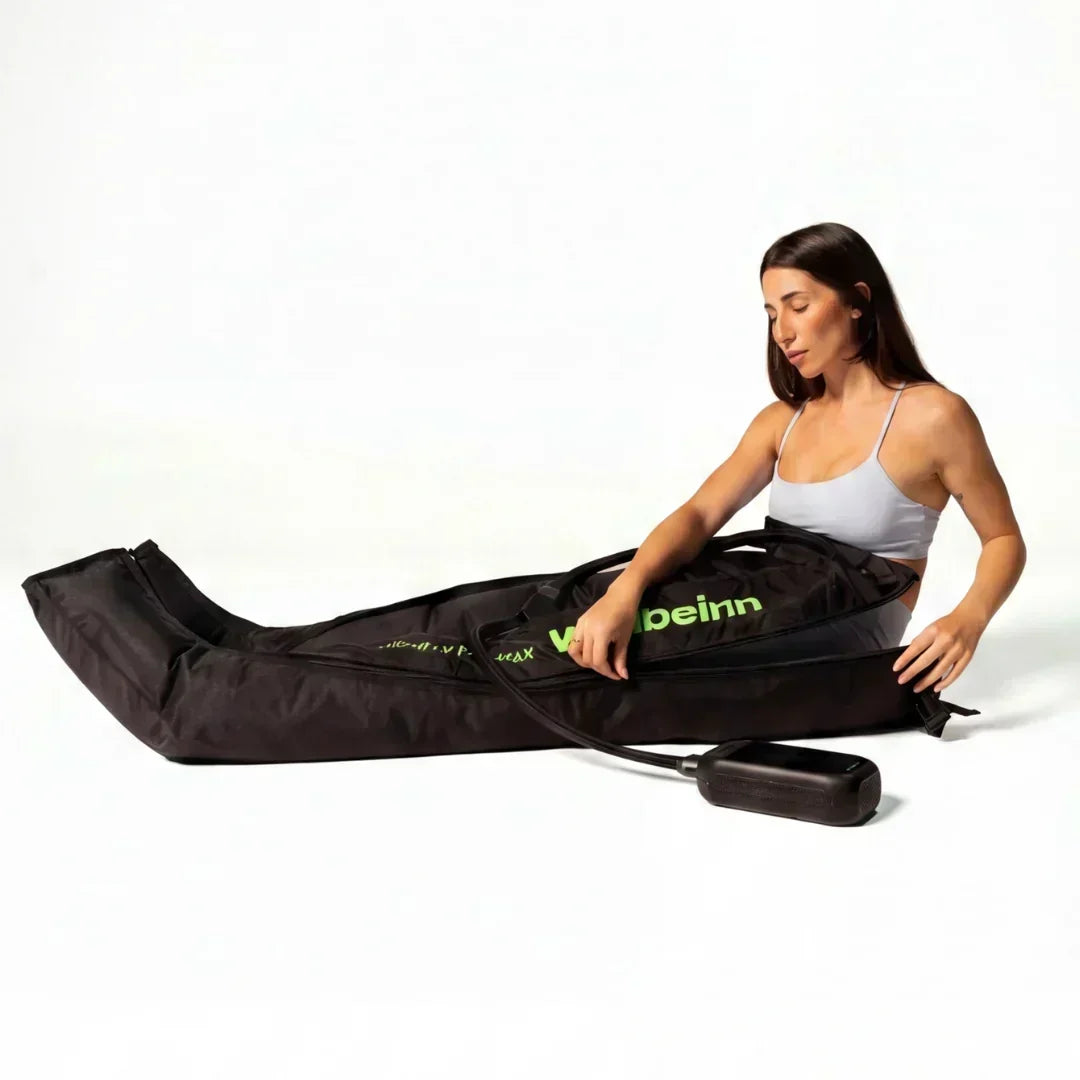
Pressotherapy is sequential pneumatic compression. Air chambers inflate in sequence, from the ankle upward. Basically, it recreates from the outside the squeezing action your calf performs from within when you walk. That’s why it makes sense precisely on days when you haven’t been able to move.
What you notice when you finish a session is a sensation of lightness in your legs. Your ankle feels less tight, your foot less hot, and your legs more rested. It’s a feeling of comfort, not a treatment, and it’s best to say it exactly as it is.
Now for the interesting part, which is where almost the entire industry gets things backwards.
The numbers game, and why we don’t play it
If you compare pressotherapy devices, you’ll notice something curious. They all compete for the highest number. 260 mmHg. 46 levels. 8 chambers. Figures that sound like power and, let’s be honest, mean nothing to the person reading them.
The result is that no one knows how to interpret those numbers, so people end up comparing the only one they do understand, the price, and the cheapest one wins.
Our pressotherapy pants reach 260 mmHg. We deliberately limit them to 200.
The reason has been measured. Partsch used ultrasound to measure how much pressure is needed depending on the body's position, and found that when lying down, between 20 and 25 mmHg is enough to completely close the leg veins, both superficial and deep. When sitting, between 50 and 60 is needed. Standing, about 70. Twenty lying down. Not two hundred and sixty.
Partsch B, Partsch H · Calf compression pressure required to achieve venous closure from supine to standing positions · Journal of Vascular Surgery, 2005. Small study, 9 healthy volunteers and 5 patients.
Giving up a number that would help us win the comparison on the spec sheet is an uncomfortable marketing decision. But beyond a certain point, what appears is not more benefit, but less tolerance. And a session you cannot tolerate is a session you do not do.
Why each chamber operates independently
There is another detail that almost no one in the industry uses, and which I find the most interesting of all.
The pressure shown by the device is not the pressure that reaches the tissue. And it does not reach all areas equally. Zaleska, Olszewski, and their team measured it with a needle, directly inside the tissue, and found that inflating the chamber to 120 mmHg produced about 130 mmHg of pressure in the calf and only about 40 in the groin. The same chamber, three times less pressure higher up. The authors themselves conclude that different pressures need to be applied at different levels of the limb.
Zaleska M, Olszewski WL et al. · Lymphatic Research and Biology, 2013;11(4):227-232. Measurement in limbs with fluid accumulation, not healthy legs.
That is why, in our HighFly Pro Max pressotherapy trousers, each chamber is configured independently. It is not a luxury feature for people who want to press buttons. It is the logical consequence of that fact.
Which of the two suits you
There are two, and the difference is not which one is better but what each one is for.
| Model | Format | Control | Who it is for |
|---|---|---|---|
| HighFly Pro | Boots, coverage up to the hips, glutes, and lower back. 6 chambers. Wireless battery lasting more than 3 h | 6 ready-made modes. Choose one and get started | For those who want to sit on the sofa and not think. It covers most cases well |
| HighFly Pro Max | Full trousers, same coverage. 6 chambers. USB-C battery lasting up to 6.5 h. LCD screen | From 0 to 200 mmHg in 6 levels, 5 programs, and one chamber-by-chamber custom program | For those who want to adjust the settings according to the day and see what the device is doing at any given moment |
If what you want is to sit down for twenty minutes after a long day and get up with lighter legs, the HighFly Pro is more than enough. The Pro Max makes sense if you like fine-tuning, want different programs for different days, or are looking for the trouser format for its fit.

HighFly Pro · Pressotherapy Boots
6 sequential chambers from the foot to the hip, 6 preset modes, and a wireless battery lasting more than 3 hours so you can use it wherever you want. Twenty minutes on the sofa and your legs feel lighter.
View HighFly ProHow to tell if what you're doing is working
This is where many people go wrong. You start a routine, three weeks later you don't "look" different, and you give up. The problem is that you're using the worst measuring instrument there is: your own perception.
There are simple ways to have data instead of a sensation.
- Ankle circumference measured with a tape measure. Measure it in the morning and again at night, always at the same point. The difference between the two is what has accumulated during the day. Record it once a week.
- Photo of the sock mark. Every Sunday night, at the same time, with the same sock. It sounds silly and is one of the most useful things you can do, because your eyes get used to it in three days and the photo doesn't.
- Body water percentage. If you have a bioimpedance scale, it gives you this figure. It's worth knowing that this is the parameter that fluctuates the most of all, so compare weekly averages and never two isolated days. If you want to properly understand this number and the other seven, we explain it all in the article about what a bioimpedance scale really measures.
With any of the three, in four weeks you'll have a baseline to guide you. And a line tells you things that a sensation doesn't.
When does this stop being about habits?
Everything above assumes one important thing: what you are experiencing is tired, swollen legs. Both legs are more or less equally affected, symptoms appear over the course of the day, improve when you elevate them, and you wake up feeling fine the next day.
If your case does not fit this, it is beyond the scope of a blog article and you need to consult your doctor.
1. Both legs suddenly swell and you are also short of breath, have trouble breathing when lying down, or notice pain or pressure in your chest.
2. One leg becomes cold, pale, or bluish, with intense, sudden pain, and you cannot feel its pulse. Every hour truly counts here.
3. An area of your leg becomes red, hot, and swollen, keeps getting larger, and you also have a fever or feel unwell.
And with less urgency, but without putting it off, make an appointment with your doctor if any of these occurs.
- Swelling or pain in one leg only, especially if it appears suddenly or is accompanied by warmth and redness in one area.
- Swelling that does not go down in the morning after sleeping with your legs elevated.
- Prominent veins that hurt, are uncomfortable, or have changed appearance over a short period.
- Wounds on the lower part of the leg that take a long time to heal.
- Skin changes near the ankle, dark spots that do not go away, skin that feels hardened, or eczema that keeps coming back in the same area.
- Pain when walking that forces you to stop and improves with rest.
- You are pregnant or take hormonal medication and notice a significant change.
- You have a direct family history of serious circulatory problems.
The essentials in four lines
Frequently asked questions about circulation in the legs
In everyday use, it is not a diagnosis but a set of sensations. Heaviness at the end of the day, swelling that comes and goes, a sock mark, tingling when crossing your legs. It usually comes from the return of blood from the legs to the heart, which goes against gravity, not receiving enough help from the calf muscle pump. And that pump is activated only when you move, not when you are standing or sitting still.
Four things come together. Veins lose their ability to stretch with age, and this has been measured: venous compliance in the calf decreases by around 40% in sedentary people when comparing younger and older adults. Muscle mass is lost if you do not strength-train. A typical day now tends to involve more hours sitting in a chair and in a car than it did at 25. And in women, hormonal fluctuations affect how the body handles fluids. Of the four, the one you can change most quickly is calf muscle mass.
Walking is the most accessible and one of the most effective things you can do. Thirty minutes a day, and three ten-minute sessions count. Each step activates the calf muscle pump, which moves most of the venous return when you walk. Then, move your ankle several times a day, elevate your legs at night, and do some strength training two days a week. And if you want to know what has the strongest support in studies, it is compression, which is also inexpensive.
Both are bad if you stay still; the real problem is immobility. That said, standing still without moving is more demanding, because the entire column of blood weighs from the heart to the ground. In people who were studied, venous pressure at the ankle while standing still was around 84 mmHg, whereas simply walking slowly was enough to lower it to about 23. When you are seated, the vertical column is shorter, but the pump does not work either, and a bent knee does not help. The solution for both situations is the same: get up and move around every hour or hour and a half.
No, and it is one of the most common myths out there. The pressure one leg puts on the other when you cross them is not enough to damage a vein. What can happen is that you notice tingling from postural compression, or that if you already have discomfort, holding that position for a long time makes it slightly worse. But crossing your legs is not causing the problem. You can cross them comfortably, changing position from time to time as you would with any sustained posture.
Yes, and it is one of the uses with the strongest supporting evidence. It has been studied in healthy people who spend the day standing or sitting, and light compression reduces end-of-day swelling. The 15-20 mmHg range is standard for prevention, can be purchased without a prescription, and is generally well tolerated all day. Above 20-30 mmHg, a professional should advise you, because at those levels your leg's arterial circulation should be assessed first. And if your doctor has already prescribed a specific level of compression, follow their instructions.
It is sequential pneumatic compression, meaning air chambers that inflate in sequence from the ankle upward. From the outside, it mimics the squeezing action your calf performs internally when you walk, which is why it makes sense on days when you have not been able to move around. What you notice afterward is a feeling of lightness and rested legs. It is for comfort and well-being, not a treatment. And to be honest, most studies have been conducted in people with already diagnosed problems, so there is less evidence for healthy people than is usually claimed.
Much less than the industry claims. Partsch used ultrasound to measure how much pressure is needed depending on posture and found that, when lying down, just 20 to 25 mmHg is enough to completely close the leg veins, both superficial and deep. When sitting, 50 to 60 is needed, and when standing, about 70. So although our hardware reaches 260 mmHg, we deliberately limit it to 200. Above a certain point, what you gain is not a benefit but discomfort.
Because the pressure shown on the device is not the pressure that reaches the tissue, and it does not reach all parts of the leg equally. Zaleska and Olszewski measured it with a needle directly inside the tissue and found that inflating the chamber to 120 mmHg produced about 130 mmHg in the calf and only about 40 in the groin. The authors conclude that different pressures should be applied at different levels of the limb, and that is exactly what configuring each chamber separately allows.
There are quite a few situations in which you should consult a professional first. Pregnancy, any diagnosed circulation problem, poor arterial circulation in the legs, medication related to blood clotting, heart problems or shortness of breath with minimal exertion, open wounds, infection or irritated skin in the area, recent severe bruising to the leg, and loss of sensation in the leg. And if you have ever been told that you had a blood clot, you absolutely must consult a professional before using anything. This is not a list intended to scare you; compression moves fluid around inside the body, and that is not harmless in every situation.
Between 3 and 5 times a week, in 10- to 20-minute sessions. I should warn you that these figures are only guidelines and come from the product's own instructions, not from a standardized protocol, because there is no well-supported scientific regimen for home use. The best time is usually at the end of the day, after taking off your outdoor clothes and before dinner.
Because heat dilates the veins, which intensifies the feeling of heaviness and swelling. It is the same reason a very hot bath feels wonderful at first and then leaves your legs feeling heavier. If this happens to you, try finishing your shower with cool water on your legs, from the ankle to the knee, and avoid overdoing very hot water on the hottest days.
It helps, although many people think the opposite. When you are dehydrated, your body activates hormones that tell the kidneys to conserve water and sodium, and the result is that you retain more. Once you rehydrate, those signals decrease and the kidneys return to normal function. Drinking between one and a half and two liters spread throughout the day, rather than concentrating it all at night so you do not interrupt your sleep, is usually what works best. That said, leg swelling at the end of the day is mainly due to gravity and the hours spent still, not to whether you have drunk too little.
The day-to-day sensation improves fairly quickly, within a matter of days. The underlying change takes longer and depends greatly on each person. As a reference, studies measuring real improvements in the muscle pump through exercise usually cover periods of six weeks or more, so give it at least that long before deciding whether it is helping you. The most common mistake is giving up in the second week, which is exactly when nothing is visible yet.
There are three situations that are emergencies and cannot wait. If both legs suddenly swell and you are also short of breath or have chest pain. If one leg becomes cold and pale, with sudden severe pain and no pulse. And if an area becomes red, hot, and swollen, keeps spreading, and you also have a fever. In all three cases, go to the emergency department or call 112. Less urgently but still without putting it off, make an appointment if there is swelling or pain in just one leg, swelling that does not go down in the morning, veins that hurt or have changed, wounds that take a long time to close, dark patches or hardened skin near the ankle, or pain when walking that forces you to stop.
Redacción y revisión del artículo
Share:
Bioimpedance scale: what it really measures and how to read your data