


You started looking for a pressotherapy machine for home and ended up in a sea of specs all saying the same: “professional drainage,” “total recovery,” “advanced technology.” Prices ranging from €80 to over €800, and nowhere explains why one device costs ten times more than another.
This guide is designed so you leave knowing exactly what to look for. What a pressotherapy machine really does, the six or seven criteria that separate a good one from an expensive one that doesn’t work, what you need depending on your case, and where each model fits. No hype, and also telling you what you don’t need.
| Appearance | What you need to know |
|---|---|
| What it does | Air chambers that inflate in sequence (from ankle to thigh) to push blood and lymph toward the heart |
| What it’s for | Recovery after training, decongest heavy legs, and improve venous and lymphatic return |
| Criterion #1 when buying | Real pressure in mmHg (60-120 useful) and number of independent chambers (4 to 8) |
| Typical session | 20-30 minutes, 3-5 times per week depending on use |
| Cheap that fails | Few chambers, weak pressure without indicated mmHg, no warranty or support |
| Do I need it? | If you train hard, spend the day standing or sitting, or often have tired and heavy legs |
Which pressotherapy machine suits you?
3 questions and we’ll tell you which model fits your case
What a pressotherapy machine is and how it works
A pressotherapy machine is essentially an inflatable sleeve that wraps around the leg (sometimes also the hip or arm) and a compressor that pumps air inside. There’s no other mechanical mystery than that. What makes it useful is not the air itself, but how and in what order it distributes it.
The system divides the sleeve into several independent air chambers and inflates them in sequence: first the ankle, then the calf, then the thigh. That wave of pressure moving from bottom to top is the key. It pushes blood and lymph in the same direction your body naturally wants to move them: toward the heart.
Sequential pressure and mechanical lymphatic drainage
This is called sequential pressure, and it’s what sets a decent machine apart from a simple cuff that inflates all at once. Inflating in order, the sleeve acts like a pump: it squeezes the fluid accumulated in the tissues and directs it toward the lymph nodes, just like a manual drainage massage would, but in a constant and measurable way.
That mechanical lymphatic drainage is what helps reduce swelling in heavy legs at the end of the day and removes waste products that accumulate in the muscle after a tough workout. It’s not magic: it’s pressure applied in the right direction, for long enough.
Why venous return improves
The veins in your legs work against gravity all day. They have valves that prevent blood from flowing backward, but when you spend many hours standing or sitting, that return becomes sluggish and blood pools. Hence the feeling of heaviness, swollen ankles, and, in the long run, spider veins.
Sequential compression helps those valves: it squeezes from outside in and from bottom to top, so the blood can only flow in one direction. The result is a more efficient venous return, lighter legs, and, for athletes, a muscle that recovers faster because fresh blood with oxygen and nutrients reaches it.
The 7 criteria that really matter when buying
This is where everything is decided. If you remember these seven points, you can distinguish a serious machine from one that just looks big in the box. They are listed in order of importance.
1. Real pressure in mmHg
The most important data and the one most often hidden. Pressure is measured in mmHg (millimeters of mercury), the same unit as blood pressure. A useful machine works in an adjustable range of 60 to 120 mmHg. Below 60 you feel a pleasant tingling but the effect on circulation is weak; the real working range starts there.
Be wary of specs that talk about “professional pressure” or “high power” without giving you a number in mmHg. If they don’t specify, it’s almost always because the real figure is low. Adjustable pressure also matters: you don’t use the same pressure to decongest tired legs (softer) as for intense sports recovery (firmer).
2. Number of chambers or cells
The more independent chambers, the smoother the pressure wave and the better the drainage. The reasonable minimum is 4 chambers per leg; good machines have 6 or 8. With 8 chambers, the pressure rises almost like a continuous caress from ankle to thigh, without abrupt jumps.
Very cheap machines usually have only 2 or 3 chambers, or even just one that inflates entirely. That’s not true sequential pressotherapy: it’s a cuff that tightens and releases. You feel something, yes, but you miss out on what really makes the difference.
3. Programs and modes
A decent machine offers several programs: ascending sequential (the basic one), wave drainage, localized massage, and sometimes modes that alternate zones. You don’t need twenty programs, but you do need to be able to choose intensity and type of massage depending on the day. A timer (10, 20, 30 minutes) and the option to isolate specific zones are the most useful features for everyday use.
4. Sizes and coverage
Here is the difference between a boot and a complete set. The usual options:
- Full leg boot: covers from ankle to groin. This is what 90% of people need.
- Pants with hips and waist: adds glutes and lumbar area. Useful for full drainage and aesthetic-professional use.
- Arm cuff: separate accessory, for arm lymphedema or upper body recovery.
Also check that the size of the sleeve fits you: if you have strong thighs or are very tall, a short sleeve leaves areas untreated and presses too much on the joints.
5. Battery or plug (portability)
Traditional machines work plugged in: the compressor is a box connected by cable to the boots. It works perfectly but ties you to one spot. Modern models integrate the compressor into the boots themselves and have a rechargeable battery, so you can use them on the couch, in the car after a run, or in a hotel without looking for an outlet. If you’re going to move around, the battery changes the experience; if the machine stays fixed in your living room, the plug gives you more power for less money.
6. Noise
The compressor constantly pumps air in and out, so there is always some noise. Good machines stay around 50-60 decibels, a soft hum that lets you watch a series or read without disturbance. Cheap ones with low-quality compressors can sound like a hairdryer. This is not a whim: if the machine bothers you, you’ll use it less, and a machine you don’t use recovers nothing.
7. Warranty and support
It’s a device with a motor, valves, and electronics that you will use many hours. A guarantee of at least 2 years and a brand with real after-sales service in Spain make the difference the day something breaks. Imported machines without a local distributor usually seem cheap until they break: then there’s no one to claim from.
Which machine you need according to your case
There is no universal "best machine." There is the best one for what you are going to do with it. Three profiles cover almost everyone.
The athlete who recovers
You run, bike, do CrossFit, or play matches. What you want is to remove the tiredness from your legs after exertion and arrive fresh for the next workout. You need firm pressure (90-120 mmHg) and at least 6 chambers for serious drainage. A 20-30 minute session after training, and you notice the difference the next day. Here, muscle recovery is the goal, and pressotherapy fits very well within a routine of rest, hydration, and protein.
The person with tired legs or poor circulation
You spend the day standing (hospitality, healthcare, retail) or many hours sitting (office, driving). At the end of the day, you feel heavy legs, swollen ankles, cramps. You’re not looking for brute force, you want gentle and constant drainage: 60-90 mmHg, wave programs, calm sessions while watching TV. Here, comfort and silence matter as much as pressure.
Professional use in clinic or aesthetics
If you’re going to use it with clients in a physiotherapy or aesthetic center, the game changes. You need robust equipment, with full coverage (full leg plus hip and waist), several programs, high and adjustable pressure, and materials that withstand many hours a day. Here, you don’t skimp: a machine that fails mid-morning with a client on the table costs you more than the price difference.
Typical mistakes when buying cheap
The market is full of machines costing €80-150 that seem like a bargain. Sometimes they are for very occasional use, but these are the flaws they almost always have:
- Few chambers: 2 or 3 cells, or just one. Without real sequencing, there’s no real drainage.
- Weak pressure without mmHg: “maximum comfort” on the specs and zero numbers. They usually stay at 30-50 mmHg, below the useful threshold.
- No certification or warranty: imported devices without clear CE marking or after-sales service. Cheap until they break.
- One-size covers that fit poorly: uncovered areas and pressure where it shouldn’t be (knee, groin).
- Noisy compressor: you end up using it for two weeks and it stays in the closet.
Comparison: the two machines we recommend with criteria
We’ve talked a lot about what to look for; now it’s time to put it into perspective. These are the two machines in the HighFly range and the case for each. It’s not that one is better than the other: they meet different needs.
| Criteria | HighFly Pro | HighFly Air |
|---|---|---|
| For whom | Intensive use, demanding athlete, clinic | For those who want to take it with them or use it on the couch |
| Coverage | Boots + pants (leg, hip, waist) | Full-leg boots |
| Sequential pressure | High and adjustable, multi-chamber | Adjustable, multi-chamber |
| Power supply | Wired compressor (fixed power) | Rechargeable battery, portable |
| Mobility | Fixed equipment at home or center | Take it anywhere |
| Price | €585 (previously €834) | €499 (previously €699) |
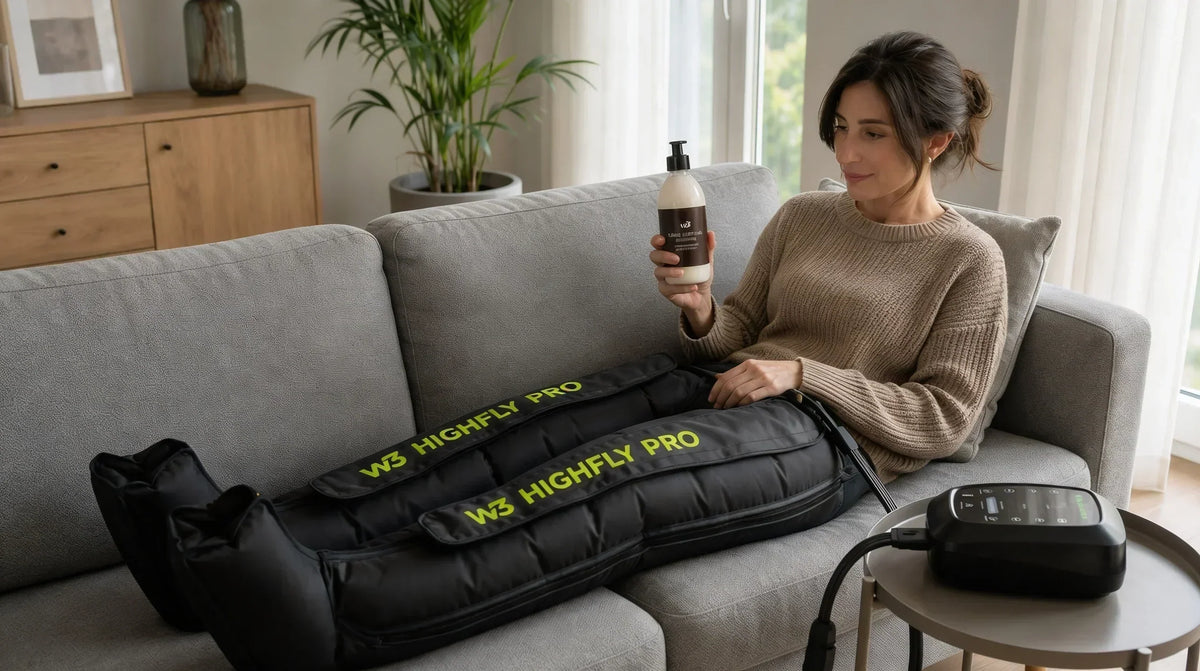
The HighFly Pro is the complete option: boots plus pants, so it covers the entire leg, hip, and waist. High and adjustable pressure for those who train hard and want serious drainage, or for those who will use it with clients in a center. It’s the equipment to avoid falling short.
The HighFly Air solves another problem: freedom. It has an integrated compressor and battery, so you’re not dependent on a plug or a cable going to a box. You use it on the sofa, take it to competitions or the hotel, and store it without hassle. If your priority is freedom of movement and you don’t need hip coverage, it’s the logical choice.

HighFly Pro
Boots + pants · high and adjustable sequential pressure · covers entire leg, hip, and waist. The complete set for intensive and professional use.
View productIs it worth it for home use or better to go to a clinic?
A pressotherapy session at a center costs around €20-40 and lasts about 30 minutes. If you use it three times a week, in a couple of months you’ve already paid the equivalent of a mid-range machine. Pressotherapy works through consistency, and having it at home is what really makes you use it, without booking appointments or traveling.
If you only want it for something very specific (a particular recovery, trying before buying), the clinic makes sense. But if your problem is recurring — heavy legs every day, frequent training — owning your own machine pays for itself and you use it whenever it suits you. You have the full cost and convenience comparison at pressotherapy at home.
Frequently Asked Questions
The useful range is from 60 to 120 mmHg. To decongest tired legs, 60-90 mmHg is enough; for intense sports recovery, you’ll want to reach 90-120 mmHg. The important thing is that it’s adjustable: being able to raise and lower it depending on the day is more valuable than a huge maximum number you’ll never use.
It does help with fluid retention: by moving lymph and improving drainage, it deflates the leg and reduces that feeling of heaviness. With cellulite, it’s more nuanced: pressotherapy can improve the appearance by reducing the accompanying retention, but it does not eliminate fat nor is it a slimming treatment. As support within a routine, it adds value; as a miracle solution, it does not.
The reasonable minimum is 4 chambers per leg. Good machines have 6 or 8: the more chambers, the finer and more progressive the pressure wave from ankle to thigh. Below 4, it’s no longer true sequential pressotherapy, but a cuff that inflates almost entirely.
Yes, in a healthy person there is no problem using it daily, in sessions of 20-30 minutes. In fact, for tired legs, a gentle daily session gives very good results. For sports recovery, 3-5 times a week after training is usually enough. More sessions do not magically speed up anything.
The full leg boot (from ankle to groin) covers what most people need: recovery after training and tired legs. The full pants add hip, buttocks, and waist, making sense for full drainage or professional aesthetic use. If in doubt, the full leg boot is the safe choice.
It depends on frequency. If you use it several times a week regularly, owning a machine pays off in one or two months compared to clinic sessions (€20-40 each) and you can use it whenever you want. For very occasional use, the clinic is more cost-effective. Pressotherapy works through consistency, and having it at home guarantees that.
Yes, it’s important to be clear. It should not be used if you have active deep vein thrombosis, infections or open wounds on the legs, decompensated heart failure, or if you are pregnant without prior consultation. For any venous or heart condition, talk to your doctor before starting. It is very safe for healthy people.
A quality machine stays around 50-60 decibels: a soft hum that lets you watch a show or read without disturbance. Cheap ones with poor compressors can be much louder. If you plan to use it while resting at night, noise is a factor to check before buying.
If the machine will stay fixed in your living room, the plug-in model gives stable power for less money. If you want to take it with you (to a competition, work, or travel) or use it on the couch without cables, the rechargeable battery model changes the experience. It’s more a lifestyle decision than a power one.
In summary: how to choose without mistakes
Stick to the essentials: look at the actual pressure in mmHg (adjustable and reaching 90-120 if you train hard), the number of chambers (6-8 for serious drainage), that the size and coverage fit your body and goal, and that there is warranty and service in Spain. If a machine meets these, you’re on the right track. If it doesn’t provide numbers and just sells “advanced technology,” it’s marketing.
If you train intensely or want it for a center, the HighFly Pro is the complete equipment covering leg, hip, and waist. If you value the freedom to take it anywhere and use it without a plug, the HighFly Air with battery solves exactly that. Both do the important thing well: multi-chamber sequential pressure to move blood and lymph in the right direction. The choice depends on how and where you will use it.
Redacción y revisión del artículo
Share:
Whey Isolate Protein and What You Need to Know Before Buying It
Why magnesium and melatonin work better together than separately