


Pressotherapy is often sold as “good for everything.” The reality is more nuanced: the real benefits depend greatly on the person’s profile and what they are seeking. It does not have the same effects on a marathon runner as on a woman with post-mastectomy lymphedema, nor on a supermarket cashier standing 8 hours a day as on a 70-year-old man with varicose veins.
This guide is for those who want to know what it will specifically offer their case, in what timeframe, and with what consistency. If you want to understand how pressotherapy works or how to choose a device, you can find that in pressotherapy: what it is and how it works and in pressotherapy at home.
| Profile | Main benefit | Timeframe to notice | Recommended frequency |
|---|---|---|---|
| Athletes (running, cycling, strength) | DOMS reduction, recovery between sessions | 1-2 sessions | 3-5 times/week |
| Heavy legs / sedentary lifestyle | Symptomatic relief, improved circulation | 4-6 sessions | 4-5 times/week |
| Retention and edematous cellulite | Volume reduction, improved skin appearance | 6-12 weeks | 5 times/week |
| Post-aesthetic/oncological surgery | Edema reduction, fibrosis prevention | 8-15 sessions | According to medical protocol |
| Pregnancy and postpartum | Relief from retention, recovery | Continuous | 2-3 times/week (with medical OK) |
| Elderly and reduced mobility | DVT prevention, improved circulation | 2-4 weeks | 3-5 times/week |
Your pressotherapy profile in 10 seconds
Choose your situation and we’ll tell you what it offers, in what timeframe, and how often
For athletes: the best documented benefit
Sports recovery is the indication for pressotherapy with the strongest evidence. A meta-analysis on sequential compression pressotherapy showed a small to moderate effect size in reducing delayed onset muscle soreness (DOMS), with consistent results across studies.
What this means in practice:
Reduction of DOMS and improved sensation the next day
DOMS — that pain that appears 24-72 hours after intense training — is an inflammatory response to muscle damage from exercise. Post-effort pressotherapy speeds up the elimination of inflammatory markers (lactate, creatine kinase, pro-inflammatory cytokines) that cause that feeling of stiffness and pain.
Typical result: 25-45% reduction in perceived DOMS the next day. It’s not absence of pain, it’s significant attenuation.
Maintaining training quality during weeks of high load
For athletes training 4-6 days a week, the problem is usually not a single session — it’s the accumulation. When by Tuesday you’re already dragging Monday’s fatigue, Tuesday’s session quality drops. This accumulates over the microcycle and ends in overtraining or injury.
Regular pressotherapy (3-5 weekly sessions of 25-30 minutes) maintains muscle freshness between sessions and allows sustaining training load for more weeks. It is both preventive and curative.
Pre-competition: unloading without losing activation
The 24-48 hours before a competition, pressotherapy with moderate pressure (60-90 mmHg) is a useful tool to arrive with light legs without unloading so much that you lose muscle activation. Especially useful in endurance sports (marathon, triathlon, long-distance cycling) where leg heaviness is a critical factor.
Combination with cold and other techniques
For advanced athletes, the combination of pressotherapy + cryotherapy (cold plunge or cold shower) enhances the effect. Pressotherapy moves fluid and inflammation; cold reduces the local inflammatory response. Typical sequence: cold plunge 5-10 minutes → pressotherapy 25-30 minutes.
Frequency and dosage
| Training load | Pressotherapy frequency | Pressure |
|---|---|---|
| Recreational (3 days/week) | 1-2 sessions/week | 60-80 mmHg |
| Serious amateur (4-5 days) | 3-4 sessions/week | 80-110 mmHg |
| Competition (6+ days) | Daily or almost daily | 90-120 mmHg |
For people with heavy legs and mild circulatory problems
Another group where pressotherapy has a clear and quick impact. Typical symptoms of the profile:
- Heaviness in the legs that appears mid-afternoon and worsens toward the evening
- Swelling of ankles and insteps at the end of the day
- Sensation of heat or burning in the legs
- Occasional nighttime cramps
- Appearance of legs more “full” or “swollen” at the end of the day than in the morning
The mechanism: the venous system depends on the muscle pump to move blood back to the heart. In people who spend many hours sitting or standing still, that pump is stopped or overloaded. Fluid accumulates and is noticeable in the legs and feet.
Pressotherapy replaces that muscle pump from the outside. Sequential compression pushes venous and lymphatic fluid in the right direction, reduces fluid buildup, and improves return to the heart.
What to expect
- First 4-6 sessions: notable symptomatic relief. Legs feel lighter, less swelling at the end of the day
- Week 4-8: visible improvement in appearance and volume. Ankles and insteps more defined
- From week 12 onwards: the effect is maintained if frequency is sustained (1-2 sessions per week as maintenance)
Difference compared to venotonic medication
Venotonic medications (diosmin, calcium dobesilate, horse chestnut extracts) act on the tone of the venous wall. Pressotherapy acts mechanically on the flow. They are not alternatives — they are complementary. Those with moderate venous insufficiency benefit from combining them.
For fluid retention and edematous cellulite
Here we must separate what pressotherapy actually does from what is attributed to it.
What it does
- Reduces the volume of accumulated water retention (between 0.5 and 2 kg of interstitial water mobilized in regular sessions)
- Improves skin appearance in edematous cellulite (the one accompanied by swelling)
- Reduces the feeling of tension and heaviness in areas with retention
- Reduces visible retention markers: stockings that squeeze less, rings that fit well again, less deep sock marks
What it does not do
- Does not eliminate structural cellulite (fibrous, advanced, with visible nodules)
- Does not reduce subcutaneous fat or slim down
- Does not eliminate established aesthetic marks (stretch marks, sagging)
Realistic timelines
For visible aesthetic results in cellulite with an edematous component:
- First 2-3 weeks: better circulation and less heaviness are noticeable
- Week 4-8: visible changes in abdominal and leg swelling
- Week 8-12: noticeable improvement in skin appearance if combined with exercise and diet
- Beyond: maintenance
Those who stop at 3-4 weeks with aesthetic expectations are not using the device incorrectly: they are measuring at the wrong time. The aesthetic change in soft tissue takes months.

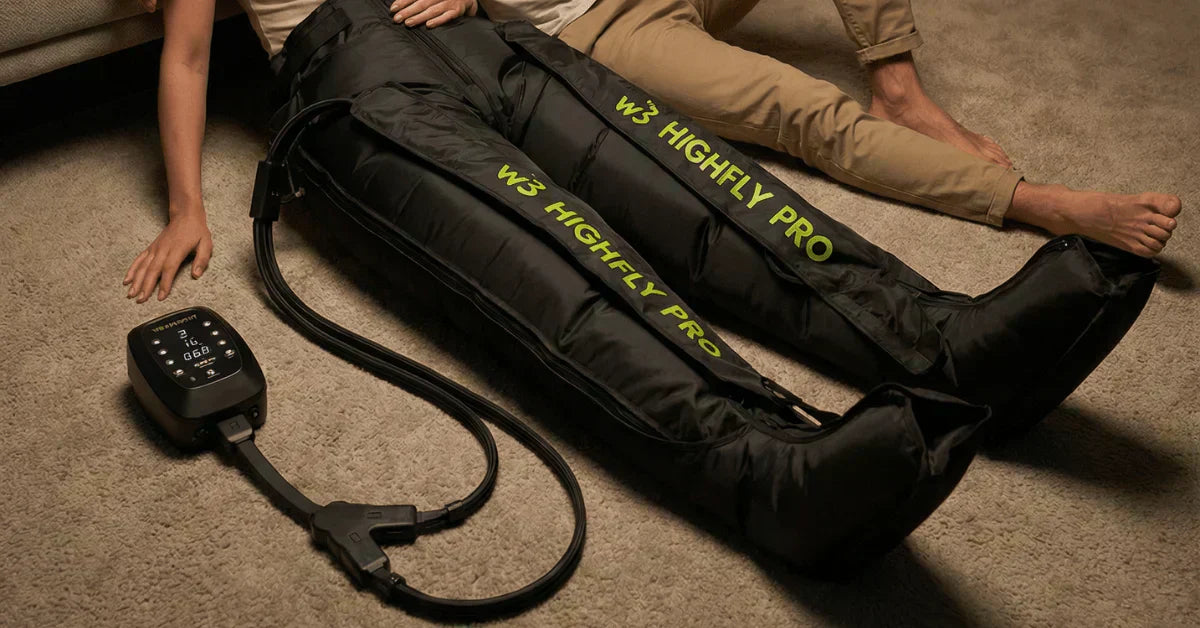
Highfly Pro — Pressotherapy boots
The professional home device: 6 chambers, 6 pressure levels, and 3 years warranty. The same technology used by physiotherapists in clinics.
View productPost-aesthetic and oncological surgery
Indication with clear clinical support and protocolized by most surgeons. Three typical scenarios:
Liposuction and abdominoplasty
After liposuction, the treated tissue fills with edema and, without management, fibrosis and adhesions form that can alter the final aesthetic result. The standard protocol is:
- Manual lymphatic drainage during the first 7-15 days post-surgery (with surgeon’s approval)
- Mechanical pressotherapy from week 2-3 up to 2-3 months post-surgery
- 3-5 weekly sessions in the active phase
The difference between following or skipping this protocol is seen in the final result at 3-6 months. Serious plastic surgeons prescribe it systematically.
Mastectomy with lymph node dissection
Post-mastectomy lymphedema is a common complication when axillary lymph nodes have been removed. The treatment of choice is:
- Manual lymphatic drainage performed by a specialized physiotherapist (not generic pressotherapy)
- Compression bandage or specific compression sleeve
- Mechanical pressotherapy as a complement, not as the main treatment
For this indication, manual drainage by a trained professional has the strongest evidence. Mechanical pressotherapy with an arm sleeve can be a useful complement between manual sessions but does not replace the clinical protocol.
Other abdominal and pelvic surgeries
Cesarean, hysterectomy, bladder surgery: situations where pressotherapy can help in the recovery phase, always with the surgeon’s and gynecologist’s approval. Usually indicated from 4-6 weeks post-surgery.
Pregnancy and postpartum
Indication that requires nuance: pressotherapy can be useful but contraindications are numerous and the decision must always involve the gynecologist.
During pregnancy
Useful for: - Gestational edema of legs and ankles (very common in 2nd and 3rd trimester) - Feeling of heavy legs - Recovery after standing for many hours
Be careful with: - Low to moderate pressures (40-80 mmHg, never maximum) - Short sessions (15-25 minutes) - Never a session near the abdomen without professional supervision - Essential approval from the gynecologist, especially if there is: - High-risk pregnancy - Preeclampsia - History of thrombosis - Placenta previa or specific complications
Postpartum
After uncomplicated vaginal delivery, pressotherapy can be resumed at 2-3 weeks with medical approval. After cesarean, wait at least 4-6 weeks.
Typical postpartum benefits: - Recovery of legs and abdomen after retention in the last trimester - Improvement of abdominal muscle tone combined with appropriate hypopressive exercises - Prevention of edema during breastfeeding with prolonged sitting - Reduction of leg heaviness if the mother returns to work soon
Elderly and reduced mobility
A profile with less media visibility but very clear benefits.
Prevention of deep vein thrombosis
Older people with reduced mobility (prolonged post-operative, stroke, hip fracture, bedridden) have an increased risk of venous thrombosis due to blood stasis. Intermittent mechanical pressotherapy is a clinically supported prevention tool and is used in hospitals for immobilized patients.
Improvement of circulation in venous diseases
Chronic venous insufficiency, severe varicose veins with symptoms, chronic heaviness sensation: pressotherapy with moderate pressures, integrated into conservative management of venous pathology, improves symptoms and prevents complications.
Reduction of evening edema
The typical swollen ankle and instep at the end of the day — very common from age 65 — responds well to regular pressotherapy. 3-5 sessions per week improve appearance and sensation measurably in 2-4 weeks.
Support for active aging
For active older adults who maintain physical activity and want to preserve vascular function and movement quality, pressotherapy is a complementary tool with a good safety profile and results.
For sedentary people and jobs with many hours standing
Two profiles sharing the problem: the venous muscle pump does not work as it should.
Sedentary people (office, driving, teleworking)
8 hours sitting causes venous stasis. Sedentary behavior is also linked to a tendency to retain fluid. For this profile, pressotherapy is a useful complement but the first step is to break sedentary habits: active breaks every hour, leg movement, stretching. On that basis, 2-3 weekly sessions significantly improve the feeling at the end of the day.
Jobs involving prolonged standing (cashiers, hairdressers, cooks, healthcare workers)
Many hours standing cause fluid accumulation in legs and feet. Pressotherapy at the end of the day is one of the habits with the highest perceived return in this profile. Sessions of 25-30 minutes before dinner, 4-5 times a week, transform the feeling with which you go to bed.
For these people, the ROI of the pressotherapy device is calculated in hours of restorative rest. What costs €30-50 per session in a clinic is €0 marginally at home once amortized. The amortization of a mid-range device (€500) is reached in 10-15 sessions — less than three months of normal use.
When NOT to expect significant results
Necessary honesty. Pressotherapy does not solve these cases:
- Fat loss: what moves is water, not fat. If the scale drops after a session, it goes back up within 24-48 hours
- Eliminating advanced fibrous cellulite: requires additional treatments (radiofrequency, structural therapeutic massage, in extreme cases surgery)
- Healing severe varicose veins with phlebitis: contraindicated in these cases, requires vascular care
- Replacing medical treatment: in secondary lymphedema from cancer or advanced venous insufficiency, pressotherapy is complementary, not a substitute
- Visible results in one week: soft tissue does not change in one week. Realistic timeframes are 4-12 weeks depending on the goal
How to combine pressotherapy with other habits
Pressotherapy is not a standalone treatment — it is one part of a care system that includes:
- Hydration: at least 2 liters a day. Without enough water, the mobilized fluid is not eliminated
- Daily movement: walking 30-45 minutes a day complements the pump effect
- Low-salt diet: sodium retains fluid. Reducing processed foods helps more than any “draining” supplement
- Strength training: muscle mass is the best natural venous pump
- Occasional manual lymphatic drainage: for advanced clinical or aesthetic cases, combining with occasional manual sessions enhances results. If you want to understand the difference between the two methods, it’s all in lymphatic drainage: what it is and benefits
Frequently Asked Questions
The reduction of leg heaviness and post-workout sports recovery. Both are noticeable after the first session. Other benefits (aesthetics, chronic retention, post-surgery) require weeks or months of consistency.
It does not reduce fat. It reduces volume by mobilizing retained fluid. If the scale drops after a session, it returns to its level within 24-48 hours. To lose fat, the tool is sustained calorie deficit + exercise, not pressotherapy.
In sports recovery: immediate short-term effect (24-72 hours). In chronic retention: 2-4 days without a new session. That’s why regularity matters more than a single session.
For mild to moderate varicose veins, it improves symptoms (heaviness, swelling). For severe varicose veins with phlebitis or thrombosis, it is contraindicated. If you have visible or symptomatic varicose veins, consult a vascular surgeon before starting.
In mild hypertension controlled with medication, there is no contraindication with moderate pressures (60-100 mmHg). In poorly controlled hypertension or with heart disease, consult a doctor first.
Yes, at reasonable pressures. Up to one session daily is safe and, in some clinical cases, recommended.
Diabetes itself is not a contraindication for pressotherapy. Care must be taken with associated complications: advanced diabetic neuropathy, leg ulcers, severe vascular problems. Consult an endocrinologist or angiologist if any of these situations apply.
It improves edematous cellulite (with a retention component). In pure fibrous cellulite, the effect is modest. As a sole tool, it does not resolve advanced cellulite — combined with exercise, proper diet, and in some cases other aesthetic techniques, it contributes to the result.
Yes. The physiology is the same. Men with varicose veins, cramps from prolonged sitting, or venous symptoms benefit just as much as women.
If you identify with any of these profiles
Before buying equipment, clearly identify your main goal:
- Sports recovery → pressotherapy with medium-high pressures (90-120 mmHg), 4-6 chambers
- Heavy legs / circulation / retention → pressotherapy with low-medium pressures (60-90 mmHg), 4-6 chambers
- Post-surgery → manual drainage with physio + mechanical pressotherapy as a complement
- Pregnancy / postpartum → specialized manual drainage, pressotherapy only with medical green light
- Senior or reduced mobility → pressotherapy with highly adjustable pressure and medical supervision
The entire line of Wellbeinn professional pressotherapy equipment meets the technical criteria for five scenarios: programmable pressure between 30 and 240 mmHg, 4-6 sequential chambers, adaptable programs, validated by sports physiotherapists. For real home use with results.
If you are still in the phase of understanding how it works or deciding if the equipment is worth it, the theoretical basis is in pressotherapy: what it is and how it works and the step-by-step buying decision in pressotherapy at home: how to choose the equipment.
Redacción y revisión del artículo
Share:
Wellbeinn consolidates its growth in the first four months of 2026 with over 3 million euros in net sales
Home Pressotherapy: How to Choose Your Equipment and Get the Most Out of It