
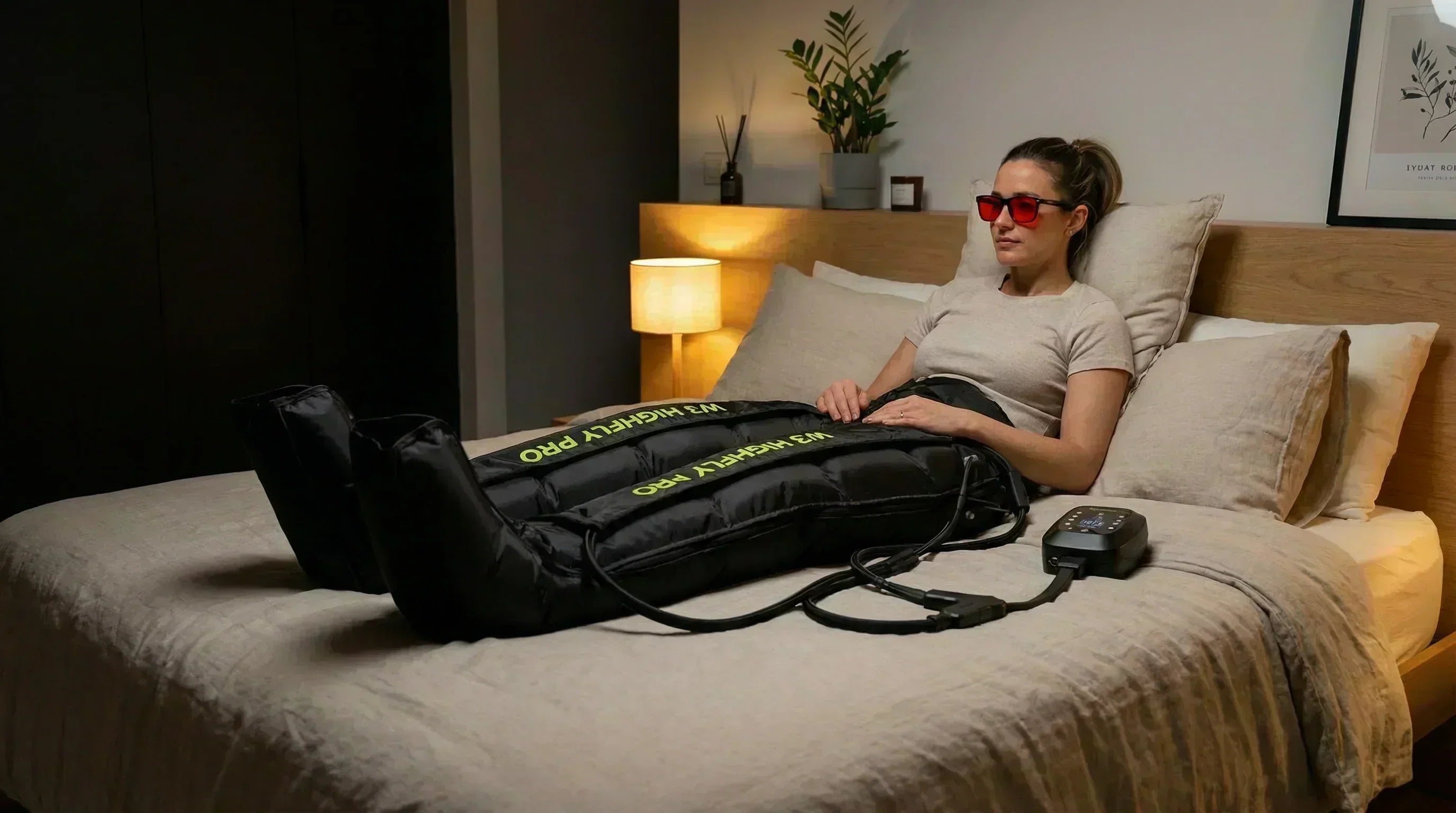


Five years ago, doing pressotherapy meant booking an appointment at a physiotherapy clinic, paying between €30 and €50 per session, and fitting it into your schedule. Today there are professional home devices for less than the cost of ten clinic sessions. But the market has filled so quickly that it’s hard to distinguish a serious device from a recycled Aliexpress one that isn’t good.
This guide is for those who have decided they want pressotherapy in their routine and need to know which device to buy, how to use it properly at home, and what mistakes to avoid. If you want to understand what pressotherapy is and how it works, you can find that at pressotherapy: what it is and what it’s for.
| Key decision | What you need to know |
|---|---|
| Type of device | Boots (most common), full pants, arm sleeve, abdominal belt |
| Initial investment | From €400 (decent entry) up to €2,000 (professional device) |
| Break-even vs clinic | €500 device pays off in 10-15 sessions |
| Ideal frequency at home | 3-5 weekly sessions of 20-30 minutes |
| Space required | Sofa or bed. No installation. Device storable in a closet |
| Time until first result | Sports recovery: 1-2 sessions · Heavy legs: 4-6 sessions |
Which home pressotherapy device suits you?
3 questions, honest recommendation in 30 seconds
Types of pressotherapy equipment for home
Not all devices do the same. The choice depends on which area you want to work on and your main goal.
Pressotherapy boots (the most common and versatile)
The standard format that covers most needs. Two boots worn like technical pants, connected to a compressor that inflates air chambers from feet to waist. Suitable for sports recovery, tired legs, fluid retention, drainage, and improved circulation.
For 90% of people considering home pressotherapy, boots are the right choice. They cover the ankle, calf, thigh, and in the most complete models, also the groin and lower abdomen. One purchase solves sports recovery and typical circulatory problems.
Full pants or full bodysuit
Boots + waist + lumbar and abdominal area in a single piece. The coverage is greater — it includes abdominal drainage and pelvic area — but the cost rises significantly and the format is more cumbersome to put on and store.
It makes sense for those who also want to work the abdominal area (generalized retention, postpartum, pelvic drainage). If your interest is only legs, the extra cost is not worth it.
Arm sleeve
Specific device for arm and armpit pressotherapy. Useful in specific cases: post-mastectomy lymphedema, shoulder injuries, recovery from sports that heavily load the upper body (climbing, rowing, calisthenics).
For general use, it doesn’t make sense as the only purchase. It’s a complement or a device for a very specific need.
Abdominal belt
Belt that inflates chambers around the abdomen and lower back area. The niche is narrow: abdominal drainage, localized retention, postpartum recovery in some cases. It’s usually a complement rather than a main purchase.
What to look for when buying a pressotherapy device
Four variables determine whether a device is serious or a consumer electronics toy.
Number of chambers (air compartments)
Each chamber is an independent segment that inflates and deflates. More chambers = more precise movement and more natural sequence. The industry divides devices into three levels:
- 2-3 chambers: basic devices. Pressure reaches the whole leg at once or in large blocks. It works, but the massage is rough. I would only recommend it as a very low-budget entry.
- 4-6 chambers: the usual range for serious home devices. The movement is sequential and you can feel the wave rising from ankle to hip. It’s the quality/price sweet spot.
- More than 6 chambers: clinical/hospital level. In home use, the difference compared to a well-designed 6-chamber device is not noticeable — you pay for sophistication intended for intensive professional use.
For real home use, 4-6 chambers is the right range. Below that, you’ll regret it. Above that, you pay for something you won’t really notice in daily practice.
Maximum and programmable pressure
Good device: adjustable pressure between 30 and 260 mmHg, in manageable increments. Poor device: 3 fixed levels without granularity (“soft / medium / strong”).
For sports recovery, the usual range is 90-120 mmHg. For retention and drainage, 60-90 mmHg. For very sensitive legs or serious circulatory problems, 40-70 mmHg. If the device doesn’t allow that granularity, it falls short.
Programs and usage modes
A decent device has at least four programs: ascending sequential (from feet to hip), descending, alternate (even and odd chambers), and fluid. The ascending sequential is the classic for drainage. The others broaden the spectrum.
If it only has a “single mode” without variants, it is a limited device.
Compressor and boot ergonomics
An underestimated detail: the compressor is heavy, noisy, and heats up. Good ones come with a handle for moving, noise below 50 dB, and a pocket design to store the boots. Bad ones sound like a vacuum cleaner, weigh more than they seem, and get stuck the first time you move them to make space on the sofa.
The pressotherapy boots, on the other hand, should have an adjustable closure (zipper with velcro), breathable fabric, and adjustable length to your height. If it only comes in one size, pay attention to whether it fits well at the top without squeezing and at the bottom without excess.
Price ranges: what to expect in each range
To avoid getting lost, the typical ranges of the serious market in Spain:
| Range | Expected features | For whom |
|---|---|---|
| Up to €350 | 2-3 chambers, limited pressure, 1-2 programs | Curiosity, very sporadic use. Not recommended. |
| 400-700 € | 4-6 chambers, programmable pressure, 4-6 programs, quality boots | Real home use, weekly sports recovery, drainage |
| 800-1.500 € | 6 premium chambers, high pressure granularity, advanced programs, premium boots, extended warranty | Frequent athletes, almost daily use, high requirements |
| From €1,500 onwards | More than 6 chambers, clinical equipment, maximum adjustments | Professional use or home consultations |
The range 400-700 € This is where the best quality/price ratio is for someone who will use it several times a week. Below this, you will notice limitations. Above this, you pay for sophistication that only makes sense if you use it daily or work with several people.

Highfly Pro — Pressotherapy boots
6 air chambers, 6 pressure levels, 3-year warranty, and interest-free financing. The reference pressotherapy equipment for home use.
View productHow long it takes to amortize the equipment
Clear calculations, with the average cost of a clinic session:
- Session at a physiotherapy clinic: €30-50 (depending on area and center)
- Mid-range home pressotherapy equipment: €500
- Break-even point: 10-17 sessions
For someone who uses the equipment once a week, the break-even point is in 3-4 months. After that, each session costs nothing (excluding electricity, which is marginal). If you use it 2-3 times a week, the equipment pays for itself in 6-8 weeks.
After two years, the equivalent cost per session drops to €2-3, compared to €30-50 at the clinic. It is one of the wellness expenses with the best quantifiable return.
How to use pressotherapy at home to get the most out of it
Having the equipment is just the beginning. The difference between seeing visible results and leaving it in the closet lies in how it is used.
The basic protocol by goal
Post-workout sports recovery:
- Frequency: one session on the evening of a hard training day
- Duration: 25-30 minutes
- Pressure: 90-120 mmHg
- Program: ascending sequential
- When: 1-2 hours after training, ideally after dinner
Tired legs / retention:
- Frequency: 4-5 sessions weekly for 4-6 weeks, then maintenance of 2-3 sessions
- Duration: 20 minutes
- Pressure: 60-90 mmHg
- Program: ascending sequential and, if your equipment allows, alternate with fluid drainage
- When: at night, after dinner, before sleeping
Aesthetic improvement (cellulite, edema):
- Frequency: 5 sessions weekly for 8-12 weeks
- Duration: 30 minutes
- Pressure: 70-100 mmHg
- Program: alternating ascending + descending sequential
- When: any time of day, ideally with clean skin
When is the best time to do the session
The time of day has its logic:
- At night, after dinner is the most recommended time for most people. Blood is in digestion, legs have been accumulating all day, and the session leaves you resting just before sleep.
- In the morning on an empty stomach works if the goal is aesthetic: cleaner circulation favors drainage.
- Right after training is not ideal: the muscle needs 1-2 hours of a useful “inflammatory window” for adaptation. Waiting until the same day’s evening gives better recovery results.
How to combine the session with other habits
Pressotherapy doesn’t work in isolation. Three combinations that multiply results:
- Abundant hydration: pressotherapy mobilizes fluids. If you don’t drink afterward, the body doesn’t fully eliminate them. At least 500 ml within the next two hours.
- Manual lymphatic drainage (when possible): combining it with occasional manual drainage sessions maximizes the effect in cases of severe retention or post-surgery.
- Light movement afterward: 10 minutes of walking after the session helps fix the effect. It’s not mandatory, but it adds benefit.
The 5 common mistakes of those starting home pressotherapy
1. Increasing pressure to the maximum from day one
More pressure does not mean better recovery. The correct pressure is the one that compresses without causing pain or leaving deep marks. Starting at 70-80% of the equipment’s maximum pressure and gradually increasing is reasonable. Excessive pressure causes pain, bruises on sensitive skin, and in some cases, counterproductive effects on capillary circulation.
2. Having sessions that are too short
Sessions under 15 minutes rarely produce significant effects. The lymphatic system takes 8-10 minutes to start “responding” to the sequential pressure stimulus. Sessions of 25-30 minutes are where the real benefits happen.
3. Expect aesthetic results in one week
Sports recovery is noticeable after the first or second session. Fluid retention changes significantly in 2-3 weeks. But aesthetic changes in cellulite or subcutaneous tissue require 8-12 weeks of minimum consistency. Those who quit after 15 days expecting aesthetic results aren’t using the equipment wrong: they’re measuring it over the wrong timeframe.
4. Using it only when something hurts or bothers you
Pressotherapy works much better as a preventive routine than as a rescue treatment. One maintained weekly session gives better results than five sessions when your legs are already swollen. Just like training: regularity matters more than occasional intensity.
5. Ignoring contraindications
There are contexts where pressotherapy is contraindicated or requires medical supervision: active deep vein thrombosis, pregnancy (always consult your gynecologist), decompensated heart failure, active skin infections, unhealed fractures, severe varicose veins with phlebitis. If in doubt, consult a healthcare professional before starting.
Who benefits most from having the equipment at home
Four profiles for whom the decision to buy is clearly positive:
- Endurance or strength athletes who train 3+ times a week and notice accumulated fatigue
- People who spend many hours standing or sitting and end the day with heavy legs and visible retention
- Women prone to fluid retention, especially in the pre-menstrual phase or post-surgery
- Older people with moderate circulatory problems, always with medical approval
And two profiles for whom buying may not be worthwhile:
- Those who will use it 1-2 times a month: it’s cheaper at a clinic.
- Those looking for a quick aesthetic result without being willing to be consistent: the equipment won’t solve that on its own.
Frequently Asked Questions
Yes, for healthy people and with reasonable pressures (60-120 mmHg). Modern equipment is designed for autonomous home use. The only essential thing is to read the manual and respect the contraindications. If you have any circulatory condition, consult your doctor first.
Up to once a day without any problem. The usual is 3-5 sessions per week for intense use, 2-3 for maintenance. There is no risk of “overuse” at normal pressures.
If you train 3+ times a week, yes. A weekly session at a clinic for sports recovery costs €30-50 · 4 = €120-200 per month. The equipment pays for itself in 3-4 months and you have the session available whenever you need it, no appointment necessary.
Mid-to-high range models come with adjustable closure (zipper + velcro) that fits normal circumferences. For very tall people (1.90 m+) or very short (1.55 m–), it is important to check the specific size. Most manufacturers offer L and XL sizes to fit.
Yes: reading, watching a series, working on a laptop, talking on the phone. Pressotherapy is done lying down or sitting and does not require active attention. This is one of its biggest attractions for home use: 25 productive minutes instead of a trip to the clinic.
The compressor can: between 40 and 60 dB depending on the model. Good equipment is below 50 dB (similar to the background noise of a normal conversation). It is not silent, but allows watching TV at low volume or reading without problem.
Yes, the boots are adjustable and the compressor is the same. The only thing to keep in mind is hygiene: wipe the inside of the boots with disinfectant after each use if shared.
For mild or moderate varicose veins, it improves symptoms (heaviness, swelling) but does not eliminate varicosis. For severe varicose veins with phlebitis, it is contraindicated. Always consult a vascular surgeon if you have active varicose veins.
If you have decided on a device
Review the basic rule: 4-6 chambers, programmable pressure between 60 and 200 mmHg, at least 4 different programs, budget between €400 and €700 if use will be regular. With these parameters, you have the right equipment for real home use.
The entire line of Wellbeinn professional pressotherapy equipment meets these requirements: designed and validated by sports physiotherapists, manufactured with the same technology as the boots used in high-performance centers, with a three-year warranty and no financing commitment. What was once only available in clinics, now in your living room.
If you are still in the phase of understanding what pressotherapy is and what it exactly does, everything is explained in pressotherapy: what it is and what it’s for. And if you are specifically interested in its effect on the lymphatic system, you can find it in lymphatic drainage: what it is and benefits.
Redacción y revisión del artículo
Share:
Benefits of pressotherapy according to your profile and how long it takes to notice them
Lymphatic drainage: what it is, real benefits, and when it’s worth it