


If you search for the “best creatine on the market” on Google, you’ll find 30 different lists recommending 30 different brands. Almost all sponsored. And almost all omit the important question: what really makes a creatine good.
The uncomfortable truth is that most creatines on the market are the same powder with different labels. If you understand the four criteria that separate a serious creatine from a mediocre one, you can identify the good one in 30 seconds just by looking at the container, without the brand telling you. This guide is that: the criteria, the traps, and the honest recommendation.
| Criteria | The question you need to ask yourself |
|---|---|
| Chemical form | Is it monohydrate? If not, discard it |
| Purity | Minimum 99%? Is it certified by analysis? |
| Granularity | 200 Mesh or finer? If it doesn’t say, assume it’s not |
| Additives | Only creatine or does it have fillers? The cleaner, the better |
| Origin | European raw material with purity analysis? |
| Certifications | Health registration? Heavy metal analysis? |
| Price per gram of creatine | Not by container — by actual gram |
Audit your current creatine in 30 seconds
Answer 4 questions about your container’s label
Why almost all the “best creatines” on the market sell the same powder
Before comparing brands, it’s useful to understand how the business works. Pure monohydrate creatine is manufactured in a handful of industrial plants worldwide. White-label brands, mid-tier brands, and premium brands buy the same raw material from the same suppliers. What changes is:
- The container, the brand, and the price
- Sometimes the granularity (more or less micronized)
- Almost never the creatine itself
This means that between two pure 99% monohydrate creatines from the same European supplier, the real difference is minimal. The smart user doesn’t ask “which brand is best?” — they ask “what does this brand deliver and what is the price per gram of pure creatine?”. It’s an auditor’s decision, not a fan’s.
Chemical form: why monohydrate wins without question
The market sells six or seven forms of creatine, each promising better absorption, less water retention, or greater stability. The evidence is clear: none have proven superior to monohydrate in serious comparative studies.
| Form | Marketing promise | What the evidence says |
|---|---|---|
| Monohydrate | The standard | The most studied (500+ studies). Gold standard. |
| Creatine HCl | Better absorption, less retention | No studies show measurable superiority |
| Creatine ethyl ester | More bioavailability | Inferior to monohydrate in direct studies |
| Kre-Alkalyn (buffered) | More stable, does not degrade | Same effect as monohydrate. Unjustified premium |
| Creatine citrate | Better solubility | As effective as monohydrate, more expensive per dose |
| Creatine malate | More energy | No evidence of superiority |
Simple conclusion: if the creatine you’re looking at isn’t monohydrate, you’re paying an unjustified premium. Any “best creatine on the market” in an exotic form is marketing. We cover this in more detail at what creatine is for.

The 4 criteria that do distinguish a good creatine
Once established that it must be monohydrate, the next step is to separate the good monohydrate from the bad.
1. Certified purity (minimum 99.9%)
A decent creatine monohydrate must have 99.9% purity or more. The remaining 0.1% are unavoidable traces from the manufacturing process. If a brand boasts “high purity” without giving the exact percentage, it’s hiding something.
Three elements that SHOULD NOT be present (or only in imperceptible amounts):
- Creatinine: degradation product. Above 0.1% indicates old or poorly processed creatine.
- Dicyandiamide and dihydrotriazine: chemical byproducts of the synthesis process. If the analyses don’t report them, the manufacturer doesn’t want you to see them.
- Heavy metals (lead, cadmium, mercury, arsenic): all industrial creatine must be below the European Union limits. Cheap Chinese creatines sometimes do not comply.
A serious creatine brand publishes the certificate of analysis. A dubious creatine only shows the label on the can.
2. Granulometry: the importance of 200 Mesh
“Mesh” is the unit that measures the particle size of a powder. The higher the Mesh, the finer the particle.
- 80-100 Mesh: standard creatine. It works, but dissolves poorly in water and leaves sediment.
- 150-200 Mesh: micronized. Better solubility, better intestinal absorption, no sediment in the glass.
- 200 Mesh or more: ultra-micronized. The one with the best user experience.
A 200 Mesh creatine mixes in water without clumps, doesn’t stick to the glass, and usually causes fewer digestive issues in sensitive people. The difference compared to a standard 80 Mesh monohydrate is noticeable from the first shake.
3. No additives, no flavor, no fillers
A decent creatine monohydrate has only one ingredient: creatine monohydrate. No maltodextrin, no flavorings, no colorings, no aspartame, no acesulfame K, no “proprietary blends.”
Flavored versions exist, sure, but at the cost of adding sweeteners and flavorings that don’t contribute to the effect. If you want flavored creatine, mix it with your protein shake or natural juice — don’t pay more for a sweetened matrix.
If a creatine lists 5+ ingredients on the label, it’s selling you more filler than active ingredient.
4. Origin and certifications
The most reliable creatine on the market has European raw materials with ISO certificates and available heavy metal analyses. Asian supply chains are cheaper but have inconsistent controls — not necessarily bad, but the risk of contaminants is higher.
Good signs: - Clearly indicated origin on the container (“Made in Spain,” “German raw material”) - Health registration (RGSEAA in Spain) - Available analyses (some brands publish them online; others provide them if you ask) - Recognized quality seal (Informed Sport, Cologne List, certifications for professional athletes)
Types of creatine on the market: what each one is
Instead of specific brands, the real categories you’ll find when comparing:
A. The “premium” with patented compound
They usually cost between €30 and €50 for 250 g. They use a registered compound (CreaPure is the best known — manufactured by AlzChem in Germany) and publish analyses. High quality and high price. If you can afford the extra cost and value maximum traceability, it’s a legitimate option.
B. The “gym brand” with fillers
Large containers and aggressive appearance, they usually have a “matrix” that mixes creatine with maltodextrin, BCAAs, taurine, and similar ingredients. The pure creatine per dose is usually 1-2 g (instead of the recommended 3-5 g). You pay for the packaging and image. Avoid them.
C. The generic white-label brand from Aliexpress / Amazon
No recognizable brand, no public analyses, unclear origin. Very low price. The creatine may be perfectly fine or it may contain traces of contaminants. A risk that doesn’t justify the savings.
D. The brand would be mid-range
Pure monohydrate, 99.9%, 200 Mesh, no additives, European raw material, health registration, reasonable price. This is the right range for most people. Here you’re not paying for marketing or exotic compounds: you’re paying for creatine that meets all the criteria and can be backed up with an analysis if you ask the manufacturer.
How to identify bad creatine by looking at the container
Five warning signs. If the container you’re looking at meets two or more, stop looking at it:
- Does not say “monohydrate” — instead uses commercial names like “creatine alpha,” “creatine platinum,” “creatine X-ploder.” It’s just marketing.
- Does not indicate purity or uses vague expressions like “ultra high purity” without percentage.
- Does not mention granulometry (Mesh) or uses expressions like “micronized creatine” without further detail.
- Lists 5+ ingredients on the label. If creatine is the fourth ingredient, there are three fillers before it.
- Does not indicate origin or health registration. If the container doesn’t want to tell you where the powder comes from, you don’t want to take that powder.
How much a decent creatine should cost
With the above criteria met, market prices in Spain (200-500 g):
- Premium brand with patented compound: €35-50 per 250 g (≈ €0.18/g)
- Serious mid-range brand: €18-25 per 300 g (≈ €0.07/g)
- White label / uncertified: €8-15 per 500 g (≈ €0.02-0.03/g) — high risk
The range €0.06-0.08/g of pure creatine is where the best quality/price ratio is concentrated. Below that, the risk of contaminants or fillers increases. Above that, you pay for brand and certification that may or may not add value depending on your case.
For a person taking 5 g per day, a 300 g container of 99.9% monohydrate at 200 Mesh lasts 2 months and costs about €12 per month. Any discussion about the “best creatine on the market” should use this order of magnitude as a reference.
Does it really matter which brand you choose?
Yes, but less than marketing wants you to believe.
What matters: - That it is pure monohydrate (no exotic forms) - That the purity is at least 99.9% - That it is 200 Mesh - That it contains no fillers - That it has traceable origin and certification
What matters less: - The exact brand among those that meet the previous criteria - The “patented compound” if an equivalent alternative meets the same guarantees - The packaging, flavor, or image of the container
A creatine that meets the five "what matters" criteria works the same as any other that also meets them. The difference between two correct creatines is statistically irrelevant. The difference between a correct and a mediocre one, however, is noticeable: in sediment, digestion, and sometimes in actual purity.
How to combine creatine with other supplements
Once you have the right creatine, two combinations multiply the effect:
- Creatine + protein: the most evidence-backed stack for strength and hypertrophy. Taking 5 g of creatine with your post-workout shake is the easiest way to integrate it. More details at creatine and protein: how to combine them.
- Creatine + carbohydrates: taking creatine with a carbohydrate source (fruit, banana smoothie) slightly improves muscle absorption via an insulin spike. It is not essential but helps during loading phases.
How and when to take it specifically is covered in how to take creatine step by step. Timing is secondary to daily consistency.
Frequently Asked Questions
The one that meets the five objective criteria: pure monohydrate, 99.9% purity, 200 Mesh, no fillers, certified origin. Any brand that meets these is in the "best creatine" range — the final decision between two correct ones is practically indifferent.
No. Above a certain threshold (≈ €0.08/g of pure creatine), you pay for brand, optional certification, or packaging. The functional difference between a proper mid-range creatine and a premium one is usually minimal.
CreaPure is a German-origin creatine monohydrate with high control standards. It is good, yes. But "better" would imply a measurable functional difference, and studies do not find it compared to other monohydrates with the same purity and granularity. If your budget allows, it is a safe choice. If not, a Spanish monohydrate with equivalent analysis works just as well.
All commercial creatine monohydrate is synthetic (not extracted from animals). Therefore, it is vegan by default. If a brand boasts about "vegan creatine" as a differentiator, they are selling you something that is standard in the industry.
A dry creatine monohydrate, in a well-sealed bottle and stored in a cool place, remains stable for years. The supposed “rapid degradation” that some brands use to sell alternative forms (Kre-Alkalyn, etc.) is a commercial myth. Creatine monohydrate is stable.
Yes, the effect is the same. But each capsule usually provides 0.5-1 g of creatine, so you need 5-10 capsules for a 5 g dose. Powder is more convenient and cheaper per gram.
It does not cause fat gain. It does cause intramuscular water retention of 1-2 kg in the first 2-4 weeks — the water enters the muscle cell, not subcutaneous tissue. This gives the muscle a fuller appearance, not softer or swollen.
No. Creatine monohydrate can be taken continuously without breaks. It is not a drug with rebound effects. The idea of “cycling” creatine is a myth that comes from steroid cycles, with which creatine has no biochemical relation.
If after reading this you want a specific recommendation
Review the five criteria and apply the filter. If a creatine meets all five (monohydrate, 99.9%, 200 Mesh, no fillers, traceable origin + health registration), it is among the “best on the market.” If it fails any, there is a better option at the same price.
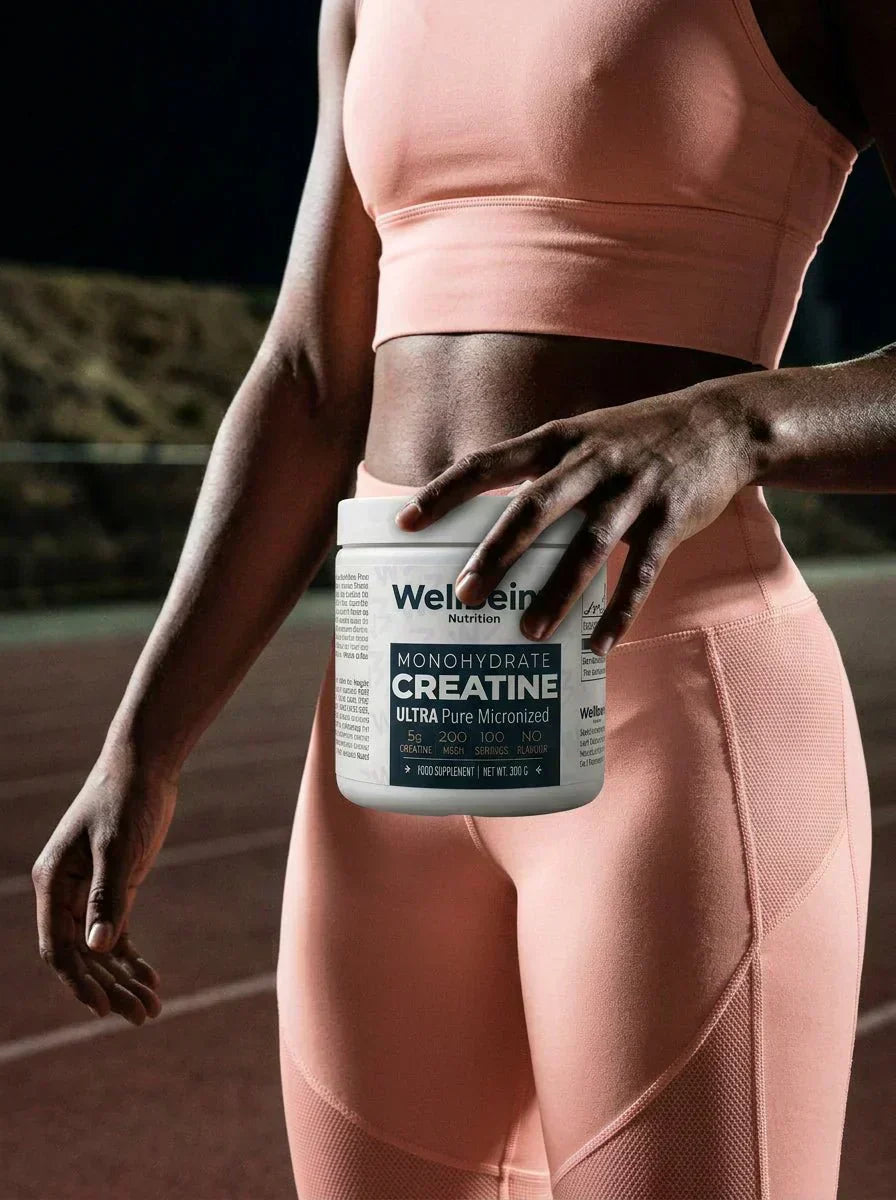
The Wellbeinn creatine monohydrate meets all five criteria: 99.9% pure monohydrate, ultra-micronized 200 Mesh, single ingredient (no aspartame, no acesulfame, no maltodextrin), made in Spain with RGSEAA health registration. 100 servings per bottle at €18.90. That results in a cost per gram of pure creatine below €0.07.
If you are still deciding whether creatine is right for you as a supplement, everything is explained in what creatine is for. And if you already have it and want to get the most out of it, the detailed guide is in how to take creatine.
Redacción y revisión del artículo
Share:
Creatine for women: what the evidence says and myths to debunk
Protein powder: what it is, types, and how to choose the one that suits you
1 comment
BURLA