


It’s eleven-thirty. You’ve spent forty minutes in bed on your phone, finally turn it off, and then spend another forty minutes staring at the ceiling. The next day, you get up feeling as if you slept with the handbrake on.
Blue-light-blocking glasses are sold as the solution to that scenario. And they work, but almost never for the reason advertised. They aren’t designed to reduce eye strain: they barely affect that. They’re designed to signal to your brain that night has fallen. That’s their real value, and it depends entirely on which lens you choose and what time you put them on.
| Lens type | How much blue light it blocks | What it’s for |
|---|---|---|
| Clear | 5-20 % | Daytime use. Effect on sleep: minimal |
| Soft yellow | 30-50 % | Working with screens in the evening |
| Amber | 60-90 % | At night, if you need to see colors reasonably well |
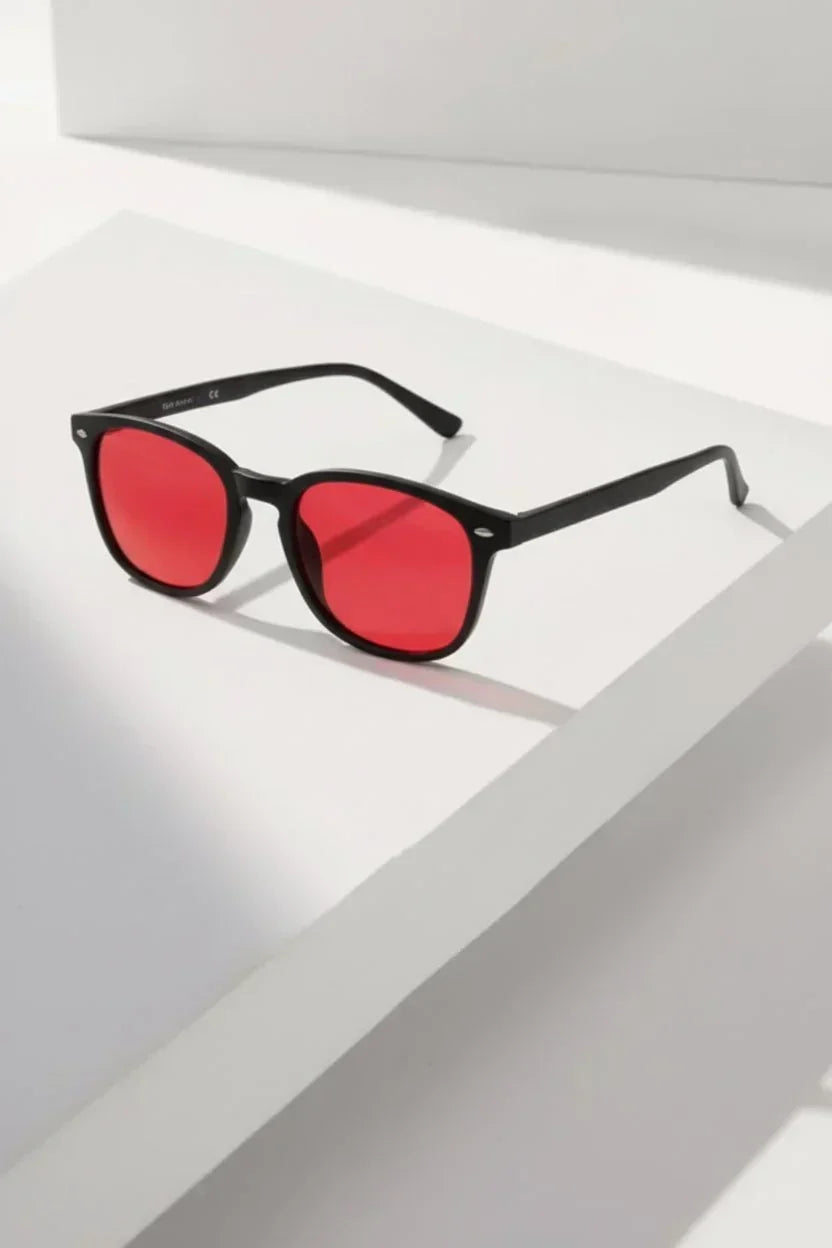
| Deep red or orange | More than 95% | The 2–3 hours before bed. The serious option |
When should you put them on?
The time matters just as much as the lens.
What blue light is and why your brain cares about it
Visible light is a range of wavelengths. Blue occupies the range from approximately 450 to 490 nanometers, and it carries the most energy within that range.
In your retina, in addition to the cones and rods you use to see, there are specialized cells that don’t form images: they contain a pigment called melanopsin, and their sole job is to tell your brain whether it’s day or night. These cells are particularly sensitive to blue light.
When they detect blue light, they send a signal to the internal clock located in the hypothalamus, and that clock slows the production of melatonin, the hormone that opens the door to sleep. It’s a system that has worked flawlessly for millennia: intense blue meant daytime sky; its absence meant sunset.
The problem arose when we filled our homes with LED lights and screens that emit precisely in that range. At eleven at night, your retina is still seeing midday.
The great misunderstanding: they’re not for your eyes
Most people buy these glasses to “rest their eyes” in front of the computer. And we need to be clear here: the evidence that filtering blue light reduces eye strain is weak. When compared with lenses without a filter, the difference in eye-strain symptoms has been small or nonexistent.
The reason is that eye strain in front of a screen isn't caused by the color of the light. It's caused by three quite different things: you blink half as often as normal, your eye keeps focusing at a fixed distance for hours, and there is often an uncomfortable contrast between the screen and the room.
Other things work for that: following the rule of looking into the distance every twenty minutes, adjusting the brightness to match the room, increasing the font size, and using artificial tears if you work in an air-conditioned place.
Where there is reasonable evidence is sleep. Blocking blue light at night allows melatonin to be released at the right time, which translates into falling asleep earlier and having more stable sleep. That's why they're worth buying.
Why the lens color determines everything
Here's the most useful filter for avoiding wasted money. A lens can only block one band of the spectrum by removing that color from what you see. It's basic physics: if the lens is transparent, it is barely blocking any blue light.
That's why transparent glasses sold as “blue-light blockers” filter between 5% and 20%, and that percentage is insufficient to significantly affect melatonin. They offer little more than a nighttime placebo.
Amber-tinted lenses block considerably more, while red or deep-orange lenses can block more than 95%. The trade-off is obvious: everything looks orange. That's the price of making them work.
The green detail
Almost no one mentions this, but it's important. The cells that regulate your internal clock respond mainly to blue light, but they are also sensitive to part of the green spectrum, around 500–530 nanometers.
Glasses that block blue light but let all the green light through still send part of the “it's daytime” signal. That's why proper lenses state the amount of blocking in both bands, and why their tint is reddish rather than yellow.
When to put them on
The rule that works is simple: two to three hours before going to bed, and don't take them off until you turn out the light.
That window is not arbitrary. Melatonin starts to rise approximately two hours before your usual bedtime, during what is known as dim-light melatonin onset. If your retina receives blue light during that window, that onset is delayed. Putting them on ten minutes before bed does not do much: the delay has already occurred.
And one condition people forget: you also have to wear them when you turn on the bathroom light. A cool-white ceiling LED emits as much blue light as your phone, and you look straight at it.

Red Horizon Glasses
They block more than 99% of blue light and more than 95% of green light—the two wavelength ranges that interfere with your melatonin. ISO and ANSI certified, with a lightweight frame and clear vision.
View productHow to choose a pair that works
Four things, and none of them is the brand:
- Declared blocking percentage by wavelength range. If the manufacturer does not say how much they block between 400 and 500 nanometers, they do not block much. Be wary of «filters blue light» without a figure.
- That they include some green light. This is what separates sleep glasses from office glasses.
- Optical certification. ISO or ANSI certification ensures that the lens does not distort or have aberrations. A poorly made, cheap lens will give you a headache.
- That you actually wear them. It sounds like a joke, but it is the decisive factor. If they are uncomfortable or do not fit over your prescription glasses, they will end up in a drawer.
What should not matter to you: whether they have an «anti-UV» filter for nighttime use—there is no ultraviolet light to filter at night—or whether they promise to improve your eyesight.
What the glasses will not fix
It is worth saying this, because many disappointments come from here. The glasses address one factor in your sleep: light exposure. If the problem is something else, you will not notice any difference.
| If your problem is… | The glasses… | What actually helps |
|---|---|---|
| Coffee after 4 p.m. | They do nothing | Cutting out caffeine 8–10 hours beforehand |
| Eating dinner very late or having a very heavy meal | They do nothing | Eating dinner 2–3 hours before bed |
| Going to bed at different times each day | They help a little | A fixed wake-up time, including on weekends |
| Anxiety or ruminating in bed | They do nothing | A mental wind-down routine before bed |
| A bedroom with light or noise | They do nothing | Complete darkness and a cool temperature |
| Screens right up until the last minute | They help quite a bit | Glasses + turn down the brightness |
If your schedule keeps shifting week after week, the problem may not be nighttime light but a lack of anchoring for your body clock; we explain it in the science of social jet lag.
What about the phone's night mode?
It helps, but it falls short. Software filters shift the color temperature toward amber and reduce some blue emission, although nowhere near 95%. They also act only on that screen: they do nothing about the ceiling light, the living-room light, or the television.
The sensible combination is to activate a software filter, turn the brightness down, and wear the glasses. Each layer removes a little.
Common mistakes
Buying clear ones. It is the most common mistake and the one that guarantees you will not notice anything.
Putting them on five minutes before bed. You are missing the window that matters.
Taking them off to go to the bathroom. That ceiling LED undoes much of the work.
Wearing them during the day. In the morning, you want exactly the opposite: blue light to set your body clock on schedule.
Expecting them to make up for going to bed at two. They regulate the signal, not your hours of sleep.
Frequently asked questions
For sleep, yes, as long as they block a high percentage and you put them on two or three hours before bed. For eye strain in front of a computer, the evidence is weak: that strain comes from blinking, sustained focusing, and contrast, not from the color of the light.
For sleep, practically not at all. They block between 5% and 20% of blue light, far below what is needed to prevent your melatonin from being suppressed. If a lens does not have an amber or reddish tint, it is not filtering much.
Two to three hours beforehand, and keep them on until you turn out the lights. Melatonin starts to rise about two hours before your usual bedtime; if you receive blue light during that window, this process is delayed.
That is not a good idea with high-blocking lenses. During the day, you need blue light: it is what keeps your body clock on schedule and you alert. Filtering it from the morning onward can end up throwing off the rhythm you are trying to fix.
The logic is reversed. During your shift, you want bright light to stay alert, and you put the glasses on during the journey home, especially if dawn is breaking, so that the morning light does not prevent you from sleeping when you arrive. Combine them with complete darkness in the bedroom.
Some models are designed to be worn over other glasses, while others are not. Check before buying, because if they do not fit comfortably, you will stop wearing them within a week. This is the factor that most determines whether they work for you.
Many people notice that they feel sleepy earlier during the first few nights. A consistent improvement in sleep quality is usually noticeable after one or two weeks of regular use, because you are readjusting a rhythm, and rhythms take time to shift.
They do different things and complement each other. Glasses prevent you from suppressing your own melatonin; the supplement provides a signal from outside. If your problem is nighttime light, start with the glasses: address the cause instead of compensating for it. You can find more information about the supplement in magnesium and melatonin.
Children’s circadian systems are especially sensitive to light at night, so the same logic applies. That said, for children, the most impactful step is removing screens before dinner; glasses are a workaround if that is not possible.
It is usually the same thing referred to in two ways: the lens looks red precisely because it blocks blue light and much of the green light. Do not confuse them with red-light therapy devices, which emit light instead of filtering it and serve a different purpose. We explain this in red-light therapy.
Key takeaway
Blue-light-blocking glasses are not a vision accessory: they are a tool for your internal clock. Their job is to prevent your brain from continuing to believe it is noon at eleven at night.
For them to work, three things are necessary: a lens with genuinely high blocking—over 95%, with an amber or reddish tint—wearing them two to three hours before bed, and not taking them off when you turn on any light. With that, most people find that they fall asleep sooner.
Add the free basics: morning sunlight, a consistent wake-up time, and a dark bedroom. You can continue with red light for sleep and the secret to better sleep.
Redacción y revisión del artículo
Share:
Contraindications for pressotherapy: when not to use it
Pressotherapy and cellulite: what it can (and can’t) do