
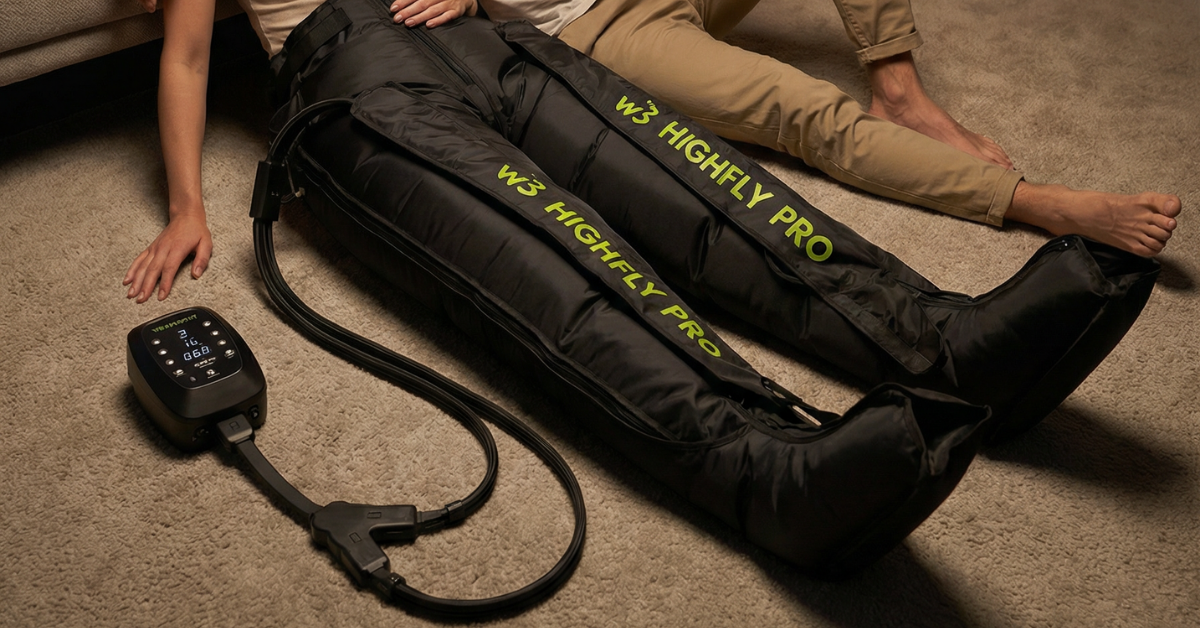


Pressotherapy has a reputation for being harmless. And in the vast majority of cases, it is: pleasant air compression, with no needles or electricity. But precisely because of that, almost no one reads the contraindications, and here they really matter.
The reason is simple to understand: pressotherapy moves things inside your body. It pushes blood and lymph from the foot toward the torso. When everything is in order, that is exactly what you want. When there is something that should not move—a clot, an infection, a heart that is already struggling with its workload—pushing it upward is a bad idea. This article separates what is an unequivocal no, what only requires prior consultation, and what is repeated online despite not being true.
| Category | What it means | What to do |
|---|---|---|
| Absolute | The risk outweighs any benefit | Do not use it |
| Relative | It may be used with adjustments or supervision | Consult before starting |
| Temporary | The obstacle goes away | Wait and resume |
| False | Commonly cited as a contraindication, but it is not | You can use it normally |
Self-check before your first session
Check whatever applies to your situation. For guidance only, never a diagnosis.
Why air compression has contraindications
Pressotherapy inflates chambers sequentially from the foot toward the hip. This movement does three things at once: accelerates venous return, stimulates lymphatic drainage, and increases the volume of blood reaching the heart in a short time.
All three are good news in a healthy leg. But each has a downside. If there is a clot in a vein, accelerating return can dislodge it. If there is an infection in the skin, the lymphatic network can spread it. And if the heart is already at the limit of what it can pump, suddenly returning more blood than it can handle overloads it.
None of this makes pressotherapy dangerous. It makes it what it is: a device with a real physiological effect, and therefore situations in which it is not appropriate.
Absolute contraindications: none here
In these cases, the answer is no—no ifs, and no “but what if it’s on a low setting…”.
Active deep vein thrombosis or suspected deep vein thrombosis
This is the number-one contraindication. A clot lodged in a deep vein in the leg can break loose and travel to the lungs. Pressotherapy pushes precisely in that direction. If you have diagnosed thrombosis, are taking anticoagulants for a recent one, or suspect you may have one, pressotherapy is off-limits until your doctor says otherwise.
Recent pulmonary embolism
For the same reason, and even more so. If you have had a pulmonary embolism, any therapy that accelerates venous return must be cleared by your pulmonologist or hematologist.
Acute infection in the area to be treated
Infectious cellulitis, erysipelas, an infected wound, or an abscess. The lymphatic system is precisely the route through which a local infection can spread. Pumping over it makes that path easier. Wait until it has resolved.
Decompensated heart failure
When the heart cannot manage the volume reaching it, blood accumulates and edema develops. Suddenly returning the fluid accumulated in the legs can worsen congestion. A stable, controlled heart is a different matter, but that is for the cardiologist to decide.
Severe kidney failure with edema
The same reasoning applies: the fluid you mobilize has to be eliminated somehow. If the kidneys do not filter properly, you are redistributing it, not eliminating it.
Open wounds, burns, or acute dermatitis
Compression over damaged skin causes pain, delays healing, and may reopen what was beginning to close. Temporary contraindication: once the skin is intact, you can resume.
Significant peripheral artery disease
If the problem is not that blood cannot flow upward, but that it does not flow down properly—poor arterial circulation, pain when walking that subsides when you stop, cold and pale feet—compression may further reduce that blood supply. This condition must be ruled out before applying any compression.
Unhealed fractures and recent injuries
Until the bone has healed and the traumatologist clears you, the area must not be compressed.
Active tumor process without medical assessment
This is territory only your oncologist should enter. Not because pressotherapy is aggressive, but because the decision to stimulate lymphatic drainage in someone with active cancer is part of their treatment, not their wellness routine.
Relative contraindications: consult first, don’t rule it out
Pressotherapy is not prohibited here. It is conditional on someone familiar with your case telling you how to use it.
| Situation | Why you need to ask | Who to ask |
|---|---|---|
| Pregnancy and postpartum | It changes venous return and increases the risk of thrombosis | Midwife or gynecologist |
| Diabetes with neuropathy | If you cannot properly feel the pressure, you cannot report that it is uncomfortable | Endocrinologist or podiatrist |
| Cancer-related lymphedema | It requires a specific protocol, not a generic program | Specialized physiotherapist |
| Severe varicose veins or previous phlebitis | Complications must be ruled out first | Angiologist or vascular surgeon |
| Uncontrolled hypertension | The increased return may raise blood pressure readings | General practitioner |
| Prosthesis or recent surgery | It depends on the timing of your procedure | Traumatologist or surgeon |
| Advanced osteoporosis | High pressure may be excessive | Rheumatologist |
In nearly all these cases, the answer ends up being “yes, but gently”: low pressures, short sessions, and slow progression. Which, incidentally, is how everyone should start.

HighFly Pro — Pressotherapy boots
Adjustable pressure starting at the gentlest level, so you can start low and increase it only when your body calls for it. With support from licensed physiotherapists to answer questions before your first session.
View productWhat is often presented as a contraindication but is not
Half the internet keeps repeating warnings that have no basis. Let’s clarify the most common ones.
Having your period. It is not a contraindication. Some people notice more abdominal discomfort when using equipment that covers that area; if so, lower the pressure or limit the treatment to your legs.
Having an IUD. Neither is this a problem. Leg compression does not interfere with an intrauterine device.
Having cellulite. Nothing to do with it. Aesthetic cellulite is not a contraindication; it is one of the reasons people use it. The question is what to expect, which we explain in how to treat cellulite at home.
Having a pacemaker. There is a widespread confusion here: a pacemaker is a classic contraindication for electrostimulation, which applies electrical current. Pressotherapy is mechanical air compression, with no electrical current that could interfere with the device. Even so, discuss it with your cardiologist, because people with pacemakers often also have an underlying heart condition that should be assessed.
Having mild varicose veins. With spider veins or early-stage varicose veins without complications, there is no problem. Caution becomes necessary when the varicose veins are significant or there has been phlebitis.
Signs to stop during the session
Even if you have passed the checkup, your body still has the right to veto. Stop the session if any of the following appears:
- Pain, not discomfort. Pressotherapy applies pressure; it should not hurt.
- Tingling or numbness that does not go away when you lower the pressure.
- Palpitations, dizziness, or shortness of breath.
- Change in foot color: paleness or a bluish tone.
- Skin marks that persist after finishing.
It almost always resolves by lowering the pressure level. If it happens again, consult a professional before continuing.
How to get started safely
If your checkup came back clear, this is the sensible progression:
- First week: 10–15 minutes at the lowest level, every other day. Observe how your leg responds.
- Second week: increase to 20 minutes while keeping the pressure low.
- Third week: increase the pressure by one level if it has felt comfortable, without changing the duration.
- From there: adjust it according to your goal, without going beyond what feels comfortable.
Hydrate afterward. You are moving fluid, and your kidneys need water to eliminate it. And if you are starting from scratch, it may help to read what pressotherapy is and what its benefits are.
Frequently asked questions
It depends on why you take them. If it is for a recent thrombosis, not until your doctor authorizes it. If it is for another reason and your condition is stable, many specialists allow it at moderate pressures. It is a five-minute conversation with the person overseeing your treatment.
No. In a healthy person, it promotes venous return, which is the opposite of the stagnation that causes it. In fact, pneumatic compression is used in hospitals to prevent it in bedridden patients. The problem is not that it causes thrombosis; it is that if a clot already exists, it may dislodge it.
Leg swelling during pregnancy is very common, and pressotherapy may seem like an obvious solution, but it is not a decision to make on your own. Pregnancy changes venous return and increases the risk of thrombosis. Ask your midwife or gynecologist: they will tell you whether it is appropriate in your case and what pressure to use.
Lymphedema is indeed one of the classic indications for pressotherapy, but only as part of a treatment plan prescribed by a specialized physiotherapist that combines bandaging, manual drainage, and compression with specific parameters. Using a generic program on your own is not the same and may shift fluid to areas where it is not wanted.
Your surgeon will determine this, and it varies greatly depending on the procedure. As a general guide, wait until the wound has closed and you have been discharged from care for that area. After vascular or orthopedic surgery, the waiting periods are usually longer.
No. It should feel firm and enveloping, like a tight hug, but never painful. If it hurts, lower the pressure. If it still hurts at the lowest setting, stop and consult a professional: pain that is disproportionate to the compression deserves medical attention.
There is no age limit. What does increase over the years is the likelihood of having conditions that affect its use, such as heart problems, arterial disease, or osteoporosis. That is why, from a certain age onward, it makes sense to discuss it with your family doctor before starting.
It is not a device designed for children, and the sizes are not suitable either. For minors, any use should be recommended by a healthcare professional for a specific reason, not as a wellness routine.
If you have an acute feverish illness, it is better to wait. Not because of a serious risk, but because it offers no benefit while your body is fighting something else, and stimulating the lymphatic system during an active infection is not sensible. Resume it once you have recovered.
Safety does not come from the location; it comes from two things: certified equipment and ruling out contraindications. At a clinic, they perform this screening; at home, it is up to you. That is why this article exists, and why it is advisable to choose equipment with CE certification and professional support behind it.
In summary
Pressotherapy is safe for most people, which is precisely why it is important to know about the minority for whom it is not. The three definitive no-go conditions are thrombosis, active infection, and decompensated heart or kidney disease. Other situations do not close the door: they call for a consultation and a gentler protocol.
If your situation is straightforward, start low, increase slowly, and listen to your body before following the program. And if you’re unsure whether your type of swelling is suitable, check how many sessions you need to notice changes before starting an intensive program.
No good therapy requires you to ignore the warnings.
Redacción y revisión del artículo
Share:
Collagen works, but almost no one takes it correctly.
Blue-light-blocking glasses: what are they really for?